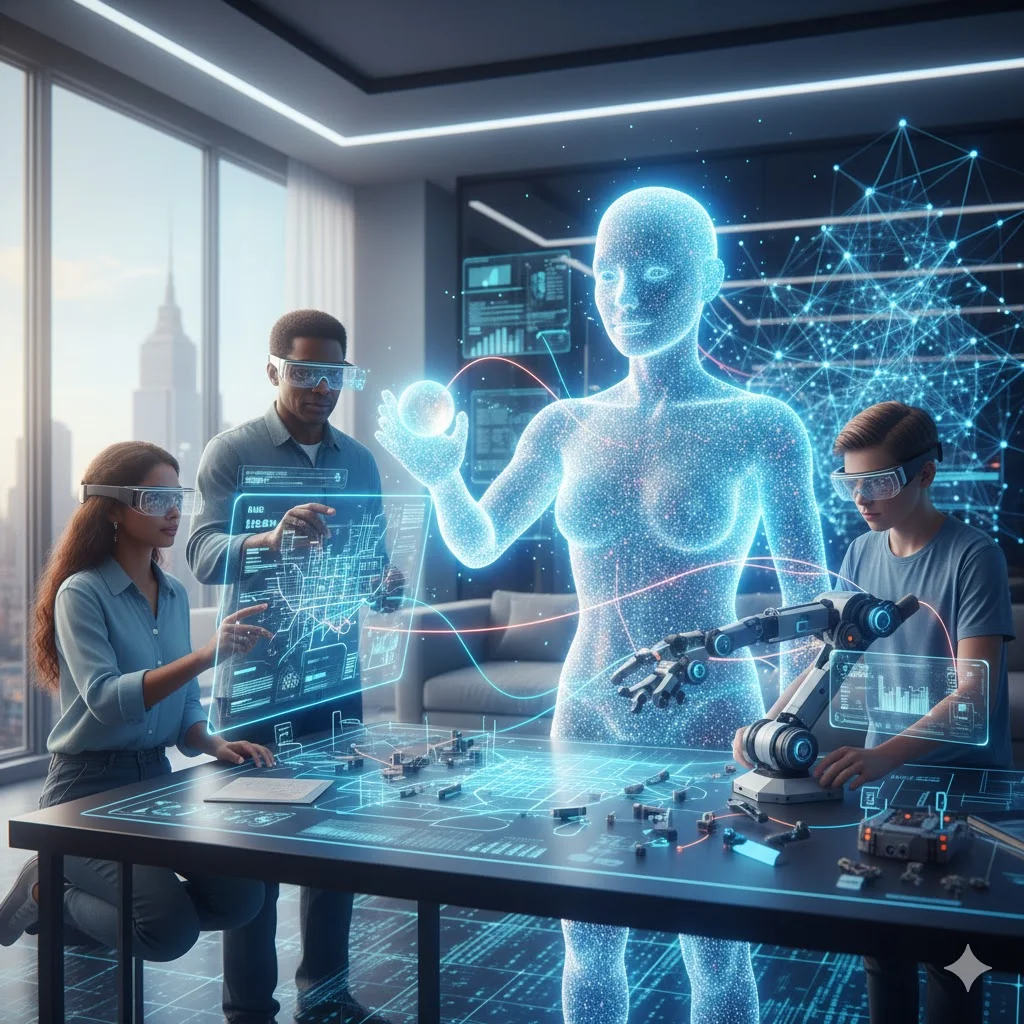

We've all been amazed by AI lately, right?
Those chatbots that write essays, solve math problems, generate computer code, and even engage in surprisingly natural conversations – it's like something out of a sci-fi movie! And at the top of that list is GPT-3, OpenAI's incredible language model, introduced in 2020. It's super powerful and versatile, but it also makes you wonder: is it actually thinking like a human, or just really good at imitating us?
That's exactly what some brilliant minds at the Max Planck Institute for Biological Cybernetics in Tübingen wanted to find out!
Instead of looking at AI from a traditional computer science angle, they decided to throw some classic psychology tests at GPT-3 – the very same tests we use to understand human intelligence. How cool is that? Their unique approach, detailed in a study by Marcel Binz and Eric Schulz, offers a fresh perspective on the capabilities and limitations of advanced AI.
language model, introduced in 2020. It's super powerful and versatile, but it also makes you wonder: is it actually thinking like a human, or just really good at imitating us? That's exactly what some brilliant minds at the Max Planck Institute for Biological Cybernetics in Tübingen wanted to find out!
Instead of looking at AI from a traditional computer science angle, they decided to throw some classic psychology tests at GPT-3 – the very same tests we use to understand human intelligence. How cool is that? Their unique approach, detailed in a study by Marcel Binz and Eric Schulz, offers a fresh perspective on the capabilities and limitations of advanced AI.
The researchers weren't just checking if GPT-3 got the right answers. They were looking at how it made mistakes, and if those errors looked like the ones humans typically make. This approach allowed them to investigate whether the model’s behavior reflected genuine human-like reasoning or simply surface-level accuracy.
They focused on assessing different aspects of general intelligence, including decision-making, information search, causal reasoning, and even the ability to question or revise initial intuitions. By comparing GPT-3's responses with those of human participants, they sought to uncover deeper cognitive parallels.
The Linda Problem: A Classic Brain-Teaser Reveals Human-Like Bias!
One of the most fascinating and revealing experiments they used was the "Linda problem." You know, the one where Linda is described as deeply concerned with social justice and opposed to nuclear power?
Then you have to decide which of the following statements is more likely:
- Linda is a bank teller.
- Linda is a bank teller and active in the feminist movement.
From a purely logical and probabilistic standpoint, the first option is clearly more likely. Adding an extra condition – being active in the feminist movement – can only reduce the probability. Yet most humans, ourselves included, often fall for the "conjunction fallacy" and intuitively choose the second option because it feels more descriptive and fits the initial profile better. It’s a classic example of how our intuition can override pure logic.
And guess what? When GPT-3 was given the same task, it did the exact same thing! Rather than choosing the logically correct answer, the language model reproduced the same intuitive error, favoring the more detailed but less probable option, just like a human would.
Is it Really Thinking, or Just a Clever Mimic? The Crucial Next Step:
At first glance, GPT-3's performance on the Linda problem makes it seem incredibly human-like. It begs the question: is it truly grappling with the nuances of probability and human description, or is something else at play? But the researchers had a brilliant counter-argument: maybe GPT-3 has just seen this problem before.
Since it was trained on a massive amount of text from the internet, it could have encountered discussions of this classic psychological task and learned the common human response. It might be mimicking learned patterns rather than demonstrating genuine cognitive processing.
To rule out this possibility and truly delve into the model's underlying cognitive processes, they designed brand-new tasks that posed similar cognitive challenges but were super unlikely to be in GPT-3's training data. These novel tasks allowed them to examine whether GPT-3’s behavior reflected deeper cognitive processes rather than simple memorization or pattern recognition from its vast training corpus.
A Mixed Bag of AI Intelligence: Strengths and Limitations Emerge:
The results of these additional, novel tests were really interesting and painted a heterogeneous picture of GPT-3’s intelligence.
In decision-making tasks, GPT-3 performed nearly on par with human participants. Its responses showed sensitivity to uncertainty and contextual information, closely resembling human judgment in many cases. This suggests a robust ability to process complex information and make choices that align with human patterns in certain scenarios.
However, the model hit some significant roadblocks when it came to other areas, revealing clear limitations. GPT-3 struggled significantly with:
-
Searching for specific information: This implies difficulty in targeted data retrieval beyond general text comprehension.
-
Causal reasoning: Understanding 'why' things happen, rather than just 'what' happens, proved challenging.
-
Understanding relationships that require interaction with the physical world: this is where its textual learning truly showed its limits, as it lacks direct embodied experience.
This highlights a key distinction between us and AI: we learn by doing! We actively interact with the world – testing ideas, observing consequences, and learning through continuous, embodied experience. GPT-3, on the other hand, learns passively from text. It processes linguistic representations of the world but doesn't experience it directly.
The Role of Real-World Interaction: The Missing Piece:
According to the researchers, one major reason for these limitations is that GPT-3 learns only from passive exposure to text. Humans, by contrast, actively interact with the world—testing ideas, observing consequences, and learning through direct, sensory, and motor experience. This active engagement allows for the development of deeper causal understanding and common-sense reasoning that is often tied to physical reality.
As the study emphasizes, “actively interacting with the world will be crucial for matching the full complexity of human cognition.” Without such interaction, language models like GPT-3 can effectively replicate linguistic patterns and common reasoning strategies found in text but struggle with the deeper, embodied causal understanding that underpins much of human intelligence.
Looking Ahead: Bridging the Gap Between Artificial and Human Intelligence:
The researchers suggest that this gap might actually shrink over time. As more and more people increasingly interact with AI systems in real-world applications – from smart assistants to autonomous vehicles – future models may begin to learn from these complex, dynamic interactions.
Over time, this could allow artificial intelligence to move closer to what psychologists would describe as human-like cognition, developing a more nuanced understanding of the world through experience rather than just textual data.
For now, the findings offer a really balanced and insightful view. GPT-3 is neither a simple text-generation tool nor a fully human-level thinker. Instead, it occupies an intriguing middle ground – capable of surprisingly human-like reasoning in some contexts, yet significantly limited by its inherent lack of real-world, embodied experience.
This research, by examining artificial intelligence through the critical lens of psychology, provides invaluable insights into what modern AI truly can do, what it cannot, and what may be required to bridge the fascinating and complex gap between artificial and human intelligence in the future.
It’s a compelling journey into the mind of machines, reminding us of the unique wonders of our own cognitive abilities.