
Databricks CEO: AI Will Make Traditional SaaS Irrelevant – Here's What's Coming Next.
The software-as-a-service (SaaS) industry is facing its biggest transformation in decades, and according to Databricks CEO Ali Ghodsi, artificial intelligence is about to change everything we know about enterprise software. In a bold announcement that's sending shockwaves through the tech industry, Ghodsi revealed how AI is reshaping the future of cloud computing and why traditional SaaS companies need to evolve or risk becoming obsolete.
Databricks Announces Explosive AI-Driven Growth:
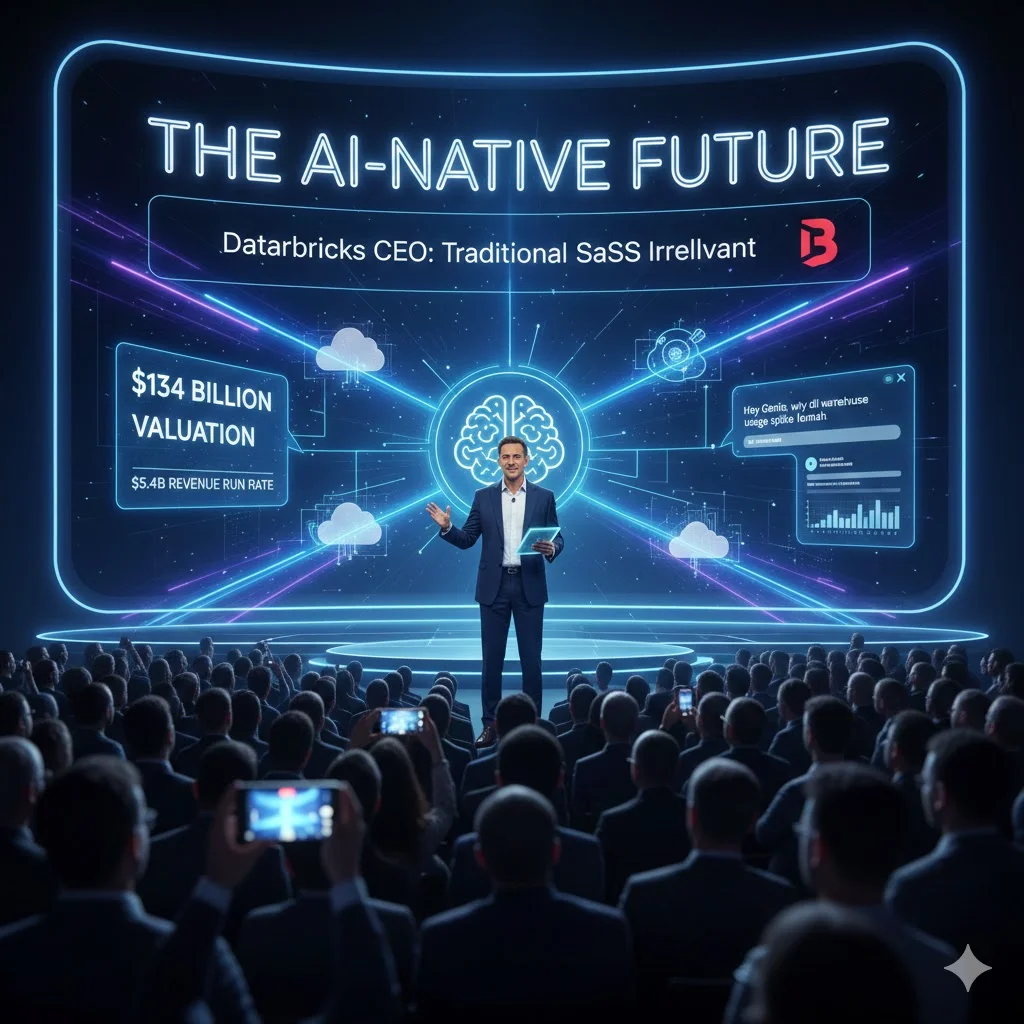
On Monday, Databricks dropped a bombshell announcement that underscores the massive shift happening in enterprise technology. The company revealed it has reached an impressive $5.4 billion revenue run rate, representing a staggering 65% year-over-year growth. But here's the headline that really matters: more than $1.4 billion of that revenue came directly from AI products.
This isn't just another tech company bragging about growth numbers. Databricks co-founder and CEO Ali Ghodsi shared these figures to address the elephant in the room that's been dominating Silicon Valley conversations: Is AI going to kill the SaaS business model?
The $134 Billion Question: Is SaaS Really Dead?
"Everybody's like, 'Oh, it's SaaS. What's going to happen to all these companies? What's AI going to do with all these companies?' For us, it's just increasing the usage," Ghodsi told TechCrunch in an exclusive interview.
The timing of this statement is particularly significant. Databricks officially closed its massive, previously announced $5 billion funding round at a jaw-dropping $134 billion valuation on Monday, while also securing an additional $2 billion loan facility. These numbers position Databricks as one of the most valuable private companies in the world.
But there's a strategic nuance here. While Ghodsi wants to distance Databricks from the traditional SaaS label—because private markets value AI companies more favorably—the reality is that Databricks is straddling both worlds. The company is still best known as a cloud data warehouse provider, the place where enterprises store massive amounts of data to analyze for critical business insights.
How AI is Transforming Data Warehouses and Enterprise Software:
Ghodsi highlighted one specific AI product that's revolutionizing how customers interact with Databricks' data warehouse: Genie, an LLM-powered user interface that's driving unprecedented usage growth.
Meet Genie: The Natural Language Interface Changing Everything:
Genie represents a fundamental shift in how enterprise software works. It's an example of how SaaS businesses can replace traditional user interfaces with natural language processing. Instead of complex queries and specialized technical knowledge, users can simply ask questions in plain English.
Ghodsi shared a practical example: he regularly uses Genie to ask questions like "Why did warehouse usage and revenue spike on particular days?" Just a few years ago, answering such a question required writing queries in SQL or other technical languages, or having a developer program a special report. Today, any product with an LLM interface can be used by anyone, regardless of technical expertise.
This democratization of data access is one of the primary reasons driving Databricks' explosive usage growth, according to Ghodsi.
The Real Threat AI Poses to Traditional SaaS Companies:
Many tech observers have been speculating wildly about how AI will disrupt the SaaS industry. Some venture capitalists have even jokingly tweeted that enterprises will rip out their existing SaaS "systems of record" to replace them with AI-generated, homegrown versions. But Ghodsi says this misunderstands the actual threat.
Systems of Record Aren't Going Anywhere:
"Why would you move your system of record? You know, it's hard to move it," Ghodsi explained. Systems of record—the databases that store critical business data on sales, customer support, finance, and other core functions—aren't easily replaceable, nor do AI model makers want to replace them.
The major AI companies aren't offering databases to store enterprise data and become new systems of record. Instead, their strategy focuses on replacing the user interface with natural language for human users, and APIs or plug-ins for AI agents.
The Disappearing User Interface: SaaS's Biggest Vulnerability:
Here's where Ghodsi identifies the real existential threat to traditional SaaS businesses: When the interface becomes just natural language, the underlying products become invisible—like plumbing in a building.
"Millions of people around the world got trained on those user interfaces. And so that was the biggest moat that those businesses have," Ghodsi warned.
Think about it: Entire careers have been built on mastering specific SaaS platforms. There are Salesforce specialists, ServiceNow experts, and SAP consultants who spend years learning intricate user interfaces and workflows. This expertise created powerful network effects and switching costs that protected SaaS companies from competition.
But when AI replaces complex user interfaces with simple natural language conversations, that moat evaporates. The specialized knowledge that made certain professionals invaluable becomes obsolete. Anyone can interact with these systems using plain English (or any other language).
The AI-Native Opportunity: New Competitors Emerging:
While established SaaS companies that embrace LLM interfaces could continue growing—as Databricks is demonstrating—this transformation also opens doors for AI-native competitors to offer alternatives designed from the ground up to work better with AI and autonomous agents.
Databricks Lakebase: Built for the AI Agent Era:
Recognizing this shift, Databricks created Lakebase, a database specifically designed for AI agents rather than human users. The early traction has been remarkable.
"In its eight months that we've had it in the market, it's done twice as much revenue as our data warehouse had when it was eight months old," Ghodsi revealed. "Okay, obviously, that's like comparing toddlers. But this is a toddler that's twice as big."
This accelerated adoption suggests that AI-native products may grow faster than their traditional SaaS predecessors, even from the same company. It's a powerful indicator of where enterprise software is headed.
Why Databricks Isn't Going Public Anytime Soon:
Despite the company's impressive growth metrics and massive valuation, Ghodsi made it clear that Databricks has no immediate plans for another funding round or an IPO.
Market Timing and Strategic Capitalization:
"Now is not a great time to go public," Ghodsi stated frankly. His reasoning reflects lessons learned from the 2022 downturn, when rising interest rates after years of near-zero rates caused public market valuations to plummet.
"I just wanted to be really well capitalized" in case markets go "south" again, he explained. With $5 billion in fresh funding plus a $2 billion loan facility, Databricks has built a substantial war chest. "It protects us, gives us many, many years of runway," Ghodsi added.
This conservative approach to going public contrasts with the tech IPO frenzy of previous years, but reflects a more mature understanding of market cycles and the value of maintaining strategic flexibility during periods of rapid technological transformation.
What This Means for the Enterprise Software Industry:
The implications of Databricks' success and Ghodsi's insights extend far beyond one company. They reveal fundamental shifts reshaping the entire enterprise software landscape.
Traditional SaaS Companies Must Adapt or Die-
Legacy SaaS providers face a critical choice: embrace AI-powered natural language interfaces and potentially cannibalize their own products, or risk being displaced by AI-native competitors who build better solutions from scratch.
Companies like Salesforce, ServiceNow, SAP, Oracle, and countless others built their businesses on complex, feature-rich interfaces that required significant training and expertise. That complexity was their moat. Now it's becoming their liability.
The Skills Gap is Reversing:
For decades, the enterprise software industry created jobs for specialists who could navigate complex SaaS platforms. Now, as AI makes these systems accessible to anyone who can type a question, that specialization becomes less valuable.
This doesn't mean jobs will disappear—but they will transform. Instead of learning how to click through seventeen menu options in Salesforce, future workers will need to know how to ask the right questions, interpret AI-generated insights, and make strategic decisions based on easily accessible data.
AI-Native Startups Have an Opening:
Perhaps the most exciting implication is the opportunity for AI-native startups. When established players are constrained by legacy architectures and existing customer bases, nimble new entrants can build superior solutions designed specifically for the AI era.
These next-generation products won't just slap a chatbot interface on top of old technology. They'll be architected from the ground up to work with AI agents, optimize for natural language interaction, and integrate seamlessly with the emerging AI ecosystem.
Key Takeaways: The Future of SaaS in the AI Era:
Based on Databricks' experience and Ghodsi's insights, here are the critical lessons for anyone involved in enterprise software:
-
SaaS isn't immediately dying– Contrary to dramatic predictions, traditional SaaS businesses aren't about to disappear overnight. Systems of record remain valuable and difficult to replace.
-
User interfaces are the vulnerability– The real threat isn't to the underlying data or functionality, but to the traditional user interfaces that created switching costs and required specialized expertise.
-
Natural language is the new UI– LLM-powered interfaces like Databricks' Genie are making enterprise software accessible to everyone, regardless of technical skill.
-
AI-native architecture matters– Products built specifically for AI agents, like Lakebase, are showing faster adoption than traditional equivalents, suggesting architectural advantages.
-
The moat is evaporating – Millions of trained users who mastered complex interfaces represented SaaS companies' biggest competitive advantage. As AI simplifies interaction, that advantage disappears.
-
Adaptation beats replacement – While established SaaS companies face threats, those that successfully integrate AI can actually grow faster, as Databricks demonstrates with its 65% year-over-year growth.
-
Market timing is everything – Even highly successful companies are thinking carefully about when to go public, recognizing that market conditions matter as much as company performance.
What Should SaaS Companies Do Now?
If you're leading a SaaS company or investing in enterprise software, the message from Databricks is clear: the AI transformation is already here, and it's accelerating faster than most people realize.
-
Invest in natural language interfaces – Don't just add a chatbot; fundamentally rethink how users interact with your product.
-
Build for AI agents – The next wave of customers won't just be humans; they'll be autonomous AI agents that need different types of access and interaction.
-
Focus on data, not interface – Your competitive advantage increasingly comes from the data and insights you provide, not the buttons and menus through which users access them.
-
Prepare for commodification – As interfaces become standardized around natural language, differentiation will come from intelligence, accuracy, and integration rather than feature lists.
-
Move fast – The gap between early AI adopters and laggards is widening quickly. Companies that wait too long may find themselves impossible to catch up.
The Bigger Picture: AI is Redefining Enterprise Technology:
Databricks' $5.4 billion revenue run rate and $134 billion valuation aren't just impressive numbers—they're proof points that AI is fundamentally transforming how enterprises buy, build, and use software.
The SaaS revolution of the past two decades brought cloud computing, subscription models, and platform ecosystems. Now the AI revolution is bringing natural language interfaces, autonomous agents, and intelligent automation.
Traditional SaaS isn't dead, as Ghodsi pointed out. But it is becoming irrelevant in its current form. The companies that recognize this shift and adapt quickly will thrive. Those that cling to complex user interfaces and specialized expertise requirements will find themselves increasingly marginalized.
The future of enterprise software is being written right now, and according to the CEO of one of the world's most valuable AI companies, that future looks very different from the present. The only question is: which companies will successfully make the transition, and which will be left behind?
Conclusion: Embracing the AI-Driven Future:
As we stand at this inflection point in enterprise software history, the lessons from Databricks are invaluable. AI isn't killing SaaS—it's transforming it into something new, something more accessible, and something potentially more powerful.
For business leaders, investors, developers, and users, the message is clear: the interface is changing, the moats are shifting, and the opportunities are enormous. The companies that understand this transformation and act decisively will define the next era of enterprise technology.
The $134 billion question isn't whether SaaS will survive—it's what it will become in the age of AI. And according to Ali Ghodsi, that transformation is already well underway.
Support our research
Independent analysis fueled by you.