
SaaS In, SaaS Out: What's Really Driving the SaaSpocalypse:
The Text That Changed Everything: A New Era for Enterprise Software:
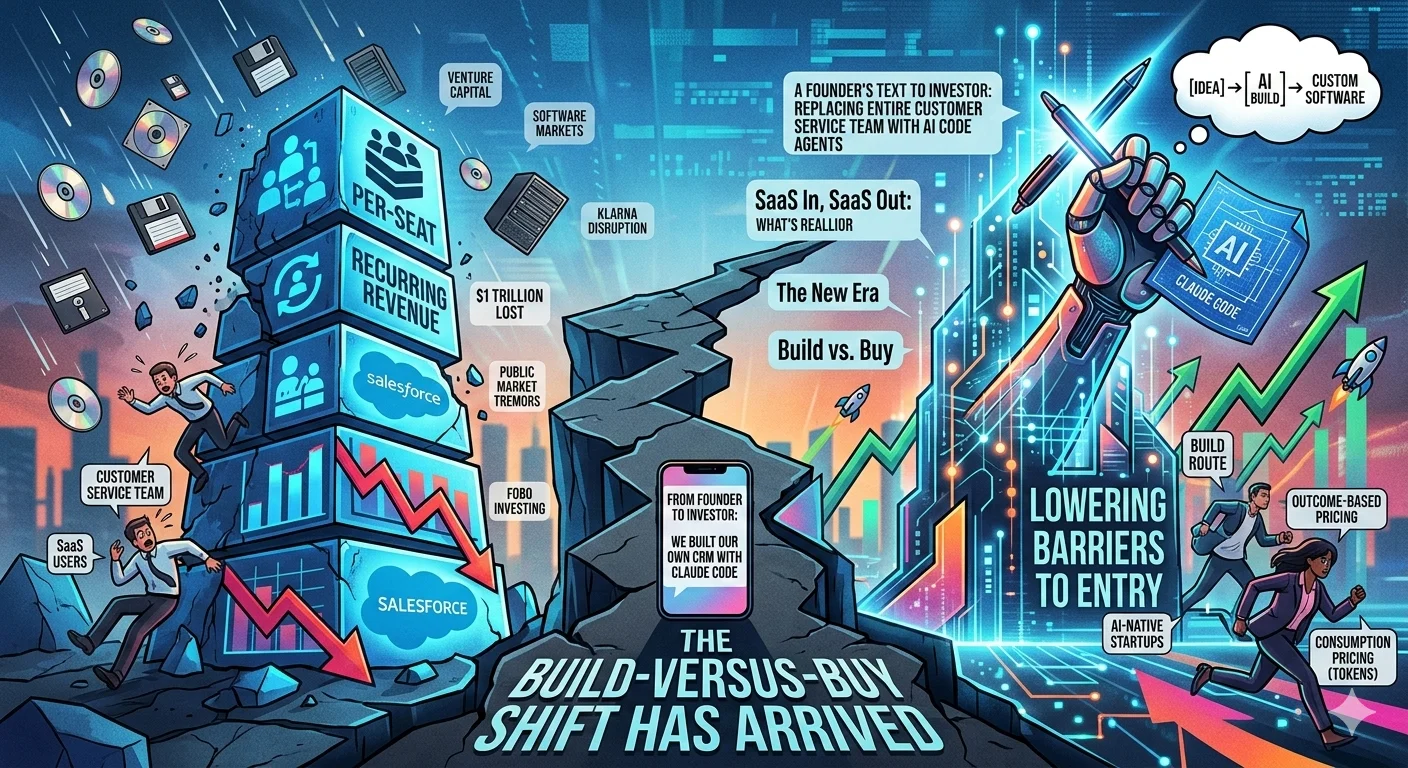
One message from a founder to his investor said more about the future of software than a thousand analyst reports. The founder had a straightforward update: he was replacing his entire customer service team with Claude Code, an AI tool capable of writing and deploying software entirely on its own. To Lex Zhao, an investor at One Way Ventures, that text wasn't just a business decision — it was a signal. The moment, he believed, had finally arrived when companies like Salesforce stopped being the automatic, unquestioned default.
The build-versus-buy shift, however, is only one piece of a much larger disruption taking shape.The deeper threat to the SaaS industry isn't just that companies can now build their own tools — it's that the very concept of using AI agents instead of human employees calls the entire SaaS business model into question.
SaaS companies have long priced their software per seat, charging based on how many employees log in and use the platform. "SaaS has long been regarded as one of the most attractive business models due to its highly predictable recurring revenue, immense scalability, and 70–90% gross margins," said Abdul Abdirahman, an investor at venture firm F-Prime.
When a single AI agent can do the work of dozens of employees, the per-seat model doesn't just strain — it breaks.
The Pricing Problem: Why the SaaS Revenue Model Is Under Siege:
The math that made SaaS so attractive to investors is now working against it. When employees simply ask their AI of choice to pull data, generate reports, or manage workflows — bypassing traditional software interfaces entirely — the concept of charging per user login becomes increasingly difficult to justify.
The rapid pace of AI development compounds the problem further, as new tools like Claude Code and OpenAI's Codex can now replicate not just the core functions of SaaS products, but also the premium add-ons that vendors relied on to grow revenue from existing customers.
Perhaps most disruptively, customers now carry what amounts to the ultimate contract negotiation weapon. If they don't like a SaaS vendor's pricing, they can — more easily than ever before — build a custom alternative from scratch. "Even if they do not take the build route, this creates downward pressure on contracts that SaaS vendors can secure during renewals," Abdirahman noted.
The first major public signal came in late 2024, when Klarna announced it had ditched Salesforce's flagship CRM in favor of a homegrown AI system. The realization that a growing number of companies could do the same sent shockwaves through public markets. Stock prices for SaaS giants like Salesforce and Workday began sliding. In early February, a sell-off wiped nearly $1 trillion in market value from software and services stocks — followed by another billion-dollar wave later that month.
Experts quickly gave the phenomenon a name: the SaaSpocalypse.One analyst coined an even more evocative term — FOBO investing: Fear Of Becoming Obsolete.
Move Fast, Break SaaS: How AI Product Launches Are Triggering Market Tremors:
The clearest illustration of the new market dynamic comes from Anthropic's own product roadmap. When the company released Claude Code for cybersecurity, related sector stocks dropped. When it released legal tools through Claude Cowork AI, the iShares Expanded Tech-Software Sector ETF — a basket of publicly traded software companies including LegalZoom and RELX — fell in tandem. Every major AI product launch has become a seismic event for SaaS valuations.
In some respects, the correction was overdue. SaaS companies had long been considered overvalued, and many built their growth during the zero-interest-rate era that has since ended. When the cost of borrowing rises, so does the cost of doing business — and the lush margins that once made SaaS so appealing begin to erode.
The more fundamental problem is that public market investors price SaaS companies by projecting future revenue — and that future has become genuinely uncertain.Nobody can say with confidence whether, in one year or five, enterprises will rely on SaaS products to the extent they once did. Every new advanced AI tool that launches sends another tremor through SaaS stock prices because it chips away at that projection.
"This may be the first time in history that the terminal value of software is being fundamentally questioned, materially reshaping how SaaS companies are underwritten going forward," Abdirahman said.
Slapping AI features on top of existing SaaS products, it turns out, may not be enough to survive. A new wave of AI-native startups is rising at a record pace, having completely redefined what it means to build software. "Software is now easier and cheaper to build, meaning it's easier to replicate," said Yoni Rechtman, a partner at Slow Ventures. That's good news for the next generation of founders — and a serious structural threat to the incumbents who spent years, and billions, constructing their existing tech stacks.
The Hidden AI War
Nobody Is Telling You About
Our latest documentary deep-dive into the geopolitical struggle for machine intelligence dominance. Explore the two paths of AI development: open source vs. closed architecture.
New Business Models: Consumption, Outcomes, and the Post-SaaS Economy:
The SaaS pricing model may be fracturing, but no clear successor has yet emerged to replace it. Some AI companies are experimenting with consumption-based pricing — charging customers based on how much AI they actually use, measured in tokens. Others are pushing toward outcome-based pricing, where fees are tied directly to how well the AI performs.
That second approach is being championed, perhaps ironically, by former Salesforce CEO Bret Taylor. His AI startup Sierra — a customer service agent platform that functions as a quasi-Salesforce competitor — charges customer based on results rather than seats or usage volume. The approach appears to be working: Sierra hit $100 million in annual recurring revenue in less than two years, reaching that milestone by November.
The durability question that once made SaaS so appealing is now more complicated than it used to be. There was a time when cloud-based software seemed immune to depreciation — a permanent upgrade from the on-premises software companies once had to install and maintain on their own servers. Being in the cloud, however, offers no protection against an entirely new technological paradigm rising to compete. AI-native companies adapt, adopt, and build at a speed that traditional SaaS companies simply cannot match.
SaaS companies are, after all, themselves the former disruptors. They replaced old-school on-premises vendors in the last great wave of enterprise technology disruption. Now they face the same fate.
"The most important thing to understand about the SaaS pullback is that it is simultaneously a real structural shift and potentially a market overreaction,"** Abdirahman observed, noting that investors typically **"sell first and ask questions later.
SaaS IPOs: Why the Pipeline Has Gone Cold:
The chill from investors isn't limited to publicly traded SaaS companies — it has frozen the IPO pipeline entirely. A Crunchbase report found that while the IPO market appears to be thawing for some sectors, there are no venture-backed SaaS filings expected on the horizon. Large, late-stage private SaaS companies like Canva and Rippling face a particularly difficult set of pressures: a narrow IPO window, sky-high expectations driven by AI advancements, and the unstable stock prices of their already-public peers.
Some mid-size SaaS companies have even struggled to raise extension rounds in the private market — not just from public investors, but from venture funds grappling with the same existential questions about the sector's long-term trajectory.
"Nobody wants to be subjected to the volatility of public markets when sentiment can send companies into downward tailspins," said Rechtman, who expects many of these companies to stay private for significantly longer than originally planned.
Meanwhile, the market watches and waits for a different kind of IPO story. Speculation has been building that both OpenAI and Anthropic are considering going public — possibly even later this year. The finances of the first AI-native companies to attempt an IPO will be scrutinized as a proxy for whether the new paradigm can actually deliver the durable returns that SaaS once promised.
The Road Ahead: Death, Disruption, or Reinvention?
Despite the alarm, not everyone is ready to write the obituary for SaaS. Aaron Holiday, managing partner at 645 Ventures, is clear about his view: "This isn't the death of SaaS." Rather, he sees it as the beginning of an inevitable transformation — an old snake shedding its skin.
Enterprises will always need software built around compliance, auditability, workflow management, and long-term durability — capabilities that flashy AI tools don't automatically provide. Most of the new features companies are currently experimenting with, Holiday argues, simply **"won't stick."
"Durable shareholder value isn't built on hype," he said. "It's built on fundamentals, retention, margins, real budgets, and defensibility."
The most likely outcome, as with every major technology disruption before it, is a fusion of old and new. The SaaS companies that survive will be those that find ways to embed AI deeply into their core value proposition — not as a surface-level feature, but as a fundamental rearchitecting of how their products work and how they charge for them. The ones that fail will be those that mistake momentum for moat.
The SaaSpocalypse isn't the end of enterprise software. It's the beginning of a reckoning — and the question isn't whether the industry will change, but who will be left standing when it does.