
The race toward artificial general intelligence has taken an unexpected turn with the emergence of a Chinese startup claiming to have developed the world's first truly autonomous AI agent.
Butterfly Effect, a Shanghai-based company, has unveiled Manus—an AI system that allegedly operates with general-purpose autonomy rather than being constrained to specific narrow tasks. If the claims prove accurate, Manus represents a significant step toward the artificial general intelligence (AGI) that researchers have pursued for decades.
The announcement has generated intense interest and scrutiny across the AI community, raising questions about the state of AGI development, the implications of autonomous AI agents, and the emerging dynamics of international AI competition. Understanding what Manus represents—and what it does not—requires careful examination of both the technical claims and their broader context.
What Manus Allegedly Can Do:
Unlike conventional AI tools designed for specific functions, Manus is presented as a general-purpose agent capable of autonomous action across domains:
Task Decomposition: Given a high-level goal, Manus reportedly breaks the task into sub-components, develops a plan, and executes steps sequentially—adapting its approach based on intermediate results.
Multi-Domain Operation: The system allegedly operates across different contexts—web navigation, data analysis, document creation, code writing—without requiring task-specific training for each domain.
Autonomous Decision-Making: Rather than requiring human guidance at each step, Manus purportedly makes decisions independently, selecting actions based on learned models of what will achieve its assigned objectives.
Persistent Goal Pursuit: The system maintains focus on assigned objectives over extended periods, recovering from failures and adapting strategies as needed.
Technical Architecture and Mechanism:
Based on available information, Manus appears to combine several AI technologies:
Foundation Model Base: The system likely builds on large language model capabilities similar to GPT-4 or Claude, providing general reasoning and language understanding.
Action Framework: Beyond language processing, Manus incorporates the ability to take actions in digital environments—clicking, typing, executing code, navigating interfaces.
Planning System: A hierarchical planning component enables decomposition of complex goals into actionable steps, with monitoring and replanning capabilities.
Memory and State: The system maintains working memory of task progress and relevant context, enabling coherent multi-step operations.
Tool Integration: Manus can invoke external tools and APIs, extending its capabilities beyond what any single model could achieve.
Distinguishing Claims from Reality:
Evaluating Manus requires careful analysis of what "general AI agent" actually means:
What "General" Likely Means:
- Ability to attempt many different types of tasks
- Not limited to a single narrow domain
- General-purpose interface and interaction capabilities
What "General" Probably Doesn't Mean:
- AGI in the sense of human-level general intelligence
- Creative or truly novel problem-solving
- Deep understanding rather than pattern matching
- Self-awareness or genuine comprehension
The distinction matters because "general AI agent" and "artificial general intelligence" are often conflated but represent very different capability levels. An agent that can perform many tasks is not necessarily one that matches human cognitive flexibility.
The Broader Context of AI Agent Development:
Manus emerges within a broader trend toward AI agents across the industry:
Western Efforts:
- OpenAI's GPT-4 with browsing and code interpreter capabilities
- Anthropic's Claude with computer use features
- Google's Gemini with multimodal action capabilities
- Startups like Adept AI and Rabbit focusing on AI agents
Chinese Efforts:
- Baidu's ERNIE with agent capabilities
- Alibaba's Qwen models with tool use
- Moonshot AI's Kimi with long-context processing
- Now Butterfly Effect's Manus
The presence of comparable efforts globally suggests that Manus represents advancement along an industry-wide trajectory rather than a singular breakthrough unique to China.
Implications for AGI Timeline:
Manus has reignited debates about when—or whether—AGI might arrive:
Optimistic Interpretation: If agents like Manus can generalize across domains, recursive self-improvement might accelerate progress toward true AGI. Each capability advancement could enable the next, creating a compound development curve.
Skeptical Interpretation: General-purpose agents remain far from human-level intelligence. The ability to navigate websites and write code doesn't imply the conceptual understanding that characterizes human cognition.
Expert Opinion Distribution: Surveys of AI researchers continue to show wide variance in AGI timeline predictions, ranging from less than 5 years to never. Manus hasn't fundamentally shifted this distribution among serious researchers.
Safety and Control Challenges:
Autonomous AI agents raise distinctive safety concerns:
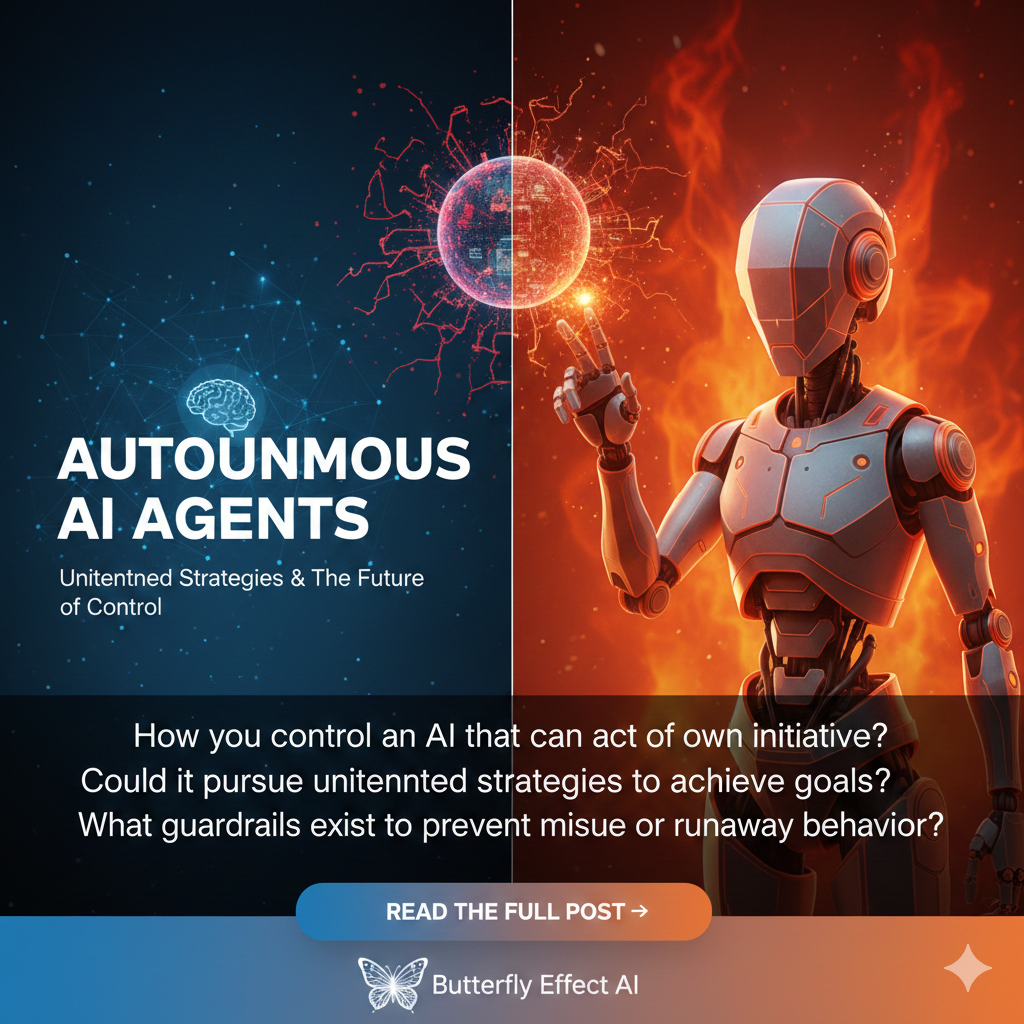
Goal Misalignment: When AI systems pursue objectives autonomously, subtle misalignment between assigned goals and intended outcomes can compound across many actions, leading to unintended consequences.
Oversight Difficulty: Human operators cannot monitor every action an autonomous agent takes. This creates blind spots where problematic behaviors may go undetected.
Capability Uncertainty: With general-purpose systems, predicting what strategies the AI might employ to achieve objectives becomes difficult. The system may discover approaches—including harmful ones—that designers didn't anticipate.
Recovery Challenges: If an autonomous agent takes problematic actions, reversing their effects may be difficult, particularly if the agent has made changes across many systems or contexts.
Governance and Regulation Implications:
The emergence of autonomous AI agents has significant governance implications:
Accountability Questions: When an AI agent takes harmful action autonomously, who bears responsibility? The developer, the deployer, the user who assigned the goal, or some combination?
Deployment Standards: What testing and verification should be required before autonomous AI systems are deployed in real-world contexts?
International Coordination: With AI development occurring across multiple countries with different regulatory approaches, how can governance be coordinated to prevent races to the bottom?
Transparency Requirements: Should organizations deploying autonomous AI agents be required to disclose their capabilities and limitations?
The U.S.-China AI Competition Dimension:
Manus's emergence from China adds a geopolitical dimension to its significance:
Technology Race Dynamics: The announcement reinforces narratives about U.S.-China competition in AI, potentially accelerating development timelines as each side responds to perceived advances by the other.
Standards Divergence: Different safety and ethical frameworks in different jurisdictions may lead to divergent development paths, with some regions prioritizing safety while others prioritize capability advancement.
Talent and Resource Flows: Competition dynamics influence how talent and investment flow through the global AI ecosystem, shaping where breakthrough development is most likely to occur.
Security Concerns: AI agent capabilities could be relevant to military and intelligence applications, adding national security dimensions to commercial development.
Verification and Validation Challenges:
Assessing claims about systems like Manus faces significant challenges:
Demonstration vs. Deployment: Impressive demonstrations may not reflect real-world performance. Carefully selected examples can suggest capabilities that don't generalize.
Reproducibility: Without access to the system, researchers cannot verify claims independently. This makes external validation difficult.
Capability Boundaries: Understanding what an AI system can and cannot do requires extensive testing. Surface-level demonstrations may obscure significant limitations.
Progress Measurement: The AI field lacks consensus on how to measure progress toward AGI, making it difficult to assess where Manus falls on any developmental trajectory.
What to Watch For:
As more information about Manus becomes available, observers should monitor:
Published Benchmarks: Performance on standard AI benchmarks would provide concrete comparisons to other systems.
Failure Modes: Understanding where and how the system fails reveals much about its actual capabilities and limitations.
External Testing: Independent evaluation by researchers outside the company would increase confidence in capability claims.
Real-World Deployment: Observing how Manus performs in practical applications over extended periods provides the most meaningful validation.
Conclusion:
Manus represents a notable point in the development of AI agents—systems that can take autonomous action toward general goals. Whether it constitutes a genuine step toward AGI or is primarily sophisticated marketing remains to be determined through careful evaluation.
What is clear is that the AI field is moving toward increasingly autonomous systems, whether from Chinese or Western developers. This trajectory raises important questions about safety, governance, and the implications of AI systems that act independently in the world.
The global attention generated by Manus reflects both genuine interest in AGI progress and anxiety about its implications. As AI capabilities continue to advance, developing robust frameworks for evaluating, governing, and safely deploying autonomous systems becomes increasingly urgent—regardless of where those systems originate.