
A new controversy is emerging in the artificial intelligence ecosystem—
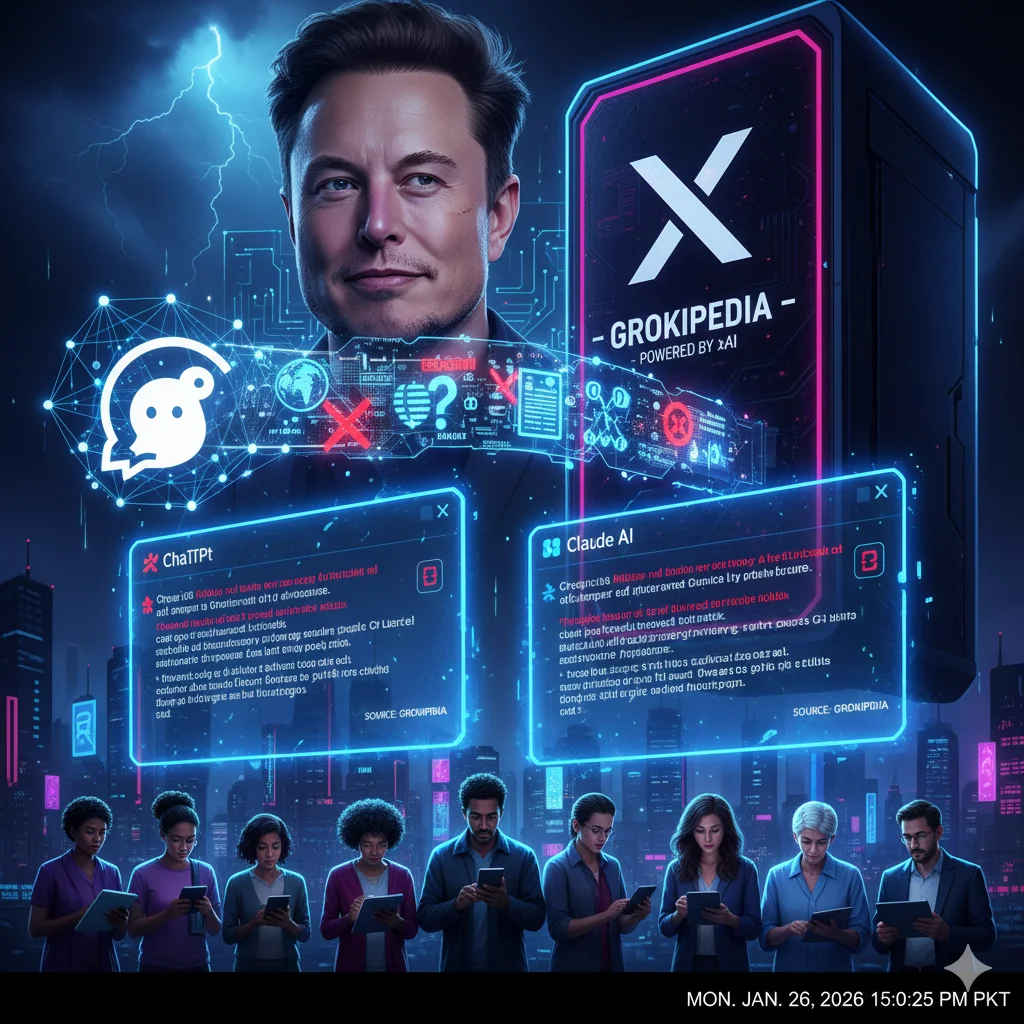
one that raises serious questions about AI training data, content moderation, and the reliability of generative AI systems. According to a recent report by The Guardian, ChatGPT has begun citing Grokipedia, an AI-generated online encyclopedia developed by Elon Musk’s xAI, as a source in some of its responses.
This development has triggered widespread concern among researchers, journalists, and digital rights advocates, particularly because Grokipedia has been widely criticized for ideological bias, factual inaccuracies, and extremist framing.
What Is Grokipedia?
Grokipedia was launched in October 2025 by xAI, Elon Musk’s artificial intelligence company, as an alternative to Wikipedia. Musk has repeatedly claimed that Wikipedia is politically biased against conservatives, and Grokipedia was positioned as a corrective to what he described as “ideological capture” of mainstream knowledge platforms.
However, shortly after its launch, reporters and watchdog groups identified troubling issues:
- Many articles appeared to be copied or lightly rewritten from Wikipedia.
- Some entries made unsubstantiated claims, including that pornography contributed to the HIV/AIDS crisis.
- Other articles provided ideological justifications for slavery.
- Several entries used derogatory and denigrating language toward transgender people.
These findings reinforced existing concerns about AI-generated encyclopedias lacking editorial oversight.
From the Musk Ecosystem to ChatGPT:
Until recently, Grokipedia’s influence appeared limited to the xAI and X (formerly Twitter) ecosystem. That has now changed.
According to The Guardian, GPT-5.2 cited Grokipedia nine times across more than a dozen responses to different user questions. This suggests that content from Grokipedia has begun circulating beyond its original platform and entering the broader AI information supply chain.
More notably, Anthropic’s Claude AI was also found to reference Grokipedia in some responses, indicating that this is not an isolated issue affecting only OpenAI models.
Why This Is Particularly Concerning:
The Guardian’s investigation found that ChatGPT did not cite Grokipedia for widely scrutinized topics—such as:
- The 6 U.S. Capitol insurrection.
- The HIV/AIDS epidemic.
- High-profile political controversies.
Instead, Grokipedia citations appeared in responses to obscure or niche historical and academic topics, where misinformation is harder for users to detect.
One example involved claims about historian Sir Richard J. Evans, which The Guardian itself had previously debunked. The concern is not merely that Grokipedia was cited—but that incorrect or misleading claims were reproduced without sufficient context or verification.
This pattern highlights a key vulnerability in modern AI systems: misinformation thrives most effectively in low-visibility knowledge gaps.
A Broader Problem With AI Training Data:
This controversy underscores a larger issue affecting all large language models: they are trained on vast quantities of publicly available data, much of which lacks consistent quality control.
AI models do not inherently understand truth or credibility. Instead, they:
- Detect patterns.
- Aggregate language.
- Weigh frequency and relevance.
- Generate probabilistic responses.
When biased or misleading sources enter the public data ecosystem at scale, AI systems can inadvertently amplify them, even if those systems were not designed to endorse such viewpoints.

Anthropic vs OpenAI: Which AI is Better at Controlling Your Desktop?
OpenAI Responds:
In response to The Guardian’s reporting, an OpenAI spokesperson stated that ChatGPT:
“aims to draw from a broad range of publicly available sources and viewpoints.”
While technically accurate, the statement has done little to reassure critics, who argue that not all viewpoints are equally credible, and that AI systems must apply stronger source evaluation mechanisms, especially when acting as de facto knowledge authorities.
Grokipedia and the Politics of Knowledge:
The Grokipedia controversy also reflects a deeper ideological struggle over who controls knowledge in the age of AI.
Traditional encyclopedias like Wikipedia rely on:
- Human editors.
- Citation standards.
- Consensus-building.
- Transparent revision histories.
By contrast, AI-generated encyclopedias can be rapidly produced at scale, often without accountability, peer review, or editorial governance. This creates fertile ground for:
- Ideological framing.
- Revisionist history.
- Cultural and political bias.
- Automated misinformation.
When such sources begin influencing mainstream AI tools like ChatGPT, the consequences extend far beyond any single platform.
Support our research
Independent analysis fueled by you.
Why This Matters for Users:
For millions of users worldwide, ChatGPT and similar tools are increasingly used for:
- Research.
- Education.
- Journalism.
- Policy analysis.
- General knowledge.
If these systems begin referencing unreliable AI-generated sources, users may unknowingly absorb distorted or false information—particularly on topics where they lack prior expertise.
The risk is not obvious misinformation, but subtle inaccuracies presented with high confidence, which can be far more damaging over time.
The Road Ahead: Transparency and Safeguards:
This episode highlights the urgent need for:
- Greater transparency in AI sourcing.
- Clearer content provenance indicators.
- Stronger guardrails against low-quality AI-generated knowledge.
- Human oversight in high-risk informational domains.
As AI systems continue to shape public understanding of history, politics, and science, information integrity must become a core design priority, not an afterthought.
Meta's Next Big Bet: This New App Lets You Build Games Simply by Typing a Prompt
Conclusion:
The appearance of Grokipedia content in ChatGPT responses marks a critical moment in the evolution of generative AI. It demonstrates how AI-generated misinformation can propagate across platforms, even when those platforms are developed by competing companies.
The challenge ahead is not simply technological—it is ethical, political, and cultural.
As AI becomes a primary interface for knowledge, the question of whose truth it reflects becomes increasingly consequential.