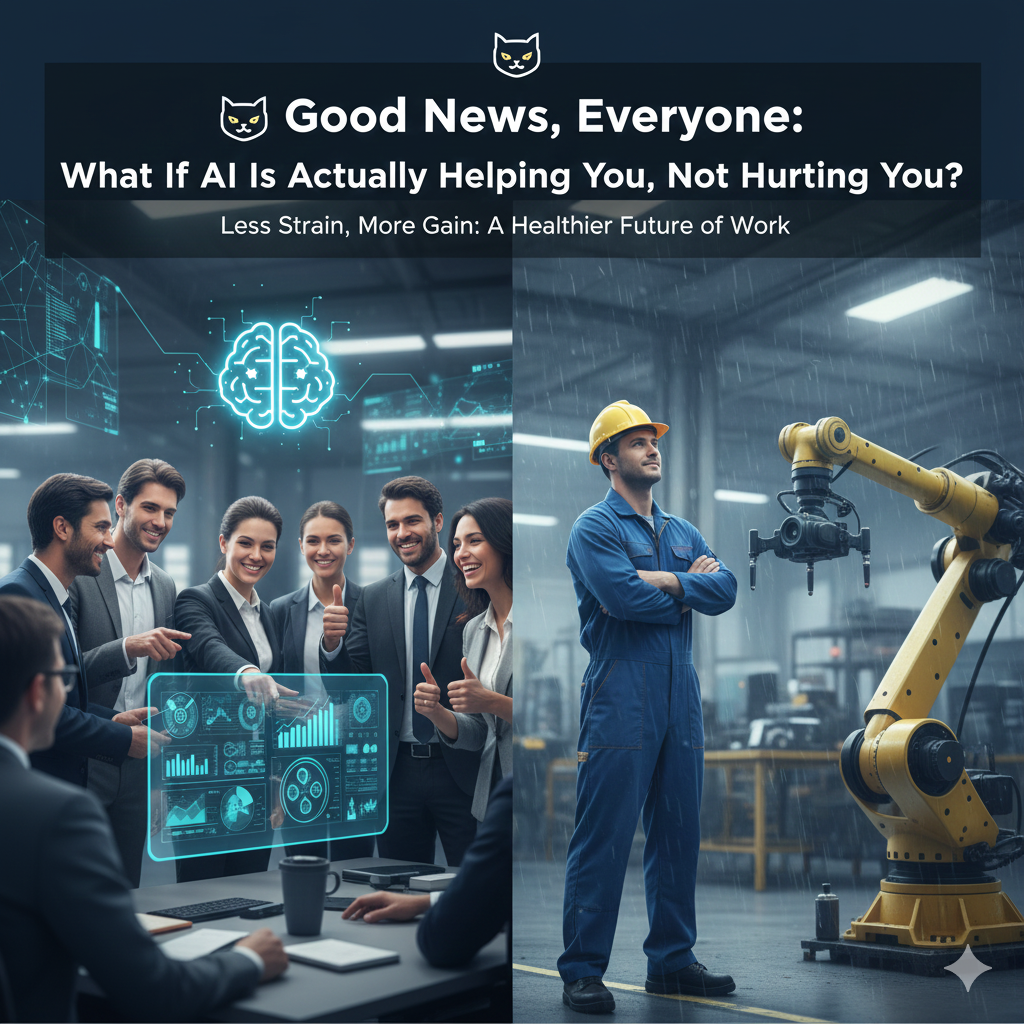

🤖 Good News,Everyone: What If AI Is Actually Helping You, Not Hurting You?
For years, the loudest narrative about Artificial Intelligence in the workplace has been a scary one: AI is coming for your job. It's going to spike your stress levels, make your work life miserable, and generally turn the office into a dystopian nightmare. But a major new study just dropped, and it offers a surprisingly warm, human-centric counter-narrative. It suggests that AI might not be the career killer we feared—it might actually be a subtle health improver.
The German Data Dig: A Surprise in the Numbers:
Researchers from the University of Pittsburgh, the University of Milan, and the German Ministry of Finance didn't rely on gut feelings or short surveys. They dug into two decades of long-term worker data from Germany—a country known for its strong labor protections. They compared the well-being of people in jobs highly exposed to AI with those in less-affected fields. The results, published in Nature: Scientific Reports, offer a refreshing pause to the panic: 🧘♀️ Myth #1 Busted:
- AI Doesn't Wreck Your Happiness.
- Job Satisfaction: Stabilized.
- Mental Health: Undamaged. The study found no significant negative average effects on job satisfaction or mental health, despite the increasing presence of AI in the workplace.
💪 The Quiet Win: A Boost to Physical Health:
This is where the findings get genuinely interesting, especially for a group often overlooked in the AI debate: workers without college degrees. The data suggested workers were reporting a slight improvement in their self-rated physical health. Why? Because AI seems to be taking over the most physically demanding tasks. It’s reducing the job intensity and strain that leads to wear-and-tear on the body.
“If anything, physical health seems to have slightly improved, likely due to reduced physical demands in AI-exposed occupations.” — Professor Luca Stella Less Stress, Less Strain, Same Pay?
The study also showed a modest dip in weekly working hours, while income and overall employment rates remained steady. In essence, workers might be experiencing:
- Slightly shorter weeks.
- Less physical labor.
- A stable paycheck. It seems that, at least in its early stages, AI is acting as a helpful collaborator, taking the heavy lifting (literally) off human shoulders.
Caveats and the Critical Next Step:
Before we declare AI our new favorite co-worker, the researchers offer important notes of caution: It's Early Days: The data covers the early stages of AI adoption. The full, long-term impact as the technology becomes deeply integrated still needs monitoring.
Perception vs. Reality:
Interestingly, people who felt they were exposed to AI reported small negative effects on their well-being. This highlights a gap: our anxiety about the technology might be a bigger factor than the reality of the tasks AI is actually performing.
Policy is Key:
The German context—with strong labor laws—matters. As Professor Osea Giuntella notes, outcomes will depend not just on the tech itself, but on how societies manage it. The takeaway is clear: the most dire, worst-case scenarios for AI are not inevitable. We have a chance, right now, to steer the ship. By focusing on policies that prioritize worker well-being, we can ensure AI remains a supportive tool that reduces physical strain and frees us up for more human-centric work. The future of work might just be one where we feel a little less stressed and a little healthier. And that’s a future worth building.
Support our research
Independent analysis fueled by you.