
Hey everyone!
Lately, it feels like AI is everywhere,
Doesn't it? From generating art that blows your mind to writing surprisingly good essays, these systems are getting smarter, faster, and more integrated into our lives. But there's one question that keeps popping up: Could AI ever become as intelligent as humans?
This isn't just a sci-fi fantasy anymore; it's a serious topic that tech giants, philosophers, and scientists are grappling with. The idea is called Artificial General Intelligence (AGI) – essentially, an AI that can do any intellectual task a human can, with all our flexibility, creativity, and understanding.
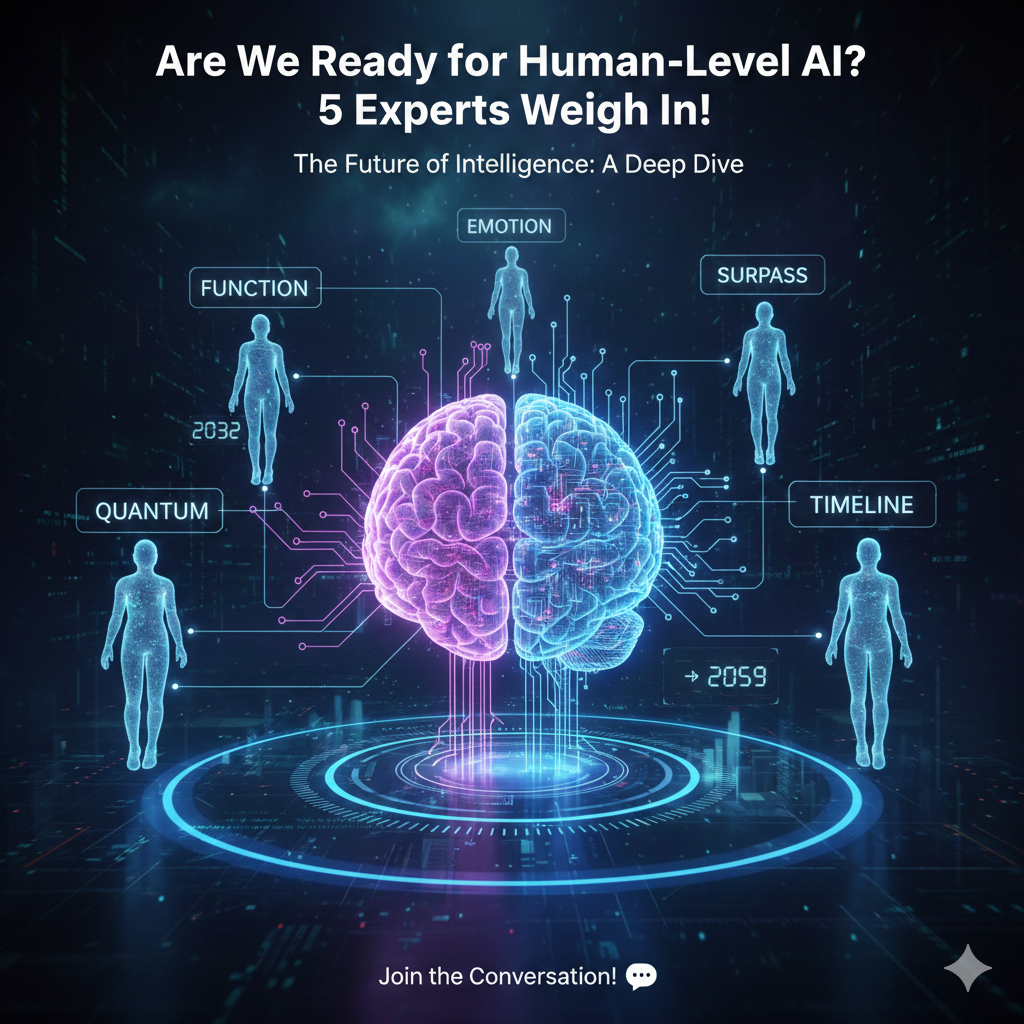
I just read a fascinating deep dive where five experts gave their take on AGI, and guess what? Every single one of them said YES, AI will reach human-level intelligence! Now, before we all start practicing our robot overlord greetings, their "yes" comes with a lot of nuances.
Let's break down some of the most compelling points:
Intelligence: More Than Just Processing Power?
Paul Formosa (AI & Philosophy) argues that if AI can learn, reason, write, and use tools, it's intelligent. Period. He believes we don't need to wait for AI to be "conscious" to call it intelligent. It's already showing remarkable intelligence, often surpassing us in specific complex domains like games.
The Missing Pieces: What Makes Us Us?
Christina Maher (Computational Neuroscience) points out that AI currently lacks things we take for granted: critical reasoning, emotional awareness, and social understanding. These are traits humans develop over years of complex interactions and experiences. While AI can mimic them, truly acquiring them is a different ballgame – for now.

Meta's Next Big Bet: This New App Lets You Build Games Simply by Typing a Prompt
Beyond Human: The "Automation of Intelligence"
Seyedali Mirjalili (AI & Swarm Intelligence) believes AI won't just match us; it will surpass human intelligence. He argues that once AI masters intuition, empathy, and creativity (which he thinks it will), it could self-improve at an exponential rate, profoundly reshaping our world. Talk about a game-changer!
Quantum Leap: The Future of AI Hardware:
Dana Rezazadegan (AI & Data Science) drops a major hint about how AGI might become possible: quantum computing. She suggests that current AI's limitations stem from biased data and finite computing power. Quantum computing could allow AI to process massive, diverse datasets like humans naturally do, leading to continuous self-improvement.
When Will This Happen? The Great Debate!
Marcel Scharth (Machine Learning & AI Alignment) firmly believes AGI is inevitable. He highlights AI's inherent advantages: speed, memory, and fewer physical limits. But he's cautious on the timeline. While some forecasts are as optimistic as 2032, a 2022 expert survey he trusts more points to a 50% chance of human-level AI by 2059. Still within our lifetime, right?
Support our research
Independent analysis fueled by you.
My Takeaway:
It's clear we're on a trajectory toward AGI, and the experts are largely in agreement. The questions are when, how, and what ethical considerations we need to address along the way. It's an exciting, slightly daunting, and incredibly important conversation for all of us to be a part of.