
Generative AI Analyzes Medical Data Faster Than Human Research Teams: A Breakthrough in Health Data Science:
Artificial Intelligence Is No Longer a Distant Promise in Healthcare:
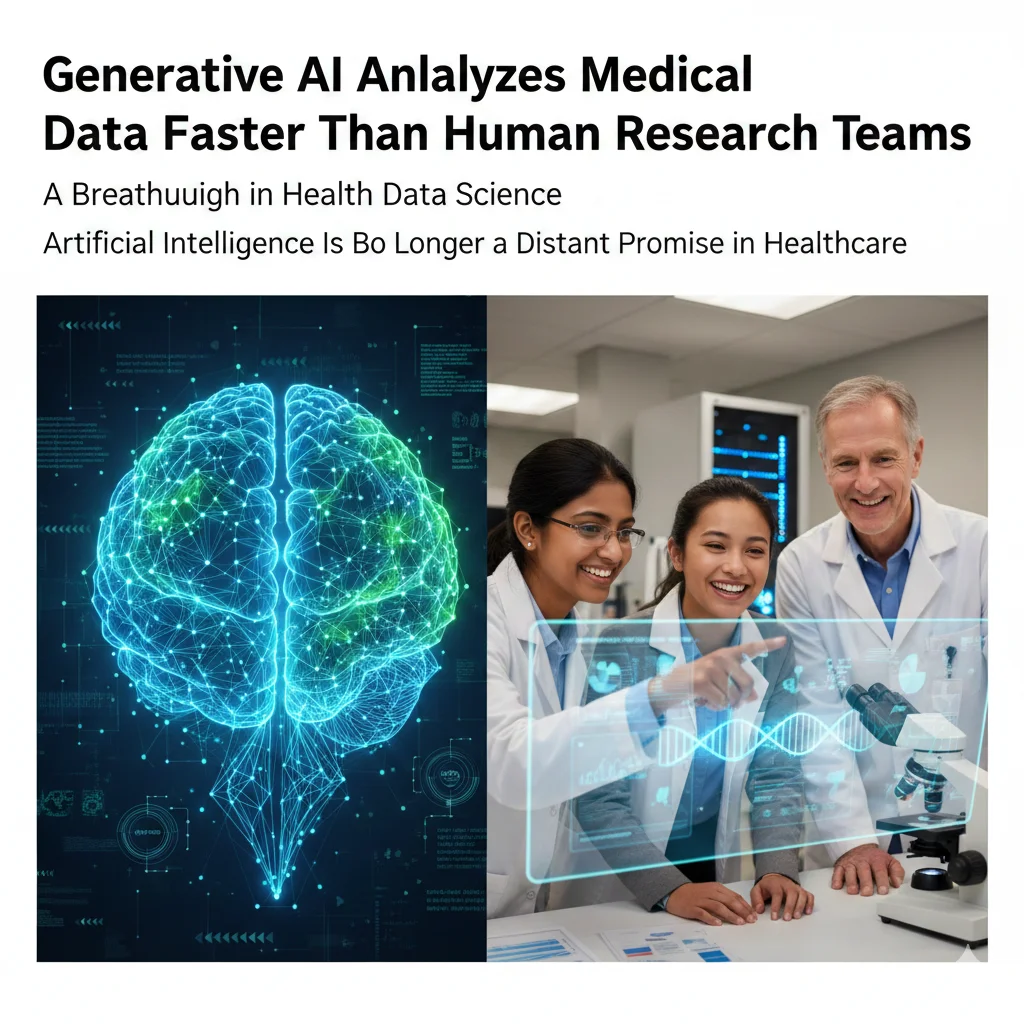
If you've been following the latest breakthroughs in medical research, you already know that artificial intelligence is actively reshaping how scientists analyze complex medical datasets. A landmark study from the University of California, San Francisco (UCSF) and Wayne State University has demonstrated that generative AI tools can process enormous health datasets significantly faster than traditional human research teams — and in some cases, outperform them altogether.
This groundbreaking research, published in Cell Reports Medicine on February 17, 2026, marks a turning point in AI-powered medical research and could accelerate discoveries that save millions of lives. So what exactly makes this breakthrough so significant? Let's dive deep.
What Did the Study Find? AI vs. Human Research Teams in Medical Data Analysis:
In one of the most compelling early real- world tests of generative AI in health research, scientists assigned identical data analysis tasks to two groups: traditional human expert teams and AI-assisted research pairs. The mission? Predict preterm birth using microbiome data from over 1,000 pregnant women across nine separate studies.
The results were eye-opening. Human teams had spent months carefully building their prediction models. The AI-assisted teams — including a junior pair consisting of a UCSF master's student and a high school student — completed the same work in a fraction of the time. The generative AI systems generated functioning analytical code in minutes, a task that experienced programmers typically require hours or even days to complete.
Remarkably, the entire generative AI effort — from inception to journal submission — took just six months, compared to the nearly two years required by traditional research methods in the original DREAM competition.
How Generative AI Is Transforming Medical Data Science:
The key advantage of generative AI in this context lies in its ability to write complex analytical code from short, precisely written natural language prompts — similar to how tools like ChatGPT respond to everyday questions. Researchers crafted detailed instructions that directed the AI systems to analyze health data in ways comparable to human experts. This capability dramatically reduces what is often called the "data pipeline bottleneck" — the time-consuming process of writing, testing, and debugging code before any actual scientific discovery can begin.
Marina Sirota, PhD, professor of Pediatrics and interim director of the Bakar Computational Health Sciences Institute at UCSF, stated that these tools could relieve one of the biggest bottlenecks in data science — and that the speed couldn't come sooner for patients who need help now.
Why Preterm Birth Research Is So Critical:
Preterm birth remains the leading cause of newborn death worldwide and a major contributor to long-term motor and cognitive challenges in children. In the United States alone, approximately 1,000 babies are born prematurely every single day. Despite its prevalence, researchers still do not fully understand the underlying causes of preterm birth.
To investigate potential risk factors, Sirota's team compiled vaginal microbiome data from approximately 1,200 pregnant women, tracking outcomes across nine separate studies. This comprehensive dataset formed the basis of the DREAM (Dialogue on Reverse Engineering Assessment and Methods) competition — a global crowdsourcing initiative where more than 100 international teams competed to develop machine learning models capable of detecting patterns linked to preterm birth.
The DREAM Challenge: Benchmarking AI Against Human Experts:
The researchers tested eight different AI chatbot systems, instructing each to independently generate predictive algorithms using the same datasets from three DREAM challenges. The AI systems received carefully written natural language prompts and were evaluated based on how well their outputs matched the performance of the original human participants.
Key Findings:
-
Only 4 of the 8 AI tools tested produced usable, high-quality code.
-
The 4 successful systems matched — and in some cases exceeded — the performance of human expert teams.
-
Junior researchers with AI assistance completed experiments, verified findings, and submitted results to a journal within a few months.
-
Traditional methods required nearly two years to consolidate and publish comparable findings.
The AI systems also analyzed blood and placental samples to estimate gestational age — a critical factor in determining the type of prenatal care women receive. Inaccurate pregnancy dating can complicate labor preparation, making this an area where improved AI tools can have immediate clinical impact.
AI in Healthcare: Democratizing Medical Research:
One of the most exciting implications of this study is its potential to democratize medical research. Traditionally, complex data analysis has required large, specialized teams of data scientists, bioinformaticians, and programmers. The barrier to entry has been high — both in terms of expertise and time.
Generative AI changes this dynamic entirely. As Adi L. Tarca, PhD, co-senior author and professor at Wayne State University, explained, researchers with a limited background in data science won't always need to form wide collaborations or spend hours debugging code — they can focus on answering the right biomedical questions.
This shift has profound implications for global health equity, allowing researchers in resource-limited settings to conduct high-impact data science without requiring the deep infrastructure that only well-funded institutions have historically enjoyed. Limitations and the Continued Need for Human Oversight:
Despite the impressive results, the researchers are clear-eyed about the limitations of generative AI in medical research. Not all AI systems performed well — only half of the tested tools produced usable results. Furthermore, AI systems can produce misleading or inaccurate outputs, and human expertise remains essential for interpreting results, asking meaningful scientific questions, and ensuring patient safety.
The study underscores that generative AI is most powerful as a collaborative tool — one that augments human intelligence rather than replacing it. Researchers can use AI to handle the time-intensive coding and data processing work, freeing up cognitive resources for higher-level scientific reasoning and clinical interpretation.
The Future of Generative AI in Health Research and Clinical Applications:
The implications of this research extend far beyond preterm birth. The ability to rapidly analyze large-scale health datasets has applications across virtually every area of medicine — from oncology and cardiology to infectious disease and neurology. As AI models become more capable and specialized for biomedical research, we can expect the timeline from data collection to clinical insight to compress dramatically.
The open data sharing model that made this research possible— pooling data from over 1,200 women across nine studies — also points to a future where collaborative, data-driven science accelerates at an unprecedented pace. As Tomiko T. Oskotsky, MD, co-director of the March of Dimes Preterm Birth Data Repository, noted, this kind of work is only possible with open data sharing and the pooling of experiences from many women and the expertise of many researchers.
Key Takeaways: Why This AI Research Matters for the Future of Medicine:
Generative AI dramatically reduces medical data analysis time — from months to days.
-
AI-generated code matched or outperformed human expert teams in complex predictive modeling.
-
Junior researchers with AI support successfully completed and published research within months.
-
Human oversight and scientific expertise remain essential components of AI-assisted research.
-
The technology holds particular promise for improving outcomes in preterm birth, gestational age estimation, and reproductive health.
-
Broader applications could transform every field of biomedical research and accelerate drug discovery, diagnostics, and personalized medicine.
Conclusion: A New Era of AI-Powered Medical Discovery:
The UCSF and Wayne State University study represents a pivotal moment in the evolution of artificial intelligence in healthcare. By demonstrating that generative AI can handle complex medical datasets with speed and accuracy comparable to — or exceeding — seasoned human research teams, this research opens the door to a future where the pace of medical discovery is no longer constrained by the time it takes to build and debug analytical pipelines.
As AI tools continue to mature and researchers develop better frameworks for safe, responsible AI integration in clinical and research settings, we are moving closer to a world where data-driven insights can be generated faster, shared more openly, and translated into life-saving treatments and diagnostics more efficiently than ever before.
For the 1,000 babies born prematurely every day in the United States — and the millions of families affected by preterm birth globally — that future cannot come soon enough.
Support our research
Independent analysis fueled by you.