
The global race to dominate artificial intelligence hardware and software is accelerating,
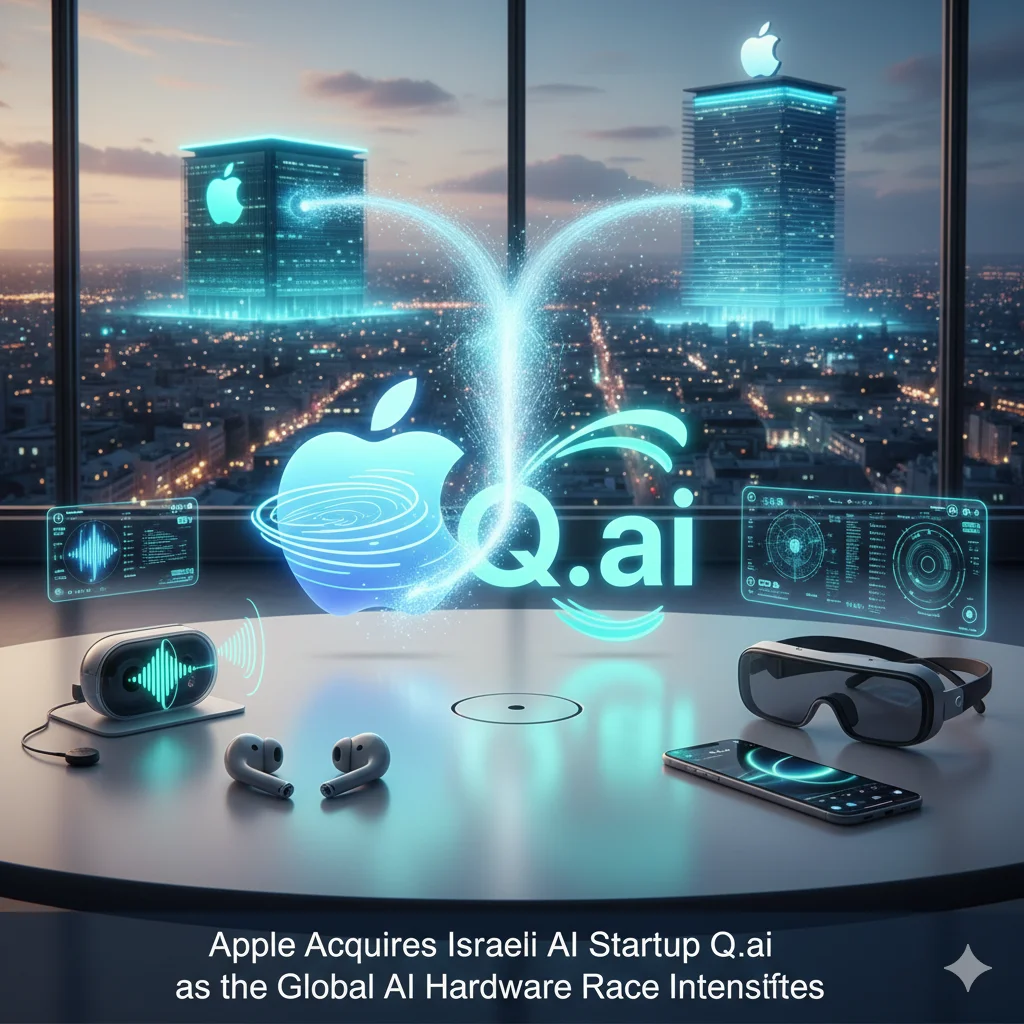
and Apple has made its next strategic move. According to reports from Reuters and the Financial Times, Apple has acquired Q.ai, an Israeli artificial intelligence startup specializing in machine learning, imaging, and advanced audio processing. The acquisition highlights Apple’s growing focus on AI-driven hardware, especially in wearables, spatial computing, and next-generation audio experiences.
As competition heats up between Apple, Meta, and Google, major technology companies are increasingly investing in AI-native hardware, rather than relying solely on cloud-based AI models. Apple’s purchase of Q.ai appears to be a calculated step toward strengthening its AI capabilities directly on consumer devices.
Why Apple Bought Q.ai:
Founded in 2022, Q.ai quickly gained attention for its cutting-edge research in audio intelligence and machine perception. The startup has developed technologies that allow devices to:
-
Interpret whispered speech.
-
Enhance audio clarity in noisy environments.
-
Use imaging and machine learning to understand subtle human signals.
These capabilities align closely with Apple’s long-term vision of on-device AI, where intelligence runs locally on hardware rather than depending heavily on external servers. This approach supports privacy, low latency, and power efficiency, all core pillars of Apple’s product philosophy.
Strengthening Apple’s Audio and Wearables Ecosystem:
Apple has been steadily introducing AI-powered features into AirPods, including live translation, adaptive noise control, and contextual awareness. The acquisition of Q.ai could significantly enhance these capabilities, allowing AirPods and future Apple audio products to better understand human speech in challenging environments.
For example, Q.ai’s technology could enable:
-
Clear voice detection in crowded public spaces.
-
Whisper-based commands for discreet interaction.
-
Smarter spatial audio tuned to user movement and surroundings.
These innovations would help Apple maintain its leadership in the premium audio and wearable technology market, while differentiating its products from competitors relying on cloud-based AI processing.
Vision Pro and Human Interface Advancements:
Beyond audio, Q.ai’s expertise extends into imaging and human signal interpretation. Apple has reportedly developed internal technology capable of detecting subtle facial muscle movements, a feature that could be transformative for the Vision Pro headset and future mixed-reality devices.
By integrating Q.ai’s machine learning models, Apple could refine:
-
Hands-free user interfaces.
-
Eye and facial expression tracking.
-
Emotion-aware computing.
-
Accessibility tools for users with limited mobility.
These advancements would support Apple’s broader ambition to redefine human-computer interaction through spatial computing and AI-driven interfaces.
A $2 Billion Deal with Strategic Significance
According to the Financial Times, Apple’s acquisition of Q.ai is valued at nearly $2 billion, making it the company’s second-largest acquisition ever, behind its $3 billion purchase of Beats Electronics in 2014.
This price tag underscores the strategic importance Apple places on AI hardware integration. Unlike many AI acquisitions focused purely on software, Q.ai brings deep technical talent and intellectual property that can be embedded directly into Apple silicon and consumer devices.
A Familiar Founder with a Proven Track Record:
Notably, this is not CEO Aviad Maizels’ first major exit to Apple. In 2013, Apple acquired PrimeSense, a pioneering 3D-sensing company led by Maizels. PrimeSense technology played a crucial role in Apple’s transition from fingerprint authentication to Face ID on iPhones.
With Q.ai, Maizels is once again contributing foundational technology that could shape Apple’s next decade of innovation. As part of the acquisition, Maizels and co-founders Yonatan Wexler and Avi Barliya will join Apple, strengthening its internal AI research teams.
Investor Backing and Startup Growth:
Despite being just a few years old, Q.ai attracted backing from top-tier venture capital firms, including:
-
Kleiner Perkins.
-
Gradient Ventures.
-
Other prominent AI-focused investors.
This strong investor confidence reflects the growing value of startups that bridge AI research with real-world hardware applications.
Timing Ahead of Apple Earnings:
The acquisition news surfaced just hours before Apple’s quarterly earnings report, where analysts are projecting approximately $138 billion in revenue. The company is also expected to report its strongest iPhone sales growth in four years, signaling continued momentum across its product lines.
The timing suggests Apple is signaling to investors that it is aggressively investing in AI innovation, even as it continues to deliver strong financial performance. Apple’s Position in the AI Arms Race
As Meta pushes AI into wearables and mixed reality and Google integrates AI deeply into Android and its hardware lineup, Apple’s acquisition of Q.ai reinforces its commitment to AI-first hardware design.
Rather than competing directly in public chatbot benchmarks, Apple is focusing on:
-
Embedded intelligence.
-
Sensor-driven AI.
-
Private, on-device machine learning.
-
Seamless user experiences.
This strategy could give Apple a long-term advantage as AI becomes more ambient, contextual, and deeply integrated into everyday devices.
Final Thoughts:
Apple’s acquisition of Q.ai marks a pivotal moment in the company’s AI strategy. By bringing advanced audio intelligence, imaging, and machine learning expertise in-house, Apple is positioning itself at the forefront of AI-powered hardware innovation.
As the AI race intensifies, this deal signals that the next major breakthroughs may not come from chatbots alone—but from how AI quietly enhances the devices people use every day.
Support our research
Independent analysis fueled by you.