
Anthropic has officially taken a major step forward in enterprise AI .
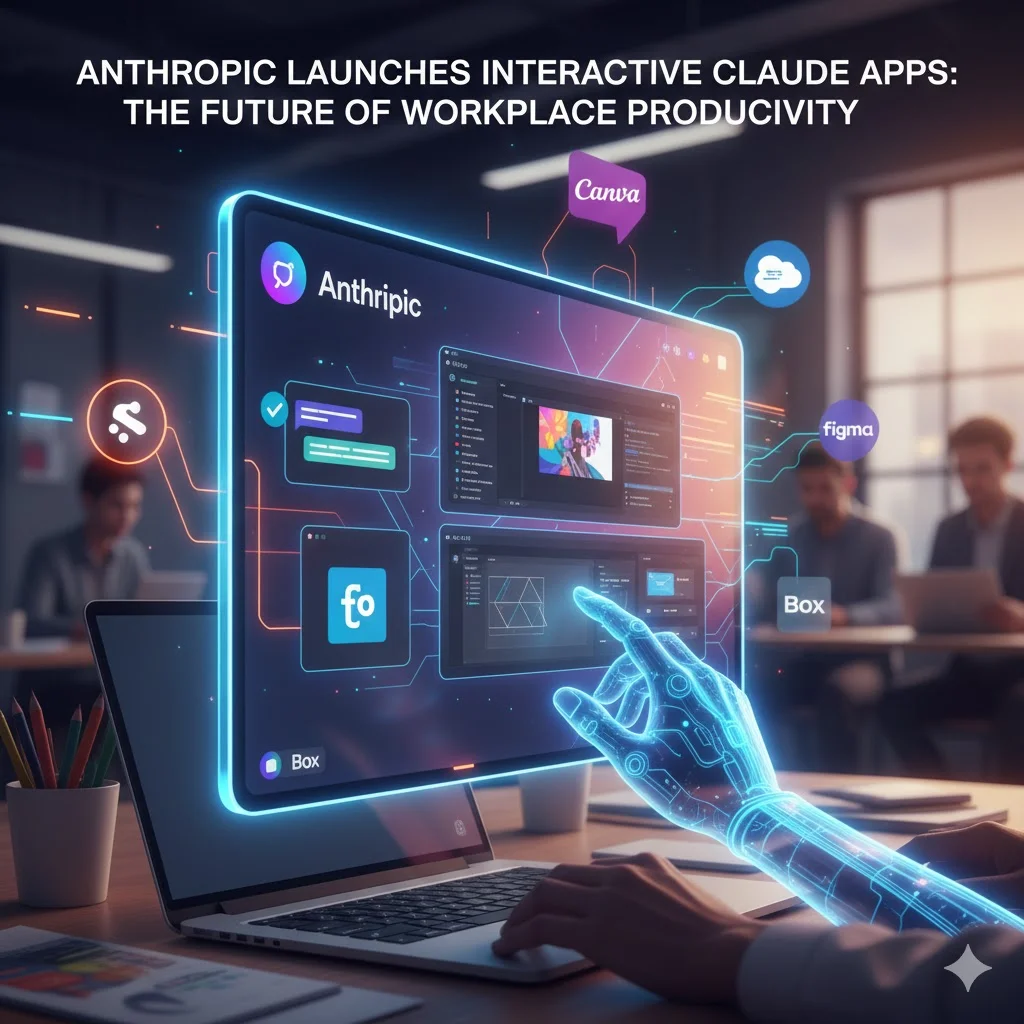
By launching interactive Claude apps, a new feature that allows users to access and operate third-party workplace tools directly inside the Claude chatbot interface. Announced on Monday, the update significantly expands Claude’s capabilities beyond conversation, positioning it as a serious competitor in the rapidly evolving AI productivity ecosystem.
With this launch, Claude users can now interact with apps like Slack, Canva, Figma, Box, and Clay, while a Salesforce integration is expected soon. The move reinforces Anthropic’s enterprise-first strategy and highlights its focus on real-world business workflows rather than consumer-only AI experiences.
What Are Interactive Claude Apps?
Interactive Claude apps allow users to connect logged-in workplace services directly to Claude, enabling the AI to perform actions instead of simply providing suggestions. Once enabled, Claude can:
-
Send and manage Slack messages.
-
Create and edit designs in Canva.
-
Update or analyze Figma design files.
-
Access and organize cloud documents in Box.
-
Work with customer and sales data via Clay.
-
Support future Salesforce workflows.
Unlike traditional AI chatbots, which often require users to copy and paste information between tools, Claude apps bring native visual interfaces and real-time app interaction into the AI environment.
According to Anthropic, this approach allows teams to analyze data, design content, and manage projects more efficiently, combining Claude’s reasoning abilities with purpose-built professional tools.
Enterprise AI Meets Visual Workflows:
In its announcement, Anthropic emphasized that many professional tasks benefit from dedicated visual interfaces, especially in areas like design, analytics, and project management.
“Analyzing data, designing content, and managing projects all work better with a dedicated visual interface,” Anthropic stated. “Combined with Claude’s intelligence, you can work and iterate faster than either could offer alone.”
This philosophy mirrors a broader industry trend toward agentic AI systems, where AI models do not just assist but actively operate tools on a user’s behalf.
Subscription Plans and Availability:
The interactive Claude apps feature is not available to free users. Access is currently limited to the following Claude plans:
-
Claude Pro.
-
Claude Max.
-
Claude Team.
-
Claude Enterprise
Eligible users can browse and activate supported apps through the Claude App Directory, available at claude.ai/directory.
This tiered rollout underscores Anthropic’s focus on business, team collaboration, and enterprise adoption, rather than mass consumer use.
Built on the Model Context Protocol (MCP)
Both Anthropic and OpenAI have built their app ecosystems on the Model Context Protocol (MCP), an open standard introduced by Anthropic in 2024. MCP allows AI models to interact with external tools in a structured, secure, and extensible way.
Notably, OpenAI’s Apps system, launched in October, also relies on MCP. Support for app-based integrations was added to MCP in November, following collaboration between major AI labs. This shared foundation could help accelerate cross-platform AI tool development across the industry.
Claude Cowork: The Future of AI Agents at Work:
The new apps become even more powerful when paired with Claude Cowork, Anthropic’s recently launched agentic AI tool. Built on top of Claude Code, Cowork allows users to assign multi-stage, long-running tasks that previously required technical skills or terminal commands.
When fully integrated, Claude Cowork could:
-
Update marketing designs in Figma.
-
Pull fresh data from Box or Salesforce.
-
Coordinate workflows across multiple connected apps.
-
Execute complex business tasks with minimal human intervention.
Although apps are not yet available inside Cowork, Anthropic has confirmed that this integration is “coming soon.”
Anthropic's Claude Mythos 5 Restored for 100+ U.S. Orgs After Unprecedented Ban
Security, Permissions, and AI Safety:
Anthropic has also issued strong guidance around AI safety and access control, acknowledging that agentic systems can be unpredictable if improperly configured.
The company advises users to:
-
Avoid granting access to financial records, credentials, or personal data.
-
Monitor AI agents closely during execution:
-
Use dedicated folders or limited-scope workspaces instead of broad cloud access.
These precautions align with Anthropic’s long-standing reputation for prioritizing responsible AI deployment in enterprise environments.
Support our research
Independent analysis fueled by you.
Why This Matters for the Future of Work:
With interactive Claude apps, Anthropic is signaling a shift from AI as a passive assistant to AI as an active workplace collaborator. By embedding Slack, Figma, Canva, Box, and future Salesforce tools directly into Claude, the company is building a unified AI workspace designed for modern teams.
As competition between Anthropic, OpenAI, and other AI providers intensifies, features like app integration, agentic workflows, and enterprise-grade safety are quickly becoming the defining battlegrounds of the AI productivity revolution.
Engineering
The Future.
No spam. Only high-signal AI dispatch.