
AWS Just Launched an AI Agent Platform Built Specifically for Healthcare — and It Could Reshape the Industry
The Launch That Changes Healthcare Administration:
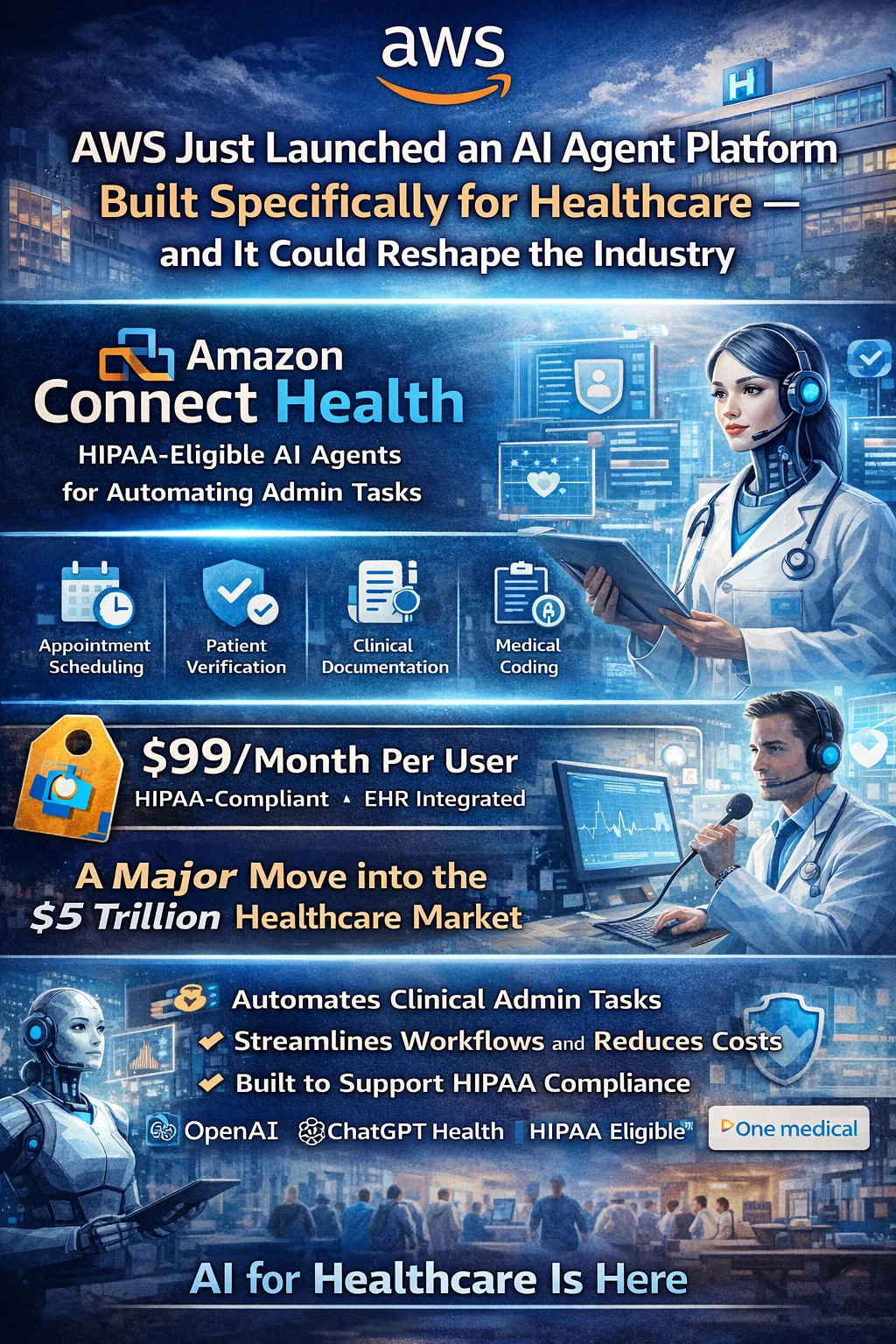
Amazon Web Services made a significant move into healthcare on Thursday with the official launch of Amazon Connect Health. The new platform is powered by AI agents — software capable of completing complex, multi-step tasks on behalf of a human — and is built specifically to help healthcare organizations eliminate the administrative burden that has long plagued the industry. Appointment scheduling, patient verification, clinical documentation, medical history reviews, and medical coding are all in the platform's crosshairs.
What sets Amazon Connect Health apart from a generic automation tool is what it was built to comply with from day one. The platform is HIPAA-eligible and integrates directly with electronic health record software, meaning it can slot into existing clinical workflows without forcing providers to overhaul their systems. AWS has already established partnerships with EHR software providers, data integrators, and patient engagement companies — a sign that the company is not launching this in isolation, but with an ecosystem already beginning to form around it.
What Amazon Connect Health Actually Does:
The platform's current feature set reflects a deliberate, phased rollout strategy. Patient verification and ambient documentation — the ability to listen to and transcribe clinical encounters in real time — are live today. Appointment scheduling and patient insights are available in preview for early adopters. Medical coding and additional capabilities are on the roadmap for later release, as AWS continues to expand the platform's scope.
The pricing model is designed to be accessible to individual practices, not just large health systems. Amazon Connect Health costs $99 per month per user, covering up to 600 patient encounters monthly. AWS notes that most primary care physicians see up to 300 patients per month — meaning the platform is sized and priced to serve even busy independent practitioners. For organizations used to paying far more for piecemeal administrative software, that figure positions Connect Health as an aggressive market entry.
AWS's Bigger Bet on Healthcare:
This launch is not Amazon's first move into healthcare — it is the latest chapter in a long-running strategic commitment. The company has been building out its healthcare infrastructure for nearly a decade. In 2018, it launched Amazon Comprehend Medical, a HIPAA-eligible natural language processor for unstructured medical data.
Amazon HealthLake followed in 2021, providing FHIR-compliant infrastructure for organizing health records. HealthOmics, a bioinformatics workflow platform, arrived in 2022. Each product has added a layer to what is becoming a comprehensive healthcare technology stack.
But Amazon Connect Health marks a meaningful inflection point. It is AWS's first major product to deploy AI agents within a regulatory-compliant healthcare platform — moving the company from infrastructure and data tools into the active workflow of clinical care. That is a fundamentally different kind of product, with a fundamentally different kind of relationship to the providers, patients, and systems it touches.
Amazon's Broader Healthcare Empire:
AWS's cloud products are only one dimension of Amazon's healthcare ambitions. On the retail and consumer side, the company has made some of the largest healthcare acquisitions of the past decade. It purchased online pharmacy PillPack in 2018 for approximately $1 billion, then acquired primary care company One Medical in 2022 for $3.9 billion. Both acquisitions have since been woven into Amazon's larger retail operations, enabling same-day prescription delivery and same-day virtual doctor visits for children — services that bring clinical care into the same logistics network as two-day shipping.
Taken together, Amazon's healthcare strategy is one of the most vertically integrated in the industry. From cloud infrastructure and AI tools for providers, to pharmacies and primary care clinics for consumers, the company is building toward a future where it touches nearly every layer of the American healthcare experience — a market worth an estimated $5 trillion annually.
The Startup Ecosystem That Saw This Coming:
Amazon's entry into AI-powered healthcare administration is a validation of a thesis that startups have been building on for years. Long before the current AI wave made headlines, companies were already attacking the administrative burden that consumes an estimated 30% of all healthcare spending in the United States. Regard, founded in 2017, uses AI to take session notes for physicians and surface relevant patient data to reduce administrative burnout. Notable, also founded in 2017, automates intake and scheduling with the same goal in mind.
What changes with Amazon's entry is not the idea — it is the scale and the distribution. A startup selling to a hospital system faces a long, trust-building sales cycle. AWS already has relationships with healthcare organizations across the country through its cloud business. Amazon Connect Health can ride those existing relationships directly into clinical settings, compressing adoption timelines that have historically stretched for years.
The AI Giants Are All Moving Into Healthcare:
Amazon is not moving alone. The broader AI industry has made a rapid, coordinated push into healthcare over the past several months. In January, OpenAI released ChatGPT Health, a version of its flagship chatbot tailored to answer consumer health questions — though it is consumer-facing and not HIPAA-compliant.
Just one week later, Anthropic announced Claude for Healthcare, which serves both consumers seeking medical guidance and professionals needing clinical tools, and is built to work within HIPAA-compliant environments. OpenAI has also launched enterprise healthcare services designed to meet the same compliance standards.
The result is a rapidly crowding field where the largest AI companies in the world are all staking out positions in healthcare simultaneously. Amazon Connect Health differentiates itself by focusing squarely on the provider side — the administrative workflows of clinicians and health systems — rather than consumer-facing health advice. In a market this large, there is room for multiple approaches. But the race to become the default AI infrastructure for American healthcare is clearly underway.
What This Means for the Future of Clinical Care:
The promise of AI in healthcare administration is not just efficiency — it is time. Every hour a physician spends on documentation, coding, and scheduling is an hour not spent with a patient. The administrative burden in American medicine is not a minor inconvenience; it is a leading driver of clinician burnout, staff shortages, and rising costs. Platforms like Amazon Connect Health, if they deliver on their promise, could give back meaningful hours to the people responsible for patient care.
For healthcare organizations evaluating their options, the arrival of a HIPAA-eligible, EHR-integrated AI agent platform from one of the world's most trusted cloud providers is a significant development. The question is no longer whether AI will transform healthcare administration — that transformation is already underway.
The question now is which platforms will earn the trust of the institutions, regulators, and clinicians who will ultimately decide what gets deployed and what does not.