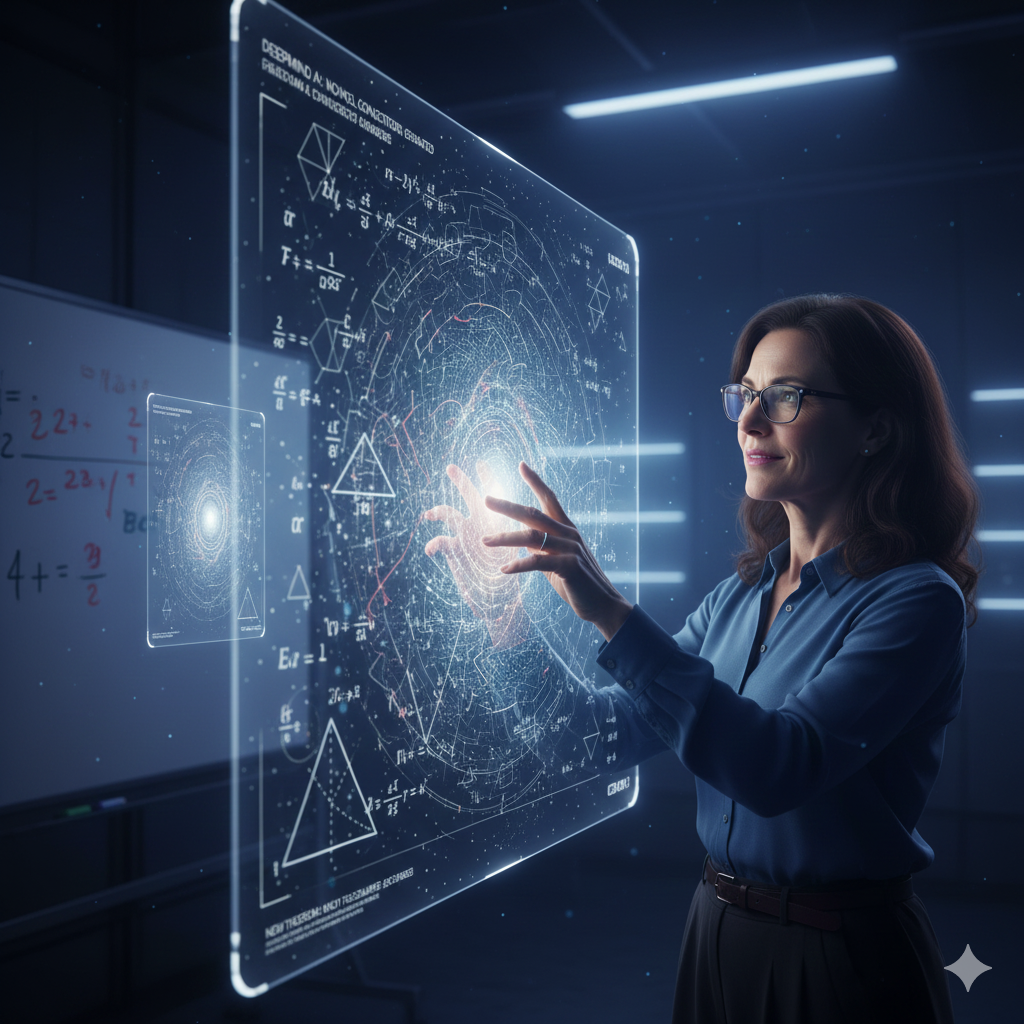

Last time, we had a chuckle about how your average five-year-old might be more innovative than ChatGPT when it comes to finding new uses for a teapot. But hold onto your hats, because a new breakthrough from DeepMind is flipping the script, showing that AI is discovering mathematical patterns never seen before by human eyes.
This isn't just about computers crunching numbers faster; it's about AI acting as a co-pilot for discovery, helping mathematicians unravel puzzles that have baffled them for decades.
From Weather Forecasts to Unsolved Algebra:
DeepMind, the same AI powerhouse behind breakthroughs in biology and weather prediction, teamed up with mathematicians to tackle some of the "most intellectually demanding" problems out there.
As Geordie Williamson, a mathematician from the University of Sydney, put it, "While machine learning has been used to analyze complex data before, this is the first time we’ve employed it to actually generate conjectures and propose new approaches to unsolved problems."
Think about that: AI isn't just analyzing; it's suggesting new theorems.
The 40-Year Puzzle: Kazhdan-Lusztig Polynomials:
One major triumph involved Kazhdan-Lusztig polynomials, a challenge in higher-dimensional algebra and symmetry that has been unresolved for 40 years. AI didn't just offer hints; it provided fresh pathways toward advancing its proof.
Even more astounding, the research uncovered a previously unknown relationship between two types of mathematical knots. Knot theory might sound niche, but it's crucial in fields like genetics, fluid dynamics, and even how our sun behaves. This means AI's discovery could have ripple effects across various scientific domains.
Why AI Sees What We Don't:
So, how can AI be so brilliant at abstract math but struggle with the simple physics of a teapot? The key lies in its ability to handle overwhelming complexity and vast datasets.
Human intuition is incredible, but our brains are wired for a three-dimensional world, for tangible interactions. When equations become mind-bogglingly complex, and data points number in the billions, AI's strength in identifying non-obvious patterns, applying learned principles to unfamiliar problems, truly shines.
It's not that AI "thinks" like a human; it "sees" connections in ways our minds simply can't, especially when those connections exist across thousands of dimensions that are invisible to us.
The Future: A Partnership, Not a Takeover:
This isn't about AI replacing mathematicians. Instead, it's about supercharging human intuition. As András Juhász from the University of Oxford explained, "When guided by mathematical intuition, machine learning offers a powerful framework for uncovering conjectures..."
Imagine a world where the incredible insight of the human mind is amplified by an AI that can sift through impossibly complex data, pointing out hidden paths to discovery. This collaboration promises to unlock secrets in pure mathematics that might have remained hidden forever.
AI is proving to be an extraordinary tool, revealing its immense value for pure mathematics. Human intuition can take us far, but AI can help us spot connections our minds might miss.
Support our research
Independent analysis fueled by you.