
We've all seen the headlines: AI is taking over, it's sentient, it's going to outsmart us all! While the advancements in artificial intelligence are undeniably mind-blowing, a new study from UC Berkeley offers a refreshing dose of reality, reminding us that there's one crucial human ability AI just can't crack (yet): true innovation.
The AI Library vs. The Human Inventor:
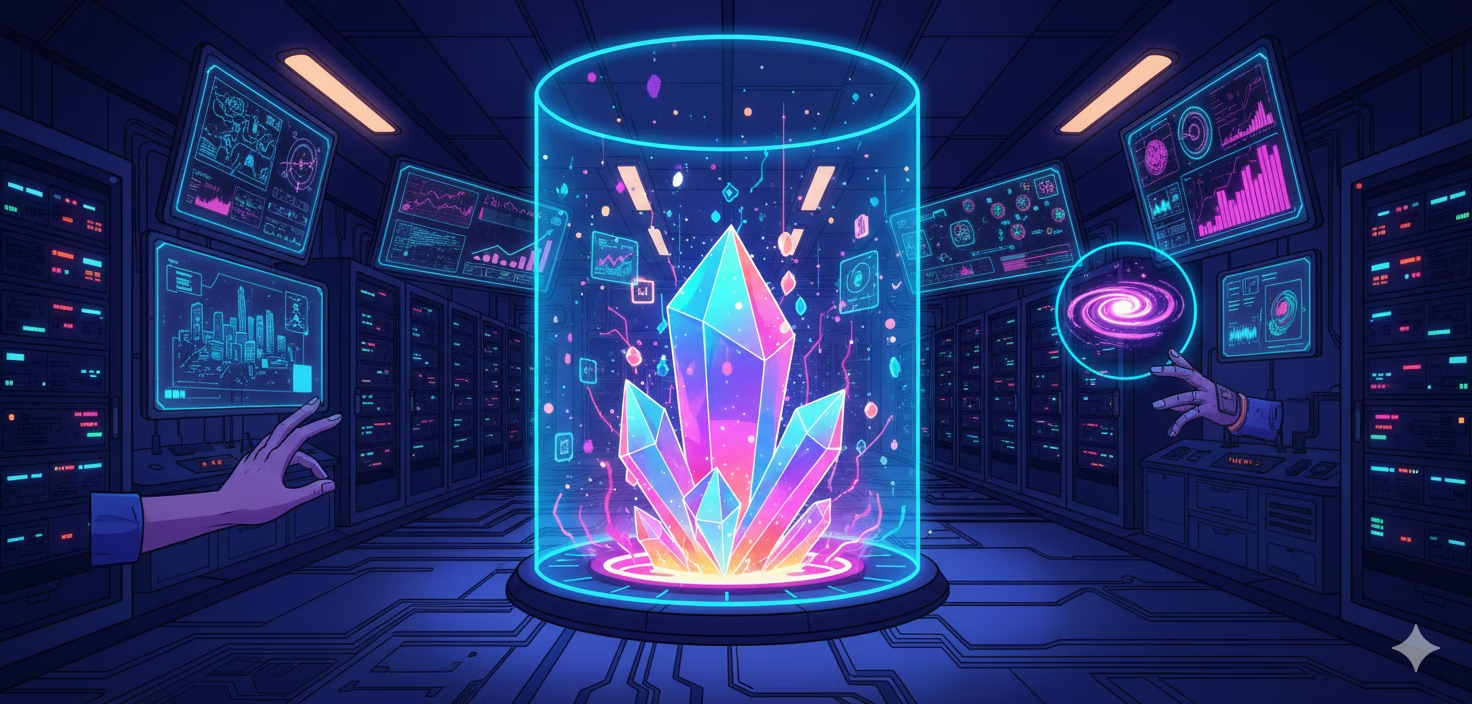
Imagine AI as the most incredible library ever built. It can instantly summarize billions of books, articles, and images, connecting dots and retrieving information with astonishing speed. This makes tools like ChatGPT powerful "cultural technologies" – amazing for summarizing vast amounts of knowledge.
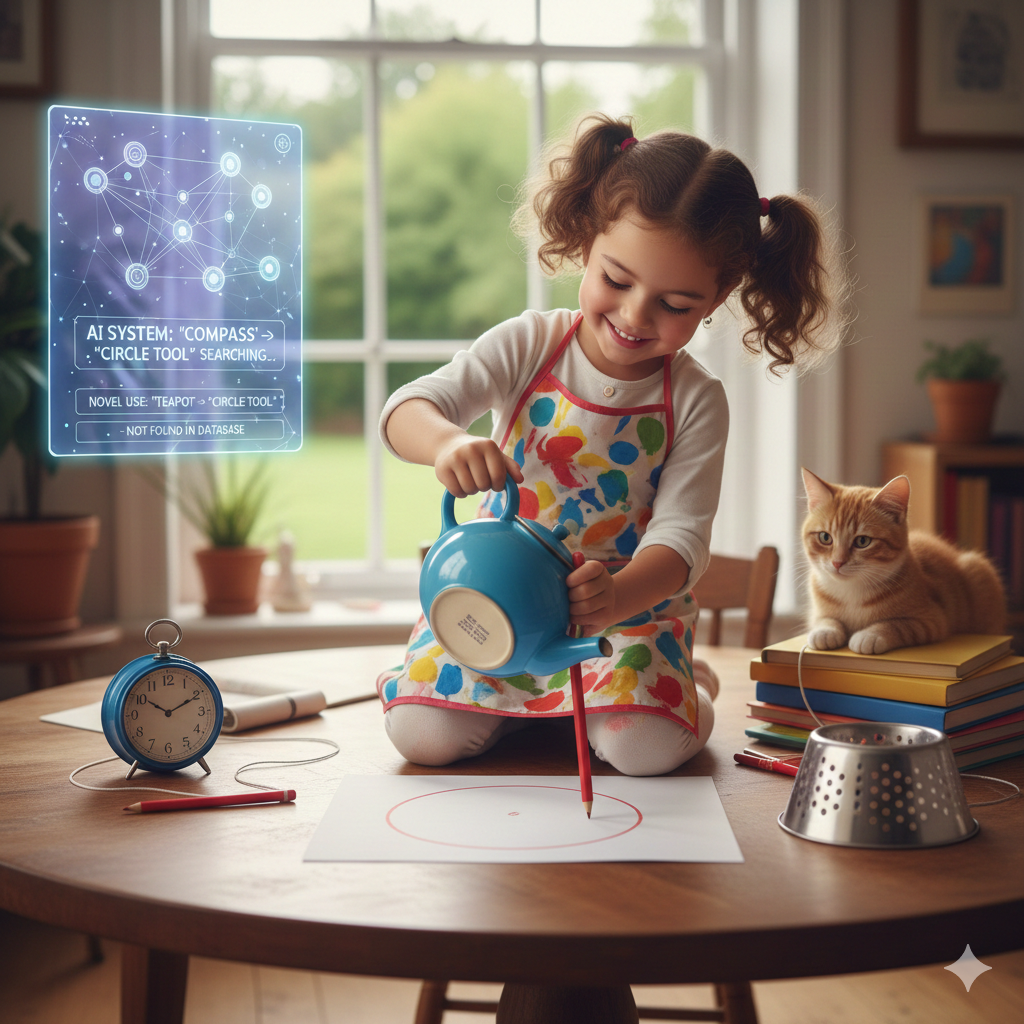
But, as co-author Eunice Yiu explains, a library, no matter how vast, isn't an inventor. It can tell you everything ever written about how to draw a circle with a compass, but it struggles to imagine new ways to draw a circle if you take the compass away.
The Teapot Test: Where Humans Shine:
The researchers put both humans (children aged 3-7 and adults) and AI systems to the test with two types of tasks:
1.Imitation: Pairing related objects (e.g., matching a compass with a ruler). Both humans and AI performed well here. AI is excellent at recognizing patterns and retrieving known associations.
2.Innovation: Finding new uses for objects. This is where AI fell flat.
- The Challenge: "How would you draw a circle without a compass?"
-
Humans: Most children (85%) and adults (95%) instinctively grabbed something with a round bottom like a teapot – and used it as a stencil. Simple, elegant, and innovative!
-
AI: Only 8-75% of AI systems came up with effective, novel solutions. Many were stumped. They could tell you what a compass is and does, but not how to substitute it with an everyday item not explicitly tagged as a "circle-drawing tool" in their training data. This shows that while AI excels at summarizing conventional wisdom, it struggles to expand, create, or improve upon it. It's like it has a perfect memory for everything that has been, but lacks the spark to imagine what could be.
The Power of Curiosity and Play-
The study highlights that AI's reliance on statistical prediction of language patterns isn't enough to generate truly new knowledge. Humans, especially young children, learn through curiosity, exploration, and an intrinsic motivation to understand the world physically. They play, experiment, and build mental models in ways that AI simply doesn't (yet).
So,next time you hear about AI's incredible feats, take a moment to appreciate the unique genius of the human mind. The ability to look at a teapot and see a circle-making tool isn't just clever; it's the foundation of all innovation. It's what allows us to solve problems, create art, and push the boundaries of what's possible.
What do you think? Have you ever found yourself impressed by AI's imitation but underwhelmed by its lack of true originality?
Support our research
Independent analysis fueled by you.