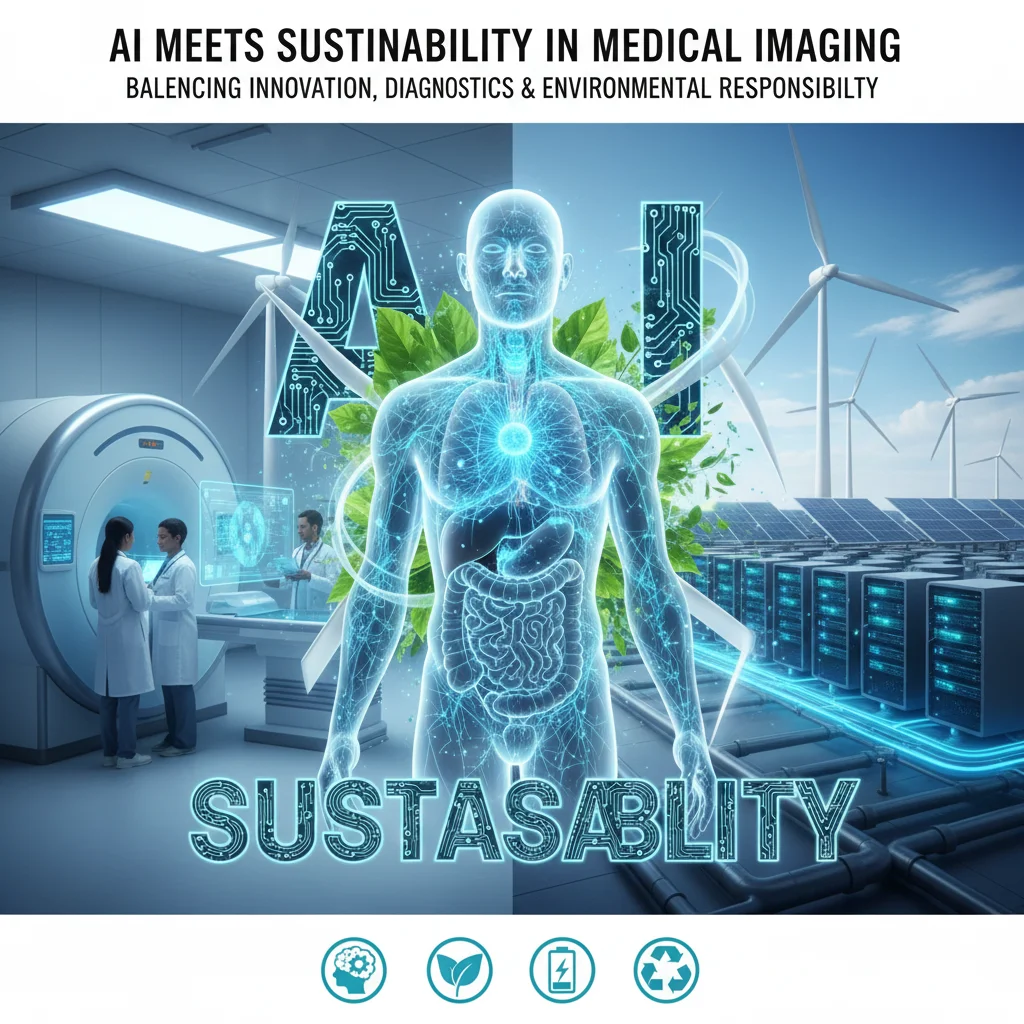

Medical imaging has become a cornerstone of modern healthcare,
playing a vital role in early disease detection, diagnosis, and personalized treatment planning. From X-rays and CT scans to MRI and PET imaging, these technologies enable clinicians to visualize complex biological processes with remarkable precision. In recent years, Artificial Intelligence (AI) has emerged as a powerful force in medical imaging, transforming how images are acquired, analyzed, and interpreted.
At the same time, sustainability has become a growing concern in healthcare innovation. Issues such as energy consumption, carbon emissions, water usage, and electronic waste are increasingly influencing how medical technologies are developed and adopted. The convergence of AI and sustainability in medical imaging represents a critical frontier—one that promises clinical advancement while demanding environmental responsibility.
The Transformative Role of AI in Medical Imaging:
Artificial Intelligence, particularly deep learning and convolutional neural networks (CNNs), is reshaping medical image analysis. AI systems can automatically detect patterns, segment anatomical structures, and identify abnormalities with a level of speed and consistency that significantly augments human expertise.
AI-powered imaging applications have demonstrated high diagnostic accuracy in areas such as:
- Tumor detection and characterization on MRI and CT scans.
- Chest X-ray screening for lung diseases.
- Brain imaging for neurological disorders.
- Automated image segmentation and quantification.
These technologies reduce interpretation time, minimize diagnostic variability, and support radiologists in managing increasing imaging workloads.
Clinical Benefits of AI in Imaging Workflows:
The integration of AI into clinical imaging workflows offers several measurable advantages:
- Improved diagnostic accuracy with reduced inter-observer variability.
- Automated triage and prioritization of urgent imaging cases.
- Workflow optimization, reducing clinician burnout and inefficiencies.
- Quantitative imaging biomarkers that support precision medicine.
Collectively, these benefits translate into faster clinical decision-making, improved patient outcomes, and more efficient use of imaging resources.
Why Sustainability Matters in Medical Imaging AI:
Despite its clinical promise, AI adoption introduces new sustainability challenges. Deep learning models require substantial computational power during both training and deployment. These processes often rely on high-performance hardware such as GPUs and TPUs, which consume significant amounts of electricity.
When AI workloads are hosted in data centers powered by fossil fuels, the result is increased greenhouse gas (GHG) emissions. As radiology departments and healthcare systems scale AI solutions, their environmental footprint becomes an important consideration.
Beyond energy use, sustainability concerns in medical imaging include:
- Carbon emissions from imaging equipment and data centers.
- Water consumption for cooling high-performance computing systems.
- Resource-intensive manufacturing of specialized hardware.
- Electronic waste from obsolete imaging and computing devices.
Understanding and mitigating these impacts is essential for sustainable healthcare innovation.
The Sustainability Paradox of AI in Medical Imaging:
Medical imaging sits at a unique paradox where AI can both enhance and undermine sustainability goals.
On one hand, AI has the potential to reduce environmental impact by:
- Minimizing unnecessary or redundant imaging studies.
- Optimizing scanner scheduling and utilization.
- Reducing repeat scans caused by poor image quality.
- Supporting preventive and early diagnosis, lowering long-term resource use.
On the other hand, AI model development and deployment can significantly increase energy consumption if sustainability is not considered from the outset.
This duality defines the sustainability paradox of imaging AI: efficiency gains at the clinical level may be offset by environmental costs at the computational and infrastructure level.
Core Challenges in Sustainable Imaging AI:
- Energy Consumption and Carbon Footprint:
Training and running deep learning models require continuous power, often increasing carbon emissions in regions dependent on non-renewable energy sources.

Meta's Next Big Bet: This New App Lets You Build Games Simply by Typing a Prompt
- Economic and Equity Considerations:
AI implementation involves high costs related to hardware, software, data storage, and maintenance. These costs raise concerns about long-term sustainability and equitable access, particularly in low-resource healthcare systems.
Support our research
Independent analysis fueled by you.
- Ethical and Regulatory Challenges:
Issues such as data privacy, algorithmic bias, and lack of explainability can lead to repeated model retraining and regulatory hurdles—indirectly increasing computational and environmental costs.
- Environmental Impact Beyond Energy:
Water usage for cooling data centers and electronic waste from outdated devices are frequently overlooked but represent significant sustainability challenges.
Strategies for Sustainable AI in Medical Imaging:
To balance innovation with environmental responsibility, several sustainability-focused strategies are emerging:
-
Green AI and efficient model design, including model pruning, quantization, and lightweight architectures.
-
Life cycle assessment (LCA) of AI systems, evaluating environmental impact from d- evelopment to deployment.
-
Renewable energy integration in hospitals and data centers supporting AI workloads.
-
Standardized sustainability metrics, such as carbon labeling and energy benchmarks for AI tools.
These approaches enable healthcare organizations to make informed decisions about AI adoption while minimizing environmental impact.
Future Directions and Research Priorities:
The intersection of AI and sustainability in medical imaging is still evolving. Future efforts are likely to focus on:
-
Developing holistic sustainability frameworks that align clinical performance with environmental responsibility.
-
Establishing policy and regulatory standards for sustainable AI in healthcare.
-
Encouraging interdisciplinary collaboration among clinicians, AI researchers, environmental scientists, and policymakers.
Such collaboration is essential to ensure that AI-driven imaging advances remain both clinically effective and environmentally sustainable.

Move Over Nvidia: Anthropic and Samsung Team Up to Break the AI Chip Monopoly
Conclusion:
The integration of Artificial Intelligence into modern medical imaging represents a transformative leap in diagnostic accuracy, workflow efficiency, and personalized patient care. However, these benefits come with environmental and economic responsibilities that cannot be ignored.
By adopting sustainable AI strategies, healthcare systems can harness the full potential of imaging innovation while reducing carbon footprint, resource consumption, and long-term costs.
The future of medical imaging lies not only in technological advancement but also in responsible, sustainable design—ensuring that progress benefits both patients and the planet.