
Artificial Intelligence has changed the way we work, learn, and create -but it comes at a steep cost: energy. Today’s AI systems, especially massive models like ChatGPT, rely on enormous data centers that consume gigawatts of electricity. In contrast, the human brain, with its unmatched intelligence and adaptability, runs on just 20 watts — about the power of a dim light bulb.
Researchers at Texas A&M University, led by Dr. Suin Yi, are tackling this challenge by developing a new type of AI called “Super-Turing AI.” Instead of following traditional computing methods, this approach is designed to mimic the way the brain learns and remembers, offering the possibility of powerful AI that is both faster and far more energy-efficient.
The Problem: AI’s Energy Crisis:
- Modern AI requires immense hardware and power.
- Current systems separate learning (training) and memory (storage), forcing huge amounts of data to move back and forth.
- This inefficiency drives up costs, increases carbon emissions, and limits scalability.
The Brain as Inspiration: In the brain, learning and memory are intertwined. Neurons strengthen or weaken their connections (synapses) through synaptic plasticity, allowing the brain to adapt and store knowledge seamlessly. Super-Turing AI borrows from this principle by merging learning and memory processes. Instead of relying on backpropagation (the standard but energy-hungry training method), it uses biologically inspired mechanisms such as:
- Hebbian learning – “cells that fire together, wire together.”
- Spike-timing-dependent plasticity – adjusting connections based on the precise timing of neuron activity.
This makes the system both more realistic and more efficient.
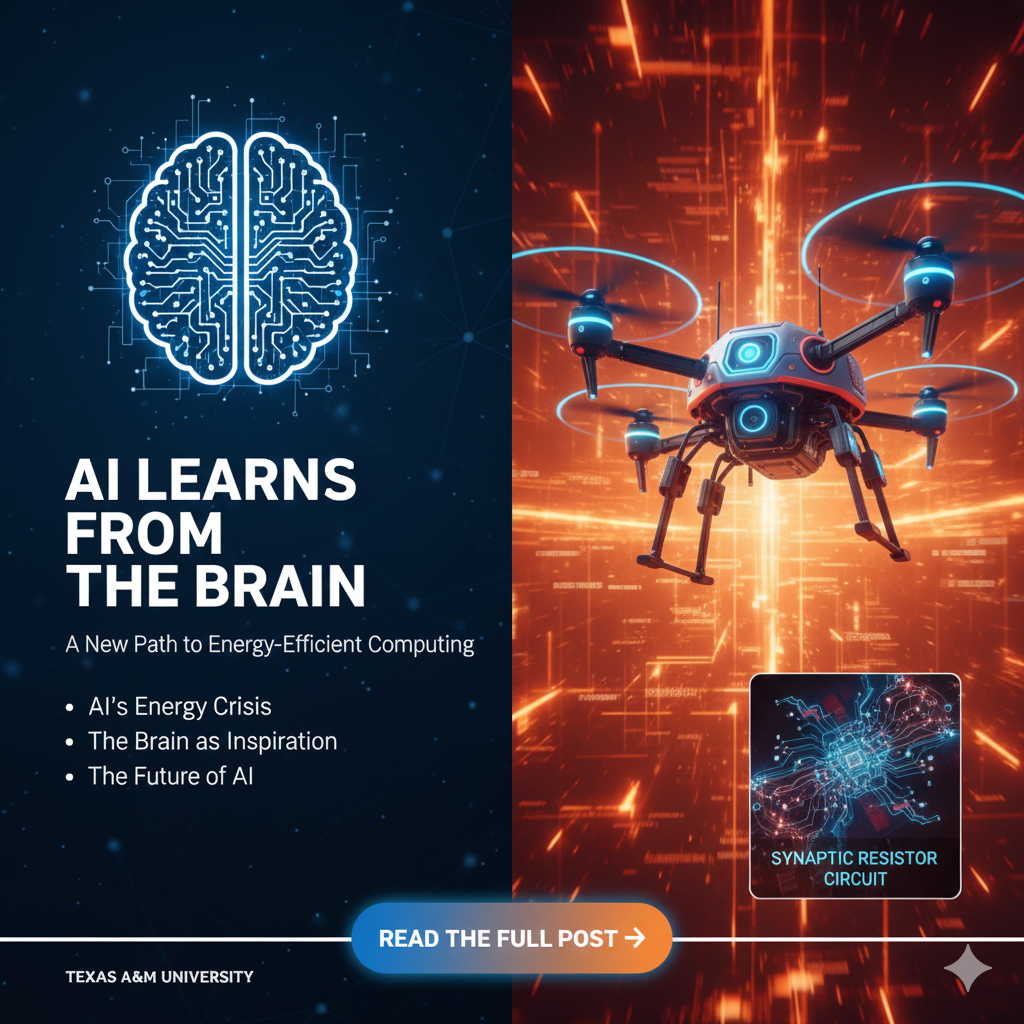
Real-World Demonstration: In a test, the team built a synaptic resistor circuit that powered a drone. Unlike traditional AI systems, the drone didn’t need extensive training before use. It could adapt and navigate a complex environment in real time — faster and with less energy. Why It Matters: The demand for AI is exploding, but its energy consumption threatens to become unsustainable. Some companies even need to build new data centers just to run their models. By rethinking hardware and architecture, Super-Turing AI could:
- Cut energy costs dramatically.
- Reduce environmental impact.
- Allow AI to scale without hitting physical and financial limit.
The Future of AI: Super-Turing AI may represent a turning point in sustainable technology. By modeling machines after the human brain, researchers hope to unlock systems that are smarter, greener, and capable of adapting on the fly. If successful, this innovation could reshape the AI industry — ensuring that the next generation of intelligent systems benefits not just technology companies, but also people and the planet.
Support our research
Independent analysis fueled by you.