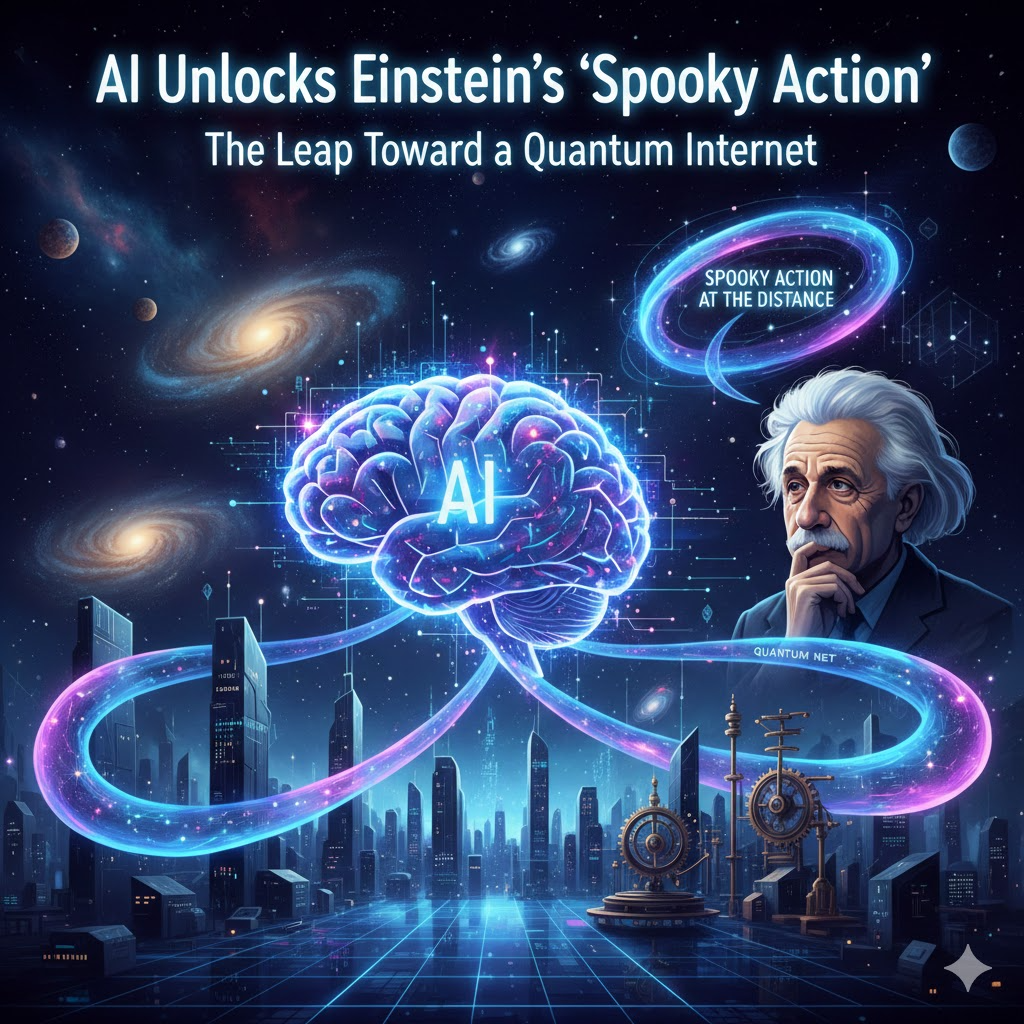

For decades, quantum entanglement — what Einstein famously dismissed as “spooky action at a distance” — has been one of the strangest and most elusive phenomena in physics. It describes the uncanny connection between two particles that remain linked no matter how far apart they are, with a change in one instantly affecting the other. Now, in a groundbreaking development, artificial intelligence has helped physicists discover a simpler way to achieve quantum entanglement. This breakthrough could pave the way for faster progress toward quantum communication systems — the foundation of a future quantum internet.
Why This Matters:
Traditional methods for creating entanglement are technically demanding and often inefficient, requiring highly controlled environments and expensive equipment. By applying AI to the problem, researchers found new strategies that reduce complexity while increasing reliability. This matters because quantum entanglement is the core ingredient for:
- Quantum cryptography – communication systems so secure that even the most advanced hackers can’t break them.
- Quantum networking – linking quantum computers across vast distances, enabling collaboration at scales impossible today.
- Scientific breakthroughs – testing fundamental theories of physics in ways that were previously impractical.
AI’s Role in the Discovery:
The research team used machine learning algorithms to sift through countless possible experimental configurations. Where human intuition might struggle, the AI was able to recognize patterns and identify the most efficient pathways to entanglement. This marks a growing trend in science: AI acting not just as a tool for automation, but as a partner in discovery, revealing solutions that humans alone might never find.
The Road to the Quantum Internet:
Imagine a future where messages, financial transactions, or government communications can be sent over channels impossible to eavesdrop on. That’s the promise of the quantum internet — and this breakthrough brings it a step closer. Of course, significant challenges remain, from building scalable infrastructure to maintaining entanglement over long distances. But with AI accelerating progress, scientists are optimistic that what once seemed like science fiction could become reality sooner than expected.
AI’s Role in the Discovery:
The research team used machine learning algorithms to sift through countless possible experimental configurations. Where human intuition might struggle, the AI was able to recognize patterns and identify the most efficient pathways to entanglement. This marks a growing trend in science: AI acting not just as a tool for automation, but as a partner in discovery, revealing solutions that humans alone might never find.
The Road to the Quantum Internet:
Imagine a future where messages, financial transactions, or government communications can be sent over channels impossible to eavesdrop on. That’s the promise of the quantum internet — and this breakthrough brings it a step closer. Of course, significant challenges remain, from building scalable infrastructure to maintaining entanglement over long distances. But with AI accelerating progress, scientists are optimistic that what once seemed like science fiction could become reality sooner than expected.
Support our research
Independent analysis fueled by you.