
Introduction: Why AI Investment Is Exploding Again:
The artificial intelligence industry entered 2025 with unprecedented momentum—and by early 2026, that momentum has only accelerated. Venture capital firms, sovereign funds, and Big Tech players are pouring historic amounts of capital into AI startups across sectors such as generative AI, AI infrastructure, healthcare AI, cybersecurity, autonomous systems, and large language models (LLMs).
According to industry tracking, 49 U.S.-based AI startups raised funding rounds of $100 million or more in 2024, with several companies closing multiple “mega-rounds.” Seven of those rounds exceeded $1 billion, signaling a structural shift in how AI innovation is being financed.
What’s more striking is that 2025 didn’t slow down. While fewer companies crossed the $1 billion mark individually, more startups raised multiple large rounds, suggesting deeper investor conviction and longer-term bets on AI dominance.
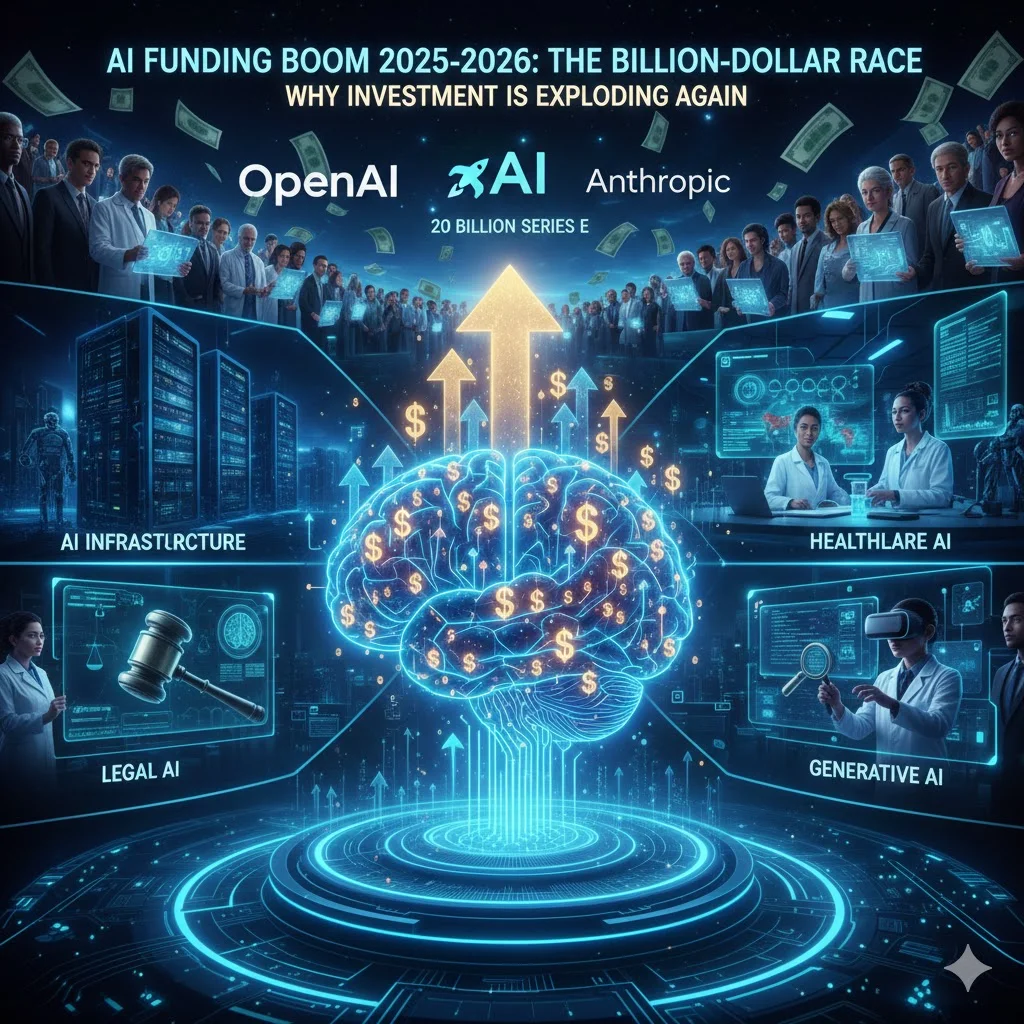
Now, with early 2026 already delivering massive announcements—including Elon Musk’s xAI securing a $20 billion Series E—the question isn’t whether AI funding will continue, but how large this cycle could become.
Key AI Investment Trends Shaping 2025–2026:
- 1. Mega-Rounds Are Becoming the Norm:
AI startups are no longer raising modest Series A or B rounds. Instead, many companies are closing $200M–$500M rounds as early as seed or Series A, especially those working on:
-
AI infrastructure.
-
Foundation models.
-
Advanced reasoning systems.
-
Autonomous AI agents.
-
Industry-specific AI platforms (healthcare, legal, biotech)
Companies like Unconventional AI, Thinking Machines Lab, and Reflection AI raised massive early-stage rounds, redefining what “early-stage” even means in AI.
2. AI Infrastructure Is the Biggest Winner:
One of the clearest signals from 2025 funding data is that AI infrastructure startups are attracting enormous capital. These include companies building:
-
AI compute chips and accelerators.
-
Model deployment platforms.
-
Inference optimization tools.
-
Agent orchestration systems.
-
Open-source AI stacks.
Notable examples include Cerebras Systems,Groq, Baseten, Lambda, Fireworks AI, and Together AI— all of which raised nine-figure rounds.
Investors are betting that the real bottleneck in AI is not ideas—but compute, efficiency, and scalability.
Healthcare, Legal, and Biotech AI Surge Ahead:
Healthcare AI Becomes a Billion-Dollar Category:
Healthcare-focused AI startups were among the most aggressively funded in 2025. Companies like Abridge, Hippocratic AI, Ambience Healthcare, EliseAI, and Tennr raised hundreds of millions to build.
-
AI medical scribes.
-
Clinical decision-support systems.
-
AI-powered diagnostics.
-
Patient communication agents.
This trend reflects growing confidence that AI can reduce healthcare costs, clinician burnout, and diagnostic errors at scale.

Meta's Next Big Bet: This New App Lets You Build Games Simply by Typing a Prompt
Legal AI and Enterprise AI Gain Serious Traction:
Legal-tech AI startups such as Harvey, EvenUp, Eudia, and Sierra attracted substantial funding as enterprises increasingly adopt AI for:
-
Contract analysis.
-
Litigation support.
-
Customer service automation.
-
Compliance workflows.
Enterprise AI platforms like Glean, Uniphore, and Distyl AI also continued to raise large rounds, signaling strong B2B demand.
Support our research
Independent analysis fueled by you.
Generative AI, Media, and Creative Tools Continue Scaling:
Generative AI remains one of the most visible segments of the ecosystem. Startups like:
-
Runway.
-
Fal.
-
Luma AI
-
ElevenLabs
-
You.com
raised large rounds to expand AI-driven video generation, image synthesis, voice cloning, and AI search.
These tools are increasingly being used in YouTube content creation, film production, game development, and marketing, making them highly relevant for creators and digital businesses.
Big Tech, Big Names, Bigger Bets:
OpenAI, Anthropic, and the Foundation Model Arms Race:
At the very top of the funding pyramid, AI research labs are raising historic sums:
-
OpenAI closed a record-breaking $40 billion round, valuing the company at $300 billion.
-
Anthropic raised multiple rounds totaling tens of billions, reaching valuations above $180 billion.
-
Thinking Machines Lab and Reflection AI emerged as serious contenders in the race toward advanced AI reasoning systems.
These investments suggest that AI is now seen as core global infrastructure, comparable to electricity, the internet, or smartphones.
What This Means for 2026 and Beyond:
With xAI’s $20 billion raise and new AI ventures emerging at record speed, all signs point toward another explosive year in 2026. However, the market is also becoming more selective:

Move Over Nvidia: Anthropic and Samsung Team Up to Break the AI Chip Monopoly
-
Investors expect real-world deployment, not just demos.
-
Efficiency, safety, and specialization matter more than hype.
-
Companies with defensible data, compute advantages, or regulatory alignment will win.
AI funding is evolving from speculative enthusiasm into long-term industrial investment.
Final Thoughts: The AI Gold Rush Is Far From Over:
The scale of AI investment in 2025–2026 confirms one thing clearly:
artificial intelligence is no longer a trend—it’s a foundational technology reshaping every industry.
From healthcare and law to infrastructure and creative media, AI startups are attracting capital at levels previously reserved for governments and mega-corporations.
- For founders, investors, content creators, and businesses alike, understanding these funding trends isn’t optional—it’s essential for staying competitive in the AI-driven future.