
AI Filmmaking Tools 2026: How Independent Filmmakers Are Using Generative AI to Tell Better Stories (Without Selling Out)
Google Flow Sessions: Indie Filmmakers Meet Generative AI:
Late last year, ten independent filmmakers gathered at Soho House New York for something unusual: a screening of short films made entirely with AI tools. These weren't tech demos or corporate showcases. They were personal, crafted, and — surprisingly — emotionally resonant.
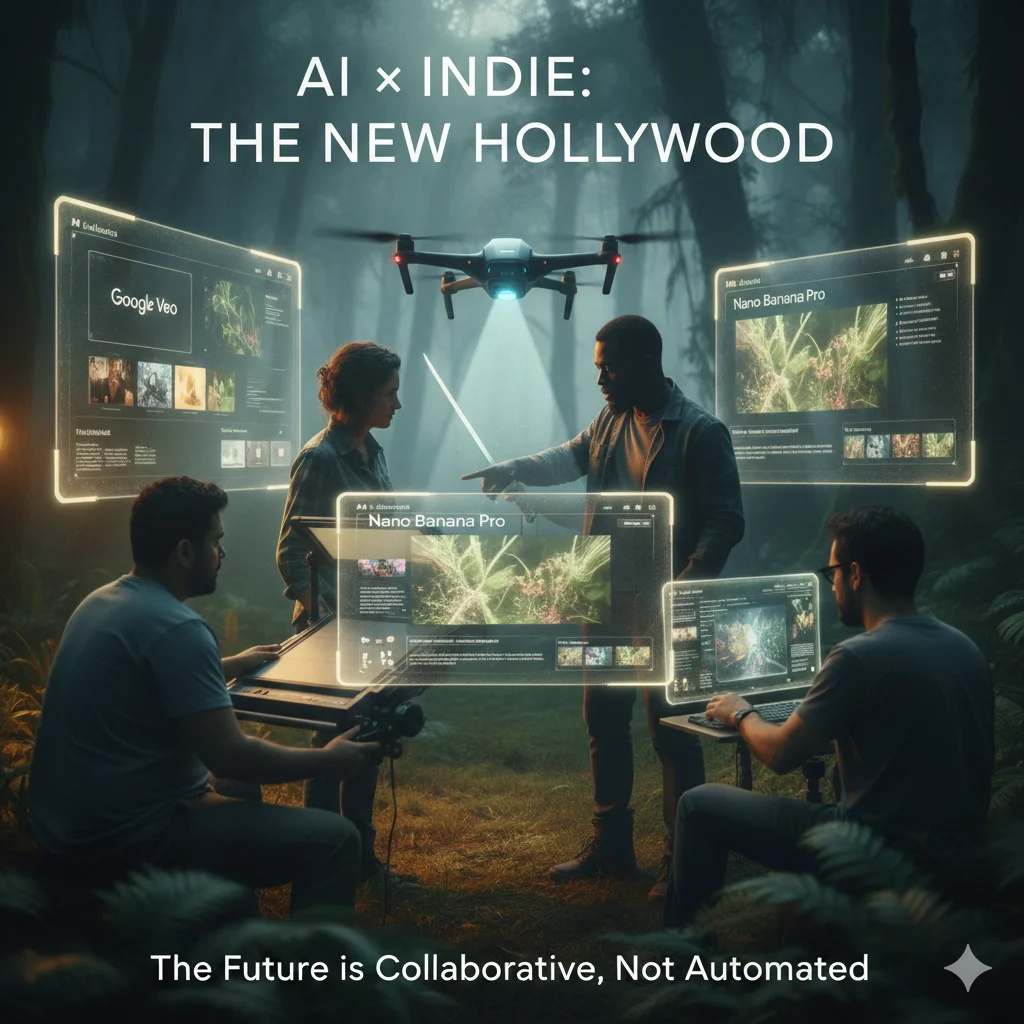
The filmmakers had participated in Google Flow Sessions, a five-week creative cohort that gave them access to Google's suite of AI filmmaking tools, including Gemini, image generator Nano Banana Pro, and the AI video generator Veo. The results ranged widely in style and subject matter, but shared one thing in common: none of them felt like "AI slop."
One of the standout films was "Murmuray" by Filipino-American filmmaker Brad Tangonan — a dreamlike short about a man visiting a childhood shrine in rural Hawai'i who gets transported to a misty forest, where he encounters a sword-wielding woman in a clay mask who turns out to be his deceased mother. The film was shot through with tactile nature visuals and desaturated, atmospheric lighting. You'd never guess it was AI-generated.
"I see all of these tools, whether it be a camera you can pick up or generative AI, as ways for an artist to express what they have in their mind," Tangonan said after the screening.
Is AI-Generated Film Just "Slop"? The Debate Dividing Hollywood:
The use of generative AI in film production has attracted fierce opposition from some of cinema's most celebrated voices.
Guillermo del Toro declared he would rather die than use generative AI in a film. James Cameron, in a recent CBS interview, called the idea of generating actors and emotions with prompts "horrifying," arguing that AI can only produce a blended average of everything humans have ever created — nothing genuinely new. Werner Herzog went further, saying AI-generated films "have no soul" and that they represent nothing more than a lowest common denominator.
These are serious arguments from serious people. And they raise a legitimate question at the heart of the AI vs. human creativity debate: Can a tool that learns from existing human work ever produce something that reflects a specific, lived, individual experience?
The filmmakers at the Google Flow Sessions think it can — but only if the human artist stays firmly in the driver's seat.
"AI is a facilitator," said Tangonan. "I'm still making all the creative decisions. When people see 'AI slop' online, it's a lot of lowest common denominator stuff. And, yeah, if you hand over the keys to AI, that's what you're going to get. But if you have a voice and a creative perspective and a style, then you're going to get something different."
How These Filmmakers Actually Used AI (It's Not What You Think)
The most important misconception about AI filmmaking tools is that they replace human creative work. For the filmmakers at Google Flow Sessions, the reality was far more nuanced.
Tangonan wrote the script for "Murmuray" entirely without AI. He assembled a visual shot list, gathered reference images, and only then used Nano Banana Pro to generate images that matched his pre-existing aesthetic. Those images became the foundation for video generation — AI as a production tool, not a creative substitute.
Keenan MacWilliam, whose short film "Mimesis" used AI to animate her own personal collection of scanned plants and marine life, was equally deliberate. MacWilliam, who travels everywhere with a flatbed scanner, trained AI models exclusively on her own dataset to ensure the visual output was an authentic extension of her style — not a remix of other artists' work.
"I made a choice to avoid using AI for anything that I could have shot with a camera or ask my collaborators to animate," MacWilliam told TechCrunch. "My goal was to unlock new forms of expression for my established themes and style, not to replace the roles of the people who I like to work with."
This disciplined, intentional approach to AI-assisted filmmaking is what separates meaningful work from automated content.
The Real Cost: Efficiency, Loneliness, and Lost Collaboration:
Here's the paradox that every indie filmmaker experimenting with AI eventually runs into: the more you can do alone, the more alone you are.
For independent creators working with limited budgets, AI video generation tools offer genuine liberation. A flying chase sequence through a misty forest — the kind of shot that would normally require expensive VFX or complex on-set rigging — becomes achievable on a short film budget. Cameron himself acknowledged in his CBS interview that cheaper VFX could open the door to more ambitious sci-fi and fantasy films beyond the realm of established IP.

Meta's Next Big Bet: This New App Lets You Build Games Simply by Typing a Prompt
But the filmmakers at Google Flow were also quick to name what gets lost. When one person can generate sets, lighting, costumes, and visual effects from a single workstation, the natural result is isolation. Directors found themselves suddenly playing roles they never trained for — set designer, costumer, lighting director — and pulling focus from the actual creative work they cared about.
"I know I'm a one-man band, and I just made all this by myself… but that should never be the way that anyone tells a story or makes a film," said filmmaker Hal Watmough, whose short "You've Been Here Before" blended hyperreal and cartoonish visual styles. "It should be a collaborative process because the more people that are involved, the more accessible it is by everyone and the more it reaches and connects with people."
MacWilliam put it even more plainly:"I think efficiency in general is not the best friend of creativity.
The Ethical Questions AI Filmmaking Can't Ignore:
Beyond creativity and collaboration, the rise of AI video tools raises urgent ethical questions that the industry is only beginning to grapple with.
Copyright and training data remain deeply contested. AI video startup Runway has reportedly scraped thousands of hours of YouTube videos and copyrighted studio content to train its models. Google, OpenAI, and Luma AI have faced similar questions. Some tools — like Moonvalley's Marey — are taking a different approach, training only on openly licensed content, but these remain the exception.
Then there are the environmental costs of AI video generation. Some estimates suggest generating just seconds of AI video can consume as much electricity as streaming content for hours — a sobering figure as the industry scales.
Support our research
Independent analysis fueled by you.
And then there's the looming question of AI-generated actors. Startups like Luma AI — which raised a $900 million Series C in November 2024 — are building tools that allow filmmakers to shoot an actor's performance once and then use AI to change the character, costume, and entire set around them. The technology to generate synthetic performances is improving rapidly.
The filmmakers at Google Flow said they'd rather work with real actors. But most acknowledged AI-generated performances are likely an inevitability for smaller studios.
If Artists Don't Define AI in Film, Studios Will:
Perhaps the most urgent message from the filmmakers at Google Flow Sessions isn't about any specific tool or technique — it's about who gets to shape how AI is used in the creative industries.
Right now, the AI film industry is flush with venture capital and moving fast. Companies like Runway, OpenAI Sora, Kling AI, Luma AI, and Higgsfield are racing to move from novelty to professional-grade post-production tools. Studios, already squeezed by rising production costs and the streaming pivot, are watching closely — and not always with artists' interests at heart.
"The film industry is floundering because people aren't innovating and everything costs too much. We need tools like this for it to survive," said Watmough. "I think it's essential that people engage with it because if we don't, then it's going to become something we don't recognize, and that's not sustainable."
Tangonan echoes the sentiment: "Whenever I do post things online, a lot of my filmmaking colleagues have a very knee-jerk reaction to it that we should all hold the line and not use any of these tools. I just don't agree with that."
The artists who refuse to engage risk ceding the conversation to studios optimizing for efficiency over expression. The artists who engage thoughtfully — transparently, ethically, and with a firm creative vision — are the ones most likely to shape what AI-assisted filmmaking actually looks like as these tools mature.
The question isn't whether AI belongs in the filmmaker's toolkit. It's already there. The question is who's holding it, and what they're choosing to make.
Move Over Nvidia: Anthropic and Samsung Team Up to Break the AI Chip Monopoly
Key Takeaways for Filmmakers Considering AI Tools:
-
AI doesn't replace creative vision — it amplifies it, for better or worse. Use it intentionally.
-
The best AI-assisted films start with a human script, a human aesthetic, and human-defined goals.
-
Collaboration still matters — the efficiency gains of working alone come at a real creative cost.
-
Transparency is essential — disclose AI use, ask ethical questions, and engage publicly with the conversation.
-
If creatives don't define the norms, corporations will — and those norms will prioritize scale over soul.