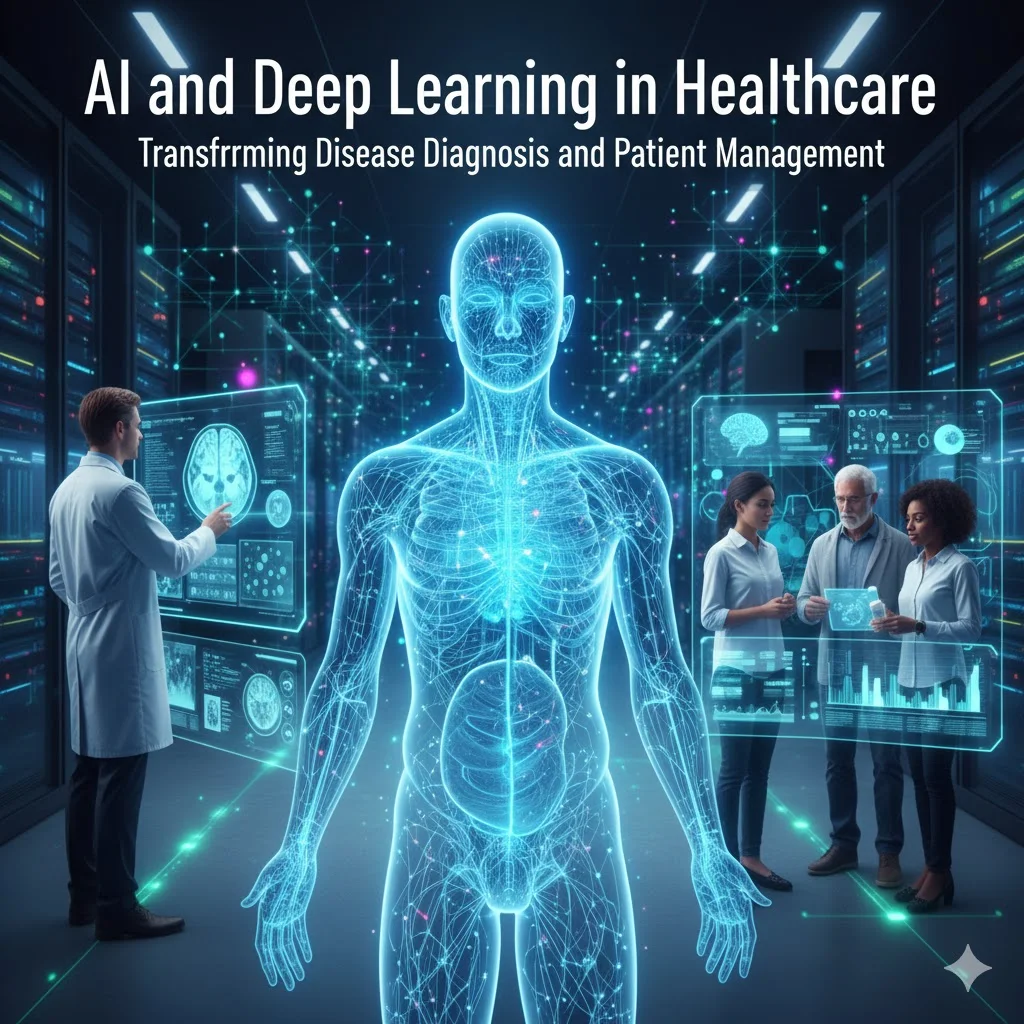

Artificial Intelligence (AI) and Deep Learning (DL) are rapidly reshaping the healthcare
landscape, offering innovative solutions for disease diagnosis, treatment planning, and long-term patient management. As healthcare systems generate massive volumes of complex data—ranging from medical imaging and genomics to electronic health records (EHRs) and wearable device outputs—traditional analytical methods are increasingly inadequate. AI-powered technologies are now essential for extracting meaningful insights, improving clinical accuracy, and enabling data-driven healthcare delivery.
This article explores how AI and deep learning are revolutionizing healthcare, highlights key applications, and discusses challenges and future directions in AI-driven disease diagnosis and management.
The Growing Role of AI and Deep Learning in Healthcare:
AI refers to computational systems capable of performing tasks that typically require human intelligence, such as learning, reasoning, and decision-making. Deep learning, a specialized subset of AI, uses multi-layered neural networks to analyze highly complex and non-linear datasets—making it particularly suitable for healthcare applications.
The rapid digitalization of healthcareh created an urgent need for intelligent systems that can analyze large-scale biomedical data efficiently and accurately. AI and deep learning are now central to precision medicine, predictive analytics, and personalized healthcare solutions.
AI-Driven Disease Diagnosis: Improving Accuracy and Early Detection:
One of the most impactful applications of AI in healthcare is disease diagnosis. Deep learning models have demonstrated exceptional performance in analyzing medical images such as X-rays, CT scans, MRIs, ultrasound images, and digital pathology slides. AI-powered diagnostic tools are currently being used to:
- Detect cancers at early stages.
- Identify cardiovascular abnormalities.
- Diagnose neurological disorders such as Alzheimer’s and Parkinson’s disease.
- Analyze retinal images for diabetic retinopathy.
- Detect lung diseases, including pneumonia and COVID-19.
By identifying subtle patterns that may go unnoticed by the human eye, AI systems support clinicians in making faster, more accurate, and more consistent diagnoses—ultimately improving patient outcomes and reducing diagnostic errors.
Personalized Treatment Planning and Clinical Decision Support:
Beyond diagnosis, AI and deep learning play a critical role in treatment planning and clinical decision support. AI algorithms analyze patient-specific data—including medical history, lab results, genetic profiles, and lifestyle factors—to recommend personalized treatment strategies.
Clinical decision support systems powered by AI help healthcare professionals:
- Select optimal treatment pathways:
- Predict patient responses to therapies.
- Reduce adverse drug interactions.
- Improve evidence-based decision-making.
In oncology, cardiology, and chronic disease management, AI-driven personalization is transforming care delivery by aligning treatments more closely with individual patient needs.
AI in Patient Monitoring and Disease Management:
The integration of AI with wearable devices and remote monitoring technologies has opened new possibilities for continuous patient care. Smartwatches, biosensors, and mobile health applications generate real-time health data that AI systems can analyze to detect early warning signs of disease progression.
AI-enabled patient management systems are particularly effective for:
- Diabetes and hypertension monitoring.
- Cardiac risk prediction.
- Post-operative recovery tracking.
- Elderly and home-based patient care.
These technologies support preventive healthcare, reduce hospital readmissions, and empower patients to actively participate in managing their health.
Challenges, Ethics, and Trust in AI-Based Healthcare:
Despite its transformative potential, AI adoption in healthcare faces several challenges. Data privacy and cybersecurity remain major concerns, as healthcare data is highly sensitive. Ensuring compliance with ethical standards and data protection regulations is critical.
Another challenge is algorithmic bias. AI models trained on non-diverse or incomplete datasets may produce inaccurate or inequitable outcomes. Transparency, explainable AI, and rigorous clinical validation are essential to building trust among healthcare professionals and patients alike.
Importantly, AI should be viewed as an assistive technology—not a replacement for clinicians. Human expertise, empathy, and ethical judgment remain central to high-quality healthcare.
Future Directions of AI and Deep Learning in Healthcare:
The future of AI in healthcare is highly promising. Emerging innovations such as explainable AI, federated learning, and multimodal data integration are expected to enhance model transparency, data security, and scalability.
As AI continues to evolve, it will play a vital role in:
- Precision medicine.
- Population health management.
- Predictive disease modeling.
- Sustainable and efficient healthcare systems.
AI and deep learning are no longer experimental technologies—they are becoming foundational pillars of modern healthcare delivery.