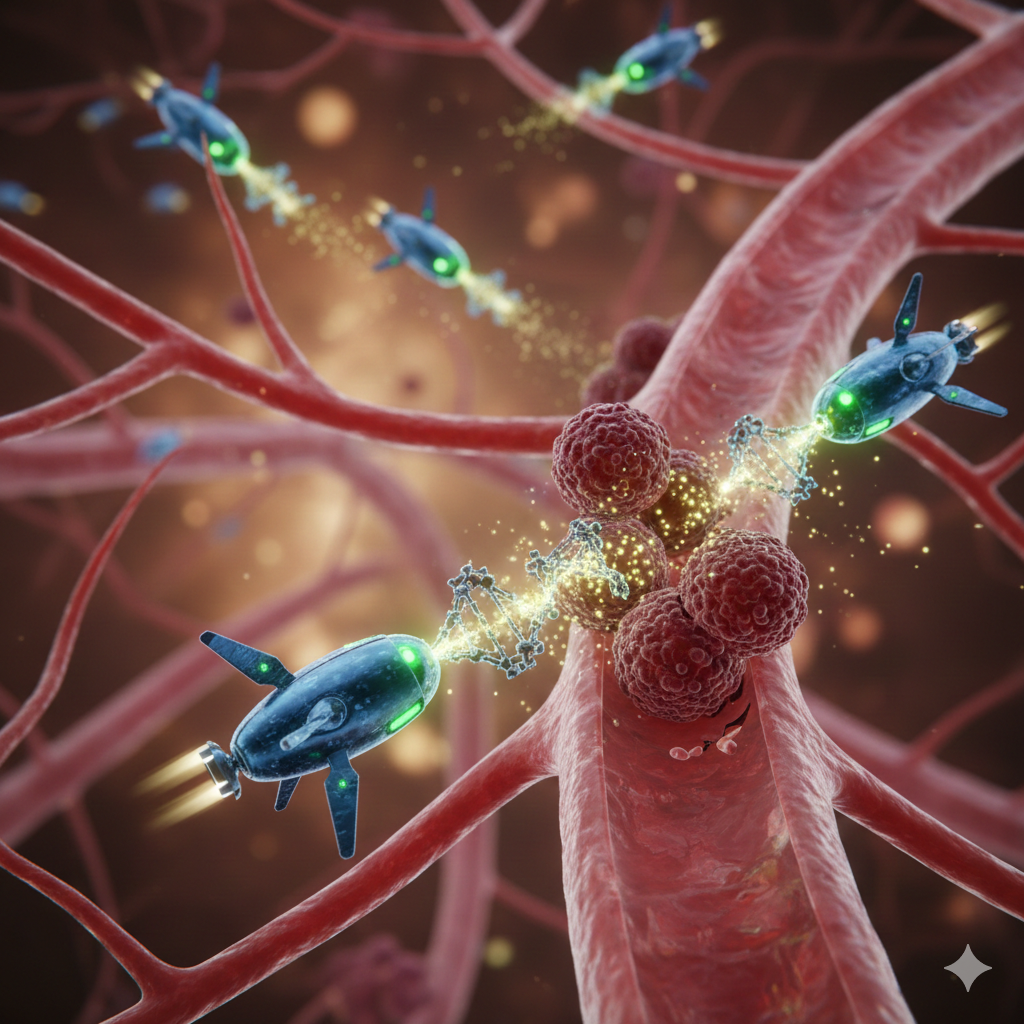

Call it science fiction turning into reality.
For decades, researchers have dreamed of tiny robots that could move inside our bodies, deliver medicine exactly where it’s needed, and fight deadly diseases like cancer without the painful side effects of conventional treatments. Today, that dream is edging closer to reality.
The Rise of Medical Nanorobots:
Scientists at Tsinghua University in China have recently developed microscopic robots that can navigate through the human body. Powered by magnetic fields, these bots are capable of moving with precision to deliver drugs, fight harmful bacteria, and even repair damaged tissues. Each robot is smaller than a strand of hair, yet fast enough to travel 4.6 times its body length per second—making it ideal for reaching hard-to-access areas inside the body. What makes them even more exciting is their design. Built from biodegradable materials, these robots naturally dissolve after completing their mission, ensuring no harmful residues remain. This approach could revolutionize treatments by directly targeting diseased cells while sparing healthy ones.
Nanobots vs. Cancer:
Researchers from China’s National Center for Nanoscience and Technology (NCNT) and Arizona State University have taken this idea further. They built DNA-based nanorobots designed to shrink tumors in mice. These bots were made from tiny DNA tubes containing a blood-clotting drug. On the outside, a DNA molecule acted like a “GPS,” attaching only to proteins found in tumors. Once in position, the DNA tube unrolled, releasing the drug directly into the cancer site. The results? Tumors shrank—without affecting healthy tissues. This is a huge breakthrough because most cancer treatments today, like chemotherapy, damage both good and bad cells, leading to severe side effects. These nanorobots promise a future of cancer therapy without side effects.
Beyond Cancer: A New Era of Medicine:
The possibilities don’t stop there. Nanorobots could one day monitor diseases, repair tissues, remove plaques from blood vessels, or even act as tiny wireless surgical tools that perform operations without cutting the body open. Imagine surgeons guiding microbots through your bloodstream with magnets to perform a biopsy or deliver targeted medicine—without a single external incision. At the University of Toronto, researchers are working on magnetic microbots that can grasp tissues and collect samples. Similarly, a Swiss team at ETH Zurich has already tested magnetically guided bots in a rabbit’s eye, successfully puncturing a blood vessel with incredible precision. Other teams are experimenting with micromotors made from materials like gold, magnesium, and carbon. These tiny engines can propel themselves using fuels naturally found in the body, such as stomach acid or water, making them ideal for targeted drug delivery.
Nature as Inspiration:
Some researchers are even turning to nature’s own tiny machines. At the Leibniz Institute in Germany, sperm cells were loaded with cancer drugs and guided with magnets to destroy mini cervical cancer tumors in lab tests—killing 87% of cancer cells in just three days. Likewise, Canadian scientists at Polytechnique Montréal hijacked bacteria that naturally swim along magnetic fields, steering them toward tumors in mice for drug delivery. These bio-hybrid approaches use living cells as propulsion systems while science provides control and targeting. It’s a clever shortcut while we develop more advanced fully artificial nanobots.
A Fantastic Voyage Becomes Reality:
The concept of miniature machines inside our bodies dates back to the 1966 sci-fi classic Fantastic Voyage, where a submarine crew was shrunk and injected into a scientist’s bloodstream. While we can’t shrink humans (yet!), the vision of navigating inside the body with tiny tools is finally coming true. **From cancer treatment to infection control, **nanobots hold the promise of safer, faster, and more effective healthcare. While the technology is still in its early stages, one thing is clear: the future of medicine might not be in pills or surgeries, but in armies of microscopic robots working silently inside us.
Support our research
Independent analysis fueled by you.