
Sam Altman Testifies Against Elon Musk: OpenAI Trial Reveals "Hair-Raising" Moments, Control Battles, and a Dynasty Clause:
Inside the OpenAI vs. Musk lawsuit — what Altman's courtroom testimony reveals about power, safety, and the soul of the world's most valuable AI company.
Introduction: The Trial That Could Reshape the Future of AI:
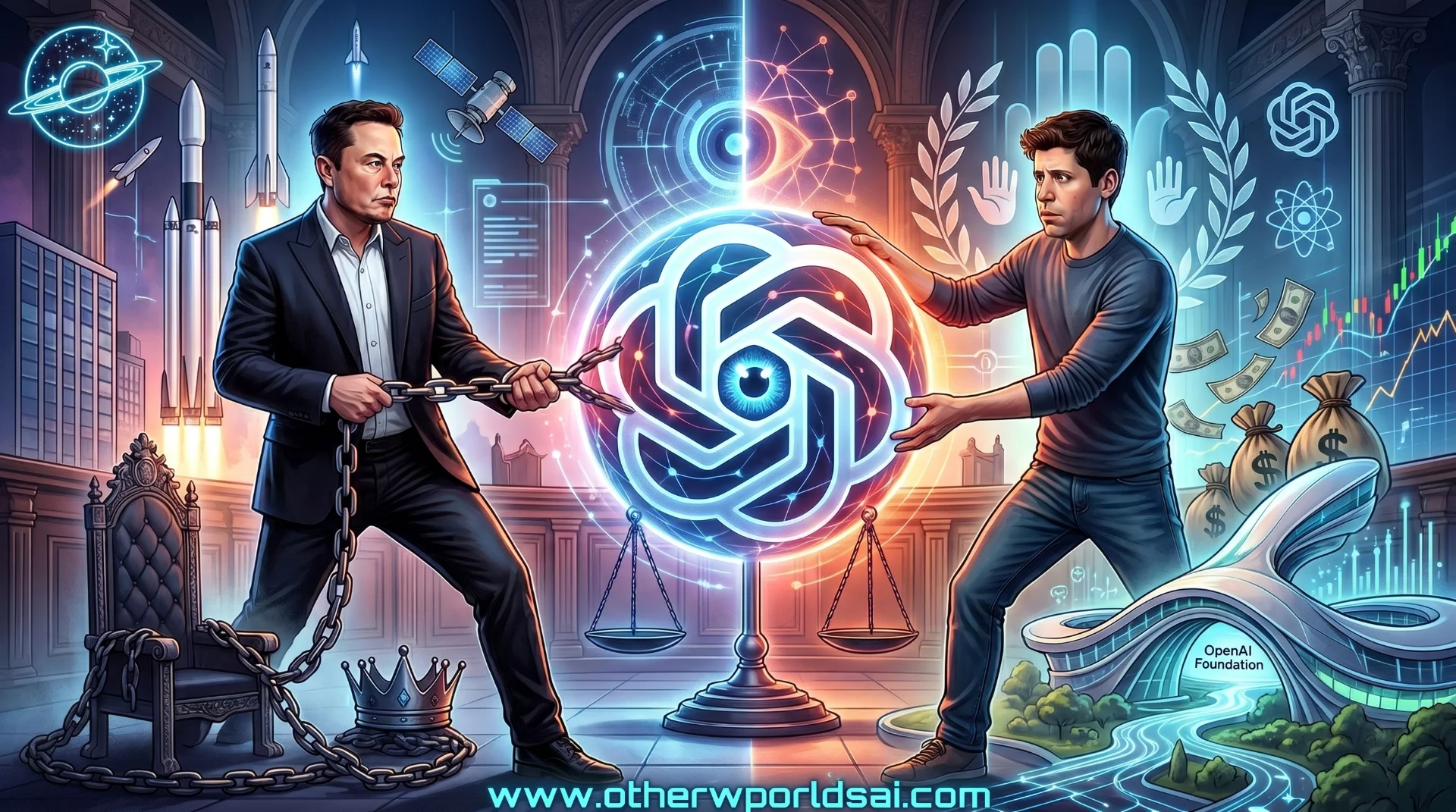
The courtroom showdown that Silicon Valley has been anticipating for months finally arrived — and it did not disappoint. OpenAI CEO Sam Altman took the stand to testify in the high-stakes lawsuit filed by Elon Musk, his former co-founder and one of OpenAI's earliest backers. At the heart of the OpenAI vs. Musk lawsuit is a fundamental question: did OpenAI's founders betray their original nonprofit mission when they launched a for-profit subsidiary — and in doing so, did they "steal a charity" as Musk's legal team alleges? Altman's answers, delivered under oath, paint a dramatically different picture.
"We Created One of the Largest Charities in the World": Altman Fires Back:
Altman was barely seated before Musk's attorneys hit him with the lawsuit's most incendiary framing — that OpenAI's co-founders "stole a charity" by pivoting the nonprofit toward commercial operations. Altman paused for several seconds before responding. "It feels difficult to even wrap my head around that framing," he said. "We created one of the largest charities in the world.
This foundation is doing incredible work and will do much more." The OpenAI foundation now holds assets on the order of $200 billion — a figure that Musk's legal team has used to underscore how dramatically the organization's scale and commercial ambition have grown.
However, Musk's attorneys also pointed out that the foundation had no full-time employees until earlier this year. OpenAI board chair Bret Taylor addressed that directly, explaining that staffing the foundation was simply a matter of converting OpenAI equity to cash — a process completed through the company's most recent 2025 corporate restructuring.
The Hair-Raising Moment: Musk's Plan to Pass OpenAI to His Children:
The most explosive testimony of the morning came when Altman described a defining moment in 2017 — a pivotal period when OpenAI's founders were debating how to structure a for-profit entity to secure the enormous funding their AI research required. During those internal debates, Altman testified that Musk's "specific plans on safety made me worry."
The moment that left the deepest impression on Altman was a single question posed to Musk during those early discussions: what would happen to OpenAI's for-profit structure if Musk died while still in control? According to Altman, Musk's answer was chilling in its implication: "Maybe OpenAI should pass to my children." Altman described this as a "particularly hair-raising moment" — and a direct contradiction of OpenAI's founding principle that advanced AI must never be concentrated in the hands of a single person or entity.
With his background running Y Combinator, one of the world's most influential startup accelerators, Altman drew on years of observing founder behavior to explain his concern. He told the court that in his experience, "founders who had control usually did not give it up" — and Musk's apparent desire to retain and potentially dynastically inherit control over an AI safety organization was fundamentally at odds with everything OpenAI was supposed to stand for.
Musk's Management Style: "He Did Not Know How to Run a Good Research Lab":
Beyond the question of control and succession, Altman offered candid — and damaging — testimony about Musk's management approach inside OpenAI. While crediting Musk's track record at Tesla and SpaceX as an engineering and manufacturing leader, Altman argued those instincts were deeply misaligned with what a world-class AI research organization actually requires.
"I don't think Mr. Musk understood how to run a good research lab," Altman testified plainly. He described one particularly harmful episode in which Musk demanded that co-founders Greg Brockman and Ilya Sutskever compile a ranked list of researchers, evaluate their individual accomplishments, and then — in Altman's words — "take a chainsaw through a bunch." The fallout was significant: "That did huge damage for a long time to the culture of the organization," Altman said, describing how key researchers were demotivated by the exercise.
In framing his own role, Altman positioned himself as a defender of the researchers who were actually building OpenAI — particularly Brockman and Sutskever, who were effectively running the company day-to-day while both Musk and Altman were occupied with other commitments. He described his actions as protecting the "sweat equity" of the people who had given the most to make OpenAI what it became.
After the Split: Musk Leaves, But Altman Keeps the Lines Open:
Despite the tensions that ultimately drove Musk off OpenAI's board, Altman testified that he maintained a working relationship with Musk for years after the departure — continuing to share updates on OpenAI's progress and even seeking Musk's guidance and financial backing. OpenAI's legal team used this to undercut Musk's current claims, noting that Musk was kept fully informed and invited to participate in the very investments he now argues corrupted OpenAI's nonprofit mission.
Altman's most humanizing anecdote came from a 2018 discussion about Microsoft's investment into OpenAI — a deal that would prove transformative for the company's trajectory and eventually help make it the most valuable AI startup in history. Altman recalled that "unlike a lot of meetings with Mr. Musk, this was a good vibes meeting," during which Musk spent much of the time "showing us memes on his phone." It was a rare moment of levity in an otherwise charged legal proceeding — and a reminder that the story of OpenAI is also, at its core, a story about a friendship that broke.
Why the OpenAI Trial Matters: AI Safety, Corporate Power, and Accountability:
The stakes of the Musk vs. OpenAI lawsuit extend far beyond the two men at its center. At its core, the OpenAI corporate restructuring legal battle is forcing the courts — and the public — to grapple with a question that will define the AI era: who gets to control the most powerful technology ever built, and what obligations come with that power?
Musk's legal team argues that the for-profit transformation of OpenAI represents a fundamental betrayal of a public trust — that a charity built to benefit all of humanity was quietly converted into a commercial engine serving investors and insiders. Altman's testimony counters that the nonprofit mission is not only intact but flourishing — that the foundation's $200 billion in assets is proof of what responsible AI commercialization can achieve when paired with a genuine safety commitment.
For observers of the broader AI industry, the trial offers a rare window into the earliest, most chaotic chapter of OpenAI's history — and the personalities, power struggles, and philosophical disagreements that shaped what is now the world's most consequential AI company. Whether the court ultimately sides with Musk's vision of AI accountability or Altman's defense of OpenAI's nonprofit evolution, the outcome will set a precedent that every major AI lab will be watching closely.
Conclusion: A Founding Myth on Trial:
Sam Altman's testimony paints a portrait of OpenAI's origins that is messy, human, and deeply contested — a far cry from the clean founding narrative either side would prefer. There were researchers demoralized by stack-ranking exercises. There were hypothetical succession plans involving billionaire heirs. There were good-vibes meetings with memes and existential debates about who deserves to hold the keys to artificial general intelligence.
What emerges from the courtroom is less a story about good versus evil, and more a story about what happens when visionary ambition, enormous capital, and genuinely high stakes collide without adequate structure.
Meta's Next Big Bet: This New App Lets You Build Games Simply by Typing a Prompt
The Elon Musk OpenAI lawsuit may ultimately be decided on narrow legal grounds — but the questions it raises about AI governance, nonprofit accountability, and the concentration of technological power will outlast the verdict by decades.
Support our research
Independent analysis fueled by you.