
America's AI Trust Crisis: Most Americans Use AI — But Barely Trust It, Fear It's Stealing Their Jobs, and 15% Would Accept a Robot Boss:
A landmark Quinnipiac University poll reveals the full, contradictory picture of how Americans really feel about artificial intelligence in 2026 — and the numbers are more alarming than the headlines suggest.
Introduction: A Nation of Reluctant AI Users:
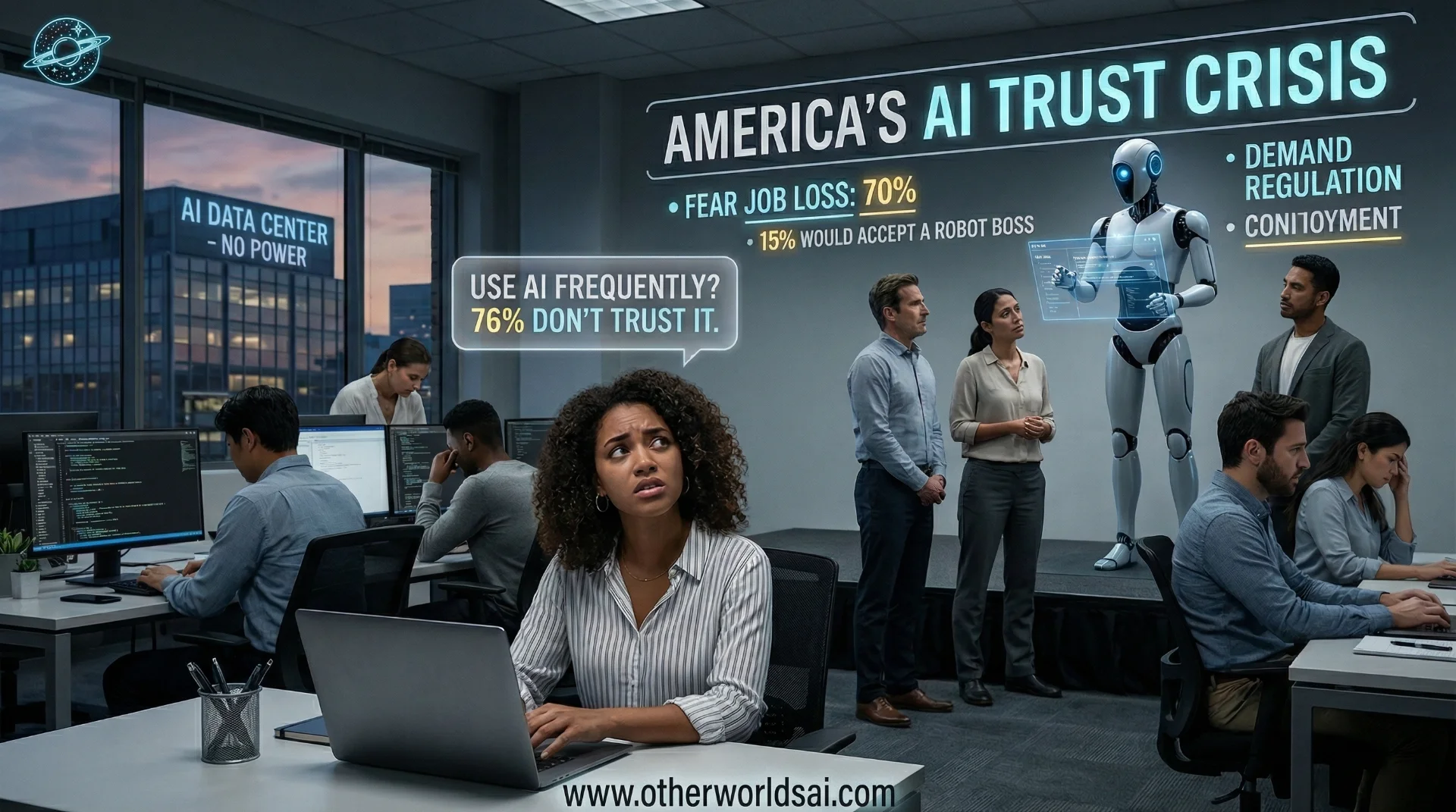
Would you trade your manager for a chatbot? A growing — if still minority — number of Americans are saying yes, and that is just one of many extraordinary findings from a sweeping new national poll. According to a Quinnipiac University poll published Monday, March 2026, 15% of Americans say they would be willing to have a job where their direct supervisor was an AI program that assigned tasks and set schedules. Quinnipiac surveyed 1,397 adults across the United States between March 19 and 23, 2026, probing attitudes on AI adoption, trust, and job fears.
The results paint a portrait of a country caught in a profound contradiction. Americans are using AI more than ever before — but trusting it less. They are adopting it in their daily lives — but dreading the world it is building. They fear it will devastate the job market — but somehow struggle to picture themselves personally on the losing side. And they want it regulated — but feel both government and industry are failing to do so.
Together, the two Quinnipiac studies released this week form the most comprehensive snapshot yet of the American public's fractured, fearful, and deeply ambivalent relationship with artificial intelligence. What emerges is not a story of rejection — Americans are not turning away from AI. It is a story of adoption under duress: a population being swept along by a technological tide it neither fully understands nor fully trusts, and which it increasingly suspects may be working against its interests.
The AI Boss Is Already Here: Meet the Great Flattening:
The idea of an AI supervisor may sound like science fiction, but the corporate world has been quietly making it a reality for years. Companies like Workday have already launched AI agents capable of filing and approving expense reports on employees' behalf — automating decisions that once required a human manager's judgment. Amazon has gone further still, deploying new AI workflows to replace core middle management responsibilities and laying off thousands of managers in the process.
Perhaps the most striking symbol of this trend comes from inside Uber, where engineers built an AI model of CEO Dara Khosrowshahi to field pitches before meetings with the real executive. The implications are staggering: not just AI as administrator, but AI as a proxy for executive judgment and decision-making at the highest levels of a billion-dollar company.
Across corporate America, this phenomenon is now being described as "The Great Flattening" — a systematic dismantling of management layers as AI takes over the coordination, scheduling, approval, and oversight functions that once justified entire tiers of middle management. Industry analysts have begun speculating that we may soon witness entire billion-dollar companies run by a single person, supported entirely by automated employees and AI executives. The age of the human org chart may be closer to its end than most workers realize.
Against this backdrop, the poll's finding that 15% of Americans would accept an AI boss takes on a different character. For some respondents, this may reflect genuine openness to AI-driven management. For others, it may reflect a more resigned pragmatism: if AI management is already spreading through corporate structures whether workers want it or not, willingness to work under it may be less a preference than an acknowledgment of an inevitable reality.
Adopting AI Without Trusting It: America's Defining Contradiction:
The single most striking finding from the Quinnipiac research is not any individual statistic— it is the yawning gap between AI use and AI trust. Of the nearly 1,400 Americans surveyed, a staggering 76% say they trust AI rarely or only sometimes. Just 21% trust AI-generated information most or almost all of the time. Yet despite this near-universal skepticism, AI adoption continues to climb: only 27% of respondents said they have never used AI tools, down from 33% in April 2025.
The academic experts who designed the survey were themselves struck by the scale of this contradiction. Chetan Jaiswal, a computer science professor at Quinnipiac, put it plainly: "The contradiction between use and trust of AI is striking. Fifty-one percent say they use AI for research, and many also use it for writing, work, and data analysis. But only 21 percent trust AI-generated information most or almost all of the time. Americans are clearly adopting AI, but they are doing so with deep hesitation, not deep trust." — Chetan Jaiswal, Computer Science Professor, Quinnipiac University
What explains this paradox? Part of the answer likely lies in the structural reality of modern work and education. AI tools have become sufficiently embedded in research, writing, and data analysis workflows that avoiding them entirely carries a competitive cost. Workers and students who refuse to use AI risk falling behind peers who do. The result is adoption driven not by enthusiasm or trust, but by necessity — a pattern that may help explain why rising familiarity with AI tools has not translated into rising confidence in their outputs.
Fear, Dread, and the Mood of a Nation: What Americans Really Feel About AI:
The emotional landscape of American attitudes toward AI in 2026 is dominated not by excitement or optimism, but by anxiety and dread. The poll found that a mere 6% of Americans described themselves as "very excited" about AI — a number so small it barely registers. Meanwhile, 62% said they were either not so excited or not at all excited. The numbers are almost perfectly inverted when the question turns to concern: 80% of Americans are either very concerned or somewhat concerned about AI, with millennials and baby boomers leading the worry rankings, and Gen Z following closely behind.
The pessimism is deepening, not fading. More Americans hold negative views about AI today than in last year's survey — a trajectory that may reflect the cumulative weight of a difficult twelve months: Big Tech layoffs attributed to AI-driven restructuring, high-profile cases of serious psychological harm linked to AI chatbot interactions, and the growing controversy over energy-hungry data centers straining local power grids. A full 55% of Americans say AI will do more harm than good in their day-to-day lives, while only a third believe it will do more good than harm.
Community-level opposition to AI infrastructure has hardened alongside these broader anxieties. A striking 65% of Americans say they would not want an AI data center built in their community — citing high electricity costs and excessive water consumption as their primary objections. This localized resistance adds a new dimension to the AI trust crisis: it is no longer purely abstract. Americans are increasingly unwilling to absorb the physical and environmental costs of AI infrastructure in their own backyards.
The Jobs Crisis: 70% Believe AI Will Shrink the Labor Market:
On no issue does the American public speak with more unified concern than the impact of AI on employment. A decisive 70% of poll respondents believe advances in AI will lead to a decrease in job opportunities — up sharply from 56% who held the same view in last year's survey. At the other end of the spectrum, a strikingly small 7% believe AI will create more job opportunities, down from 13% last year. The trend line is unmistakable: American optimism about AI's role in job creation is collapsing.
Generation Z — the cohort born between 1997 and 2008 and the most digitally fluent generation in history — is simultaneously the most familiar with AI tools and the most pessimistic about their labor market implications. A remarkable 81% of Gen Z respondents foresee a decrease in job opportunities as a result of AI advancement. As Professor Tamilla Triantoro of Quinnipiac's business analytics department observed:
"Younger Americans report the highest familiarity with AI tools, but they are also the least optimistic about the labor market. AI fluency and optimism here are moving in opposite directions." — Tamilla Triantoro, Professor of Business Analytics, Quinnipiac University The data on the ground supports this generational pessimism. Entry-level job postings in the United States have declined by 35% since 2023 — a collapse that maps directly onto the period of accelerating AI tool deployment in the workforce.
AI industry leaders have not been shy about what is driving this trend: Anthropic CEO Dario Amodei has publicly warned that AI will eliminate jobs at a scale that will require serious societal response.
Yet there exists a revealing psychological gap between macro-level fears and personal exposure. Despite widespread conviction that the overall job market will suffer, most employed Americans still don't believe AI is coming specifically for their own position. 30% of employed Americans are concerned AI will make their specific job obsolete — a number that has climbed from 21% last year, but still leaves the majority of workers feeling personally insulated from a disruption they believe will be devastating for others. Triantoro flagged this as a pattern worth watching:
"Americans are more worried about what AI may do to the labor market than about what it may do to their own jobs. People seem more willing to predict a tougher market than to picture themselves on the losing end of that disruption — a pattern worth watching as the technology moves deeper into the workplace." — Tamilla Triantoro, Quinnipiac University
Transparency and Regulation: Americans Want Accountability — and Aren't Getting It:
Beneath the polling data on jobs and trust lies a deeper structural grievance: Americans do not believe the institutions responsible for governing AI are doing their jobs. Two-thirds of respondents said businesses are not doing enough to be transparent about how they use AI in their products and operations — a finding that points directly to the opacity with which major technology companies have deployed AI systems that affect millions of people without adequate public disclosure.
That same two-thirds said the government is not doing enough to regulate AI. This sentiment arrives at a particularly fraught moment in AI governance. States across the country are actively pushing to maintain regulatory authority over AI applications within their borders, even as federal officials under the Trump administration's largely light-touch AI framework, and major industry players, advocate for limiting state-level regulation. The result is a governance vacuum at precisely the moment when public demand for oversight is at its highest.
Triantoro captured the public mood in stark terms that reflect the poll's overall message:
"Americans are not rejecting AI outright, but they are sending a warning: too much uncertainty, too little trust, too little regulation, and too much fear about jobs." — Tamilla Triantoro, Quinnipiac University
This warning carries particular weight given the demographic breadth of the concern. Anxiety about AI's trajectory is not confined to older workers fearing obsolescence or technophobes resistant to change. It cuts across generations, education levels, and employment status — a signal that the AI industry's current approach to transparency, accountability, and communication is failing to meet the public where it is.

Meta's Next Big Bet: This New App Lets You Build Games Simply by Typing a Prompt
What This Means: The Widening Gap Between AI's Promise and Public Trust:
Taken together, the two Quinnipiac studies tell a story that the AI industry urgently needs to hear. The technology is being adopted — but adoption is not the same as acceptance. Americans are integrating AI into their research, writing, and work lives not because they believe in it, but because the competitive pressures of modern professional life leave them little choice. That is a fundamentally different dynamic from the one that technology evangelists typically describe — and it carries real consequences for how AI development should proceed.
The 15% who say they would accept an AI boss are not necessarily AI enthusiasts— they may simply be the leading edge of a workforce being gradually acclimatized to management structures it never voted for. The Great Flattening is already underway at Amazon, Workday, and Uber.
The question is not whether AI management will spread— the economic incentives for companies are too powerful for that trajectory to reverse — but whether workers will have any voice in how it is implemented, what protections will exist for those displaced, and who will be held accountable when AI management systems make consequential errors.
The collapse in optimism among Gen Z — the generation that will inherit both AI's benefits and its disruptions — is perhaps the most urgent signal in the entire dataset. These are young people with high AI fluency, significant hands-on experience with the tools, and a clearer view of the labor market than any prior generation had at their age. When 81% of them foresee a shrinking job market, that is not technophobia. That is pattern recognition — and it deserves to be taken seriously by policymakers, employers, and the AI industry alike.
Conclusion: America Is Not Rejecting AI — It Is Demanding Better:
The Quinnipiac polls do not tell the story of a nation turning its back on artificial intelligence. They tell the story of a nation being asked to absorb an accelerating technological transformation without the transparency, regulation, or economic safety net it believes it deserves. Americans are using AI, they are working alongside it, and a growing minority is even willing to report to it. But they are doing so with their eyes open — and they are not satisfied with what they see.
The warning embedded in these numbers is clear. With 76% distrusting AI outputs, 80% concerned about AI's trajectory, 70% expecting a shrinking job market, and 65% opposing AI data centers in their own communities — this is not a niche backlash from a skeptical fringe. This is a majority public verdict on an industry that has prioritized deployment speed over democratic accountability.
The AI revolution is happening. But if the industry wants the public to be partners in that revolution rather than casualties of it, the path forward requires something it has been reluctant to provide:
genuine transparency, meaningful regulation, and a credible answer to the question that 70% of Americans are already asking out loud — what happens to us when the machines take the jobs?
Support our research
Independent analysis fueled by you.