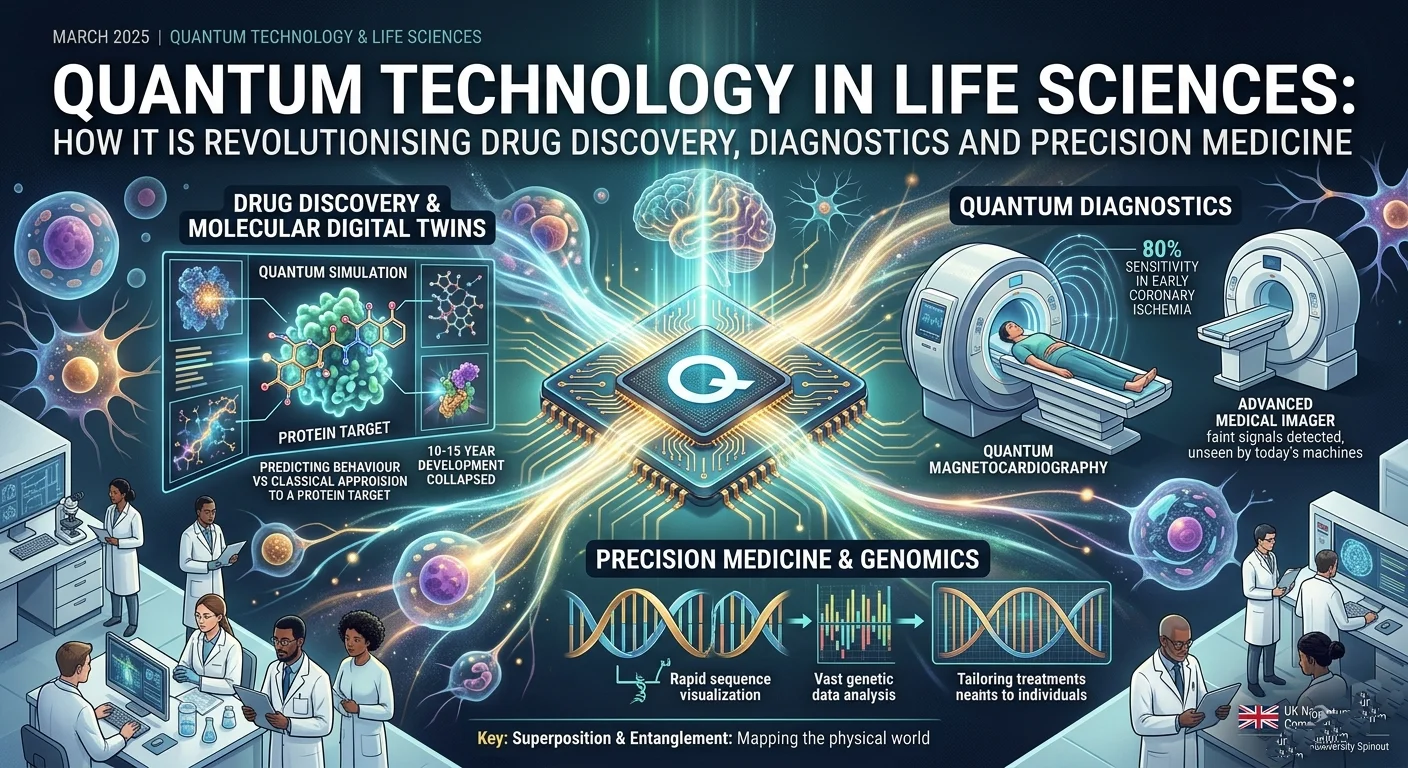

Quantum Technology in Life Sciences: How It Is Revolutionising Drug Discovery, Diagnostics and Precision Medicine:
Unlocking Your DNA: Why Quantum Computing Is the Key to True Precision Medicine
Introduction: Beyond Speed -- A Complete Paradigm Shift in Life Sciences:
When most people hear the words 'quantum technology,' the first thing that comes to mind is raw speed -- computers that can crunch numbers thousands of times faster than the most powerful machines we have today. But according to leading experts, that framing misses the bigger story entirely. The true promise of quantum technology isn't just acceleration. It's transformation.
Dr. Martin De Saulles, principal analyst for Information Matters, puts it directly: "We need to view quantum computing as not just faster processing but as a complete paradigm shift in how data can be manipulated and modelled to understand how the physical world works."
For the life sciences industry -- an industry built on understanding how molecules, cells, and biological systems behave -- that paradigm shift has profound implications. From drug discovery and genomics to real-time diagnostics and precision medicine, quantum technology is rapidly emerging as one of the most consequential forces in modern healthcare. And with the United Kingdom investing heavily in quantum infrastructure through organisations like the National Quantum Computing Centre, the race to bring these breakthroughs from the lab to the clinic is well and truly underway.
Reinventing Drug Discovery: From Trial-and-Error to Quantum Simulation:
Of all the life sciences applications experts highlight, drug discovery stands out as the area with the most immediate and dramatic potential. The current drug development process is staggeringly slow and expensive -- typically taking 10 to 15 years and costing billions of dollars to bring a single new treatment to market.
A significant portion of that time and cost is spent on a fundamental problem: we simply cannot accurately model how a potential drug molecule will behave inside the human body using classical computers.
Javier Campos, AI safety researcher and Group CTO at Peach, explains the core computational challenge: traditional computers struggle to model molecular behaviour beyond a few dozen atoms, because complexity grows exponentially with each additional particle.
This forces researchers to rely on empirical data and educated guesswork rather than precise quantum mechanical simulation -- a limitation that has defined drug development for decades.
Quantum computers change this equation entirely. By leveraging the principles of superposition and entanglement, quantum systems can natively represent molecular wave functions -- enabling researchers to simulate protein-ligand interactions, enzyme catalysis, and folding pathways at a level of fidelity that classical methods simply cannot achieve. The implications are staggering: pharmaceutical teams could predict binding affinities and toxicity profiles computationally before ever synthesising a single molecule.
De Saulles describes the concept of quantum molecular digital twins as a game-changer: "Predicting how a potential drug molecule will interact with water and proteins in the body with any degree of accuracy is impossible using standard supercomputers. Solving this 'butterfly effect' allows researchers to fail early and save years of clinical trial time." The result could be a drug development pipeline that is not just faster, but fundamentally smarter -- collapsing a multi-decade process into something orders of magnitude more efficient.
Gene de Libero, principal consultant at Digital Mindshare LLC, adds that quantum molecular simulation will also deepen our understanding of disease mechanisms themselves -- not just how to treat diseases, but why they develop in the first place. "This could significantly improve drug discovery by reducing reliance on approximations and trial-and-error, accelerating the development of new treatments and enhancing our understanding of disease mechanisms," de Libero says.
Quantum Diagnostics: Detecting Disease Earlier and More Accurately Than Ever:
Beyond drug discovery, quantum technology is poised to fundamentally transform how we detect and monitor disease in the human body. Two breakthrough areas are leading this charge: quantum magnetocardiography and quantum-enhanced medical imaging -- both of which promise levels of sensitivity and precision that today's diagnostic tools cannot match.
Daniel Jacobs, founder and CEO of Starkhorn, highlights the life-saving potential of quantum sensing in cardiovascular medicine. Heart disease kills approximately 20 million people globally each year, yet our primary diagnostic tool -- the electrocardiogram, or ECG -- frequently misses early signs of ischemia due to interference from surrounding tissues.
Quantum magnetocardiography, which uses optically pumped magnetometers to directly measure the heart's magnetic fields, achieves approximately 80% sensitivity and specificity in detecting coronary ischemia -- a dramatic improvement over conventional methods.
Tom Allen, founder of The AI Journal, broadens the scope further, pointing to quantum sensors as a transformative force across all forms of medical imaging. "Quantum sensors can pick up incredibly faint signals from the body, letting scanners 'see' structures and activity that are invisible to today's machines," Allen explains. "That makes it groundbreaking, because, in the future, doctors could detect diseases earlier; track how patients respond to treatments in real time; and do all of this with faster, less invasive scans."
Perhaps most remarkably, Allen envisions quantum sensing technology eventually migrating out of hospital settings entirely. "It also opens the door to compact -- potentially bedside -- scanners instead of today's large, expensive machines," he says. "Over time, that same sensing technology could trickle down into consumer devices, with wrist-worn or ring-based wearables continuously monitoring subtle changes in heart, brain or metabolic activity, giving people far earlier health warnings than today's smartwatches." The implications for preventive healthcare and early disease intervention are immense.
Precision Medicine and Genomics: Tailoring Healthcare to the Individual:
The third major frontier where quantum technology is set to reshape life sciences is precision medicine -- the practice of tailoring medical treatment to the unique genetic, biological, and environmental profile of each individual patient. This shift, from one-size-fits-all medicine to deeply personalised care, has long been the aspiration of modern healthcare. Quantum technology may finally make it practical at scale.
Peter Nichol, data and analytics leader for North America at Nestle Health Science, frames the opportunity in terms of computational complexity: "Quantum computing won't make your Excel spreadsheet response faster or rescue that VLOOKUP you've been struggling with.
The potential for quantum to accelerate life sciences outcomes is far more profound. When the number of possible combinations becomes extraordinarily complex, that is where quantum shows its real strength." Dose optimisation -- finding the ideal therapeutic dose for an individual patient -- is one such domain where this combinatorial power becomes clinically significant.
Oreoluwa Adesanya, an engineer and cybersecurity specialist working in AI and fraud detection research, highlights genomics as perhaps the most compelling precision medicine application of all. "Quantum computing can analyse vast genetic data sets far faster than traditional systems, enabling earlier disease detection and more targeted treatment strategies,"
Adesanya says. "This is groundbreaking, because it shifts healthcare from a reactive model to a predictive and preventive one." The ability to rapidly sequence and interpret entire genomes at scale would unlock a new era of personalised oncology, rare disease diagnosis, and pharmacogenomics -- matching patients to the treatments most likely to work for their specific genetic profile.
The UK's Quantum Ecosystem: A Global Leader Driving Life Sciences Innovation:
The United Kingdom has positioned itself at the forefront of the global quantum technology race, with substantial government investment channelled through UK Research and Innovation and the National Quantum Computing Centre. This ecosystem -- spanning universities, industry partners, and government agencies -- is actively working to translate quantum research into real-world life sciences applications.
De Saulles points to groundbreaking work coming out of Oxford University spinout Oxford Ionics, an IonQ company, as a leading example of the kind of industry-academia collaboration that is putting the UK on the global quantum map. Partnerships like these are essential to bridging the gap between theoretical quantum capability and practical deployment in clinical and pharmaceutical settings.
For life sciences organisations looking to understand where quantum investment is heading, the UK's coordinated approach offers a useful model: sustained public funding, cross-sector collaboration, and a deliberate focus on high-impact application areas. The country's quantum ecosystem is not just building technology -- it is actively shaping the roadmap for how quantum breakthroughs will reach patients and practitioners worldwide.
Key Takeaways: Quantum Technology's Life Sciences Impact at a Glance:
Here's a summary of the key quantum life sciences applications covered in this article:
-
Drug discovery: Quantum molecular simulation can reduce the 10-15 year drug development timeline by enabling computational prediction of molecular behaviour before synthesis.
-
Molecular digital twins: Simulating how drug molecules interact with proteins and water in the body -- currently impossible for classical supercomputers.
-
Quantum diagnostics: Quantum magnetocardiography achieves ~80% sensitivity in detecting coronary ischemia, surpassing conventional ECG methods.
-
Medical imaging: Quantum sensors detect faint biological signals invisible to current machines, enabling earlier and less invasive disease detection.
-
Consumer wearables: Long-term potential for quantum sensing to power next-generation health monitoring devices beyond today's smartwatches.
-
Precision medicine: Rapid genome sequencing and analysis at quantum speed enables predictive, preventive, individualised healthcare.
-
UK leadership: The National Quantum Computing Centre and Oxford Ionics are among the organisations driving global quantum life sciences innovation.
Conclusion: A Quantum Leap Toward Longer, Healthier Lives:
Quantum technology is not a distant, theoretical prospect -- it is an active and accelerating force in life sciences today. From collapsing the drug discovery timeline and catching heart disease before it becomes fatal, to sequencing genomes at extraordinary speed and enabling physicians to prescribe with individual precision, the applications are tangible, near-term, and potentially life-saving on a global scale.
The experts consulted here are unanimous: quantum computing represents not just a performance upgrade but a fundamental reimagining of what is computationally possible in medicine and biology. The questions that have stumped researchers for generations -- how does this molecule fold? How will this drug interact with this patient's unique biology? -- may soon have answers that come in hours rather than years.
For life sciences organisations, healthcare providers, and policymakers, the message is clear: the quantum era in medicine is not coming -- it is here. The organisations that invest in understanding and adopting these technologies now will be best positioned to lead the next great revolution in human health.
Published: March 2025 | Category: Quantum Technology & Life Sciences | Reading Time: ~6 min
Support our research
Independent analysis fueled by you.