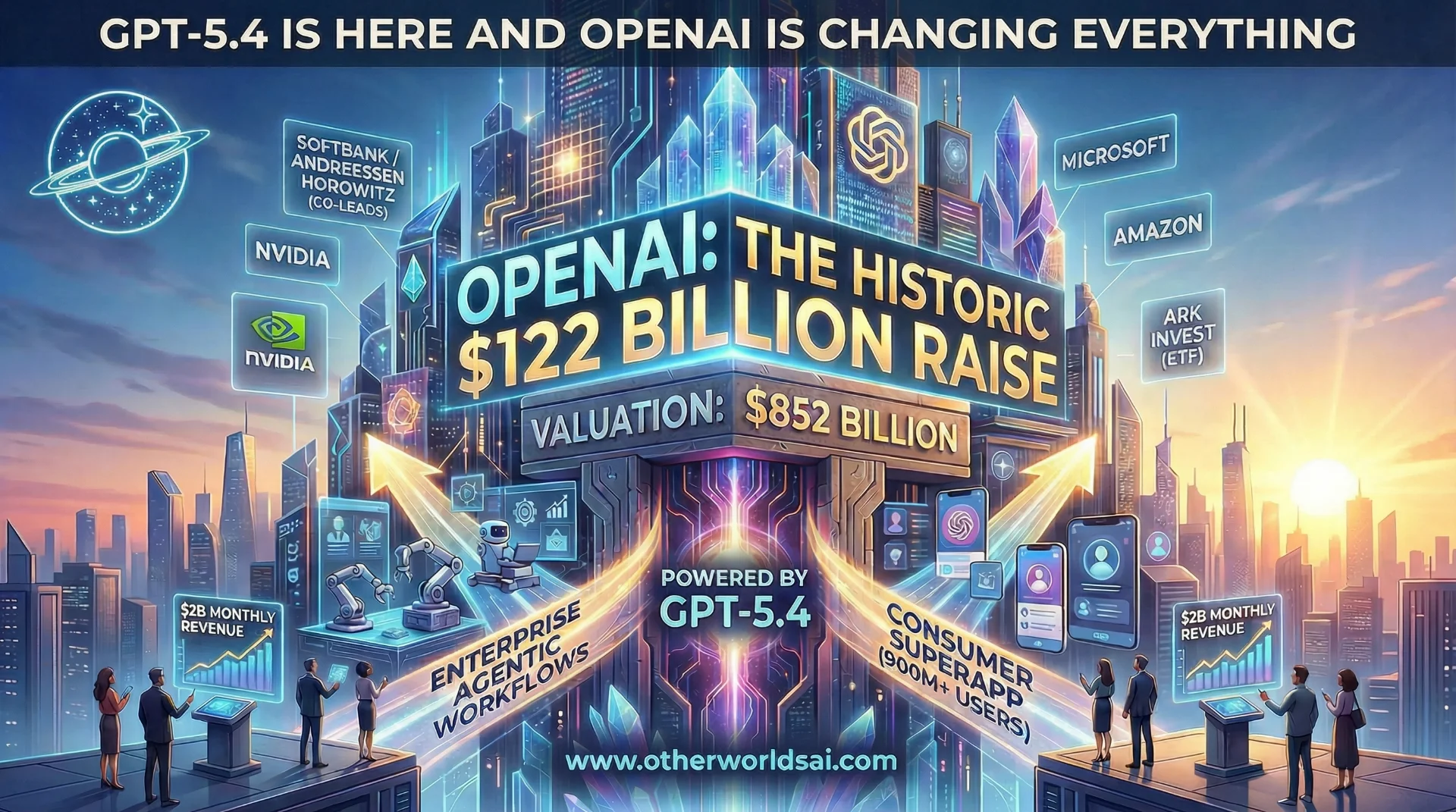

GPT-5.4 is Here: The Model Driving OpenAI’s Massive Enterprise Growth:
OpenAI Raises $122 Billion in Historic Funding Round: What It Means for the Future of AI:
OpenAI just made history — and it's not even public yet.
In what is being called the largest funding round in AI history, OpenAI has closed a staggering $122 billion raise at an $852 billion valuation, cementing its position as the world's most valuable private technology company. The round, its largest to date, signals something far bigger than a capital injection — it's a carefully orchestrated prelude to what many expect will be one of the most anticipated IPOs of the decade.
For investors, tech watchers, and everyday AI users alike, this announcement is a watershed moment in the story of artificial intelligence — and one that raises as many questions as it answers.
Let's dig into what happened, who's involved, and what it all means.
The Biggest Names in Tech Just Bet Big on OpenAI:
The sheer scale of this funding round is matched only by the star power behind it.
SoftBank co-led the round alongside Andreessen Horowitz, with D.E. Shaw Ventures, MGX, TPG, and T. Rowe Price Associates also participating. Tech giants Amazon, Nvidia, and Microsoft — already deeply embedded in OpenAI's ecosystem — joined the round as well, reinforcing the sense that the industry's biggest players are doubling down on OpenAI as the definitive AI platform of the future.
This is not just a financial vote of confidence. With names like Nvidia and Amazon in the mix, the investment is also a strategic alignment — tying the world's leading chip maker and cloud provider more tightly to the company that many believe will define the next era of computing.
Retail Investors Get a Rare Seat at the Table:
One of the most remarkable aspects of this round is who else got in — everyday investors.
About $3 billion of the total raise came from individual investors via bank channels, a highly unusual move for a company of OpenAI's stage and stature. This democratization of access to pre-IPO stock is a deliberate strategy, broadening the company's shareholder base and building retail investor loyalty well ahead of its expected public debut.
Taking that strategy a step further, OpenAI will also be included in several ETFs managed by ARK Invest, giving even more people indirect exposure to the private company's stock through publicly traded funds. For retail investors who have watched AI's rise from the sidelines, this is a rare opportunity to participate in OpenAI's growth story before it hits the public markets.
The message is clear: OpenAI isn't just raising money. It's cultivating a community of believers.
The Numbers Behind the Narrative — Revenue, Users, and Growth:
OpenAI's announcement didn't just come with a valuation. It came with receipts.
The company is now generating $2 billion in revenue per month — a figure that would make most mature tech companies blush — and it's not shy about putting that in context. OpenAI took a direct shot at some of the biggest names in tech history, stating it is growing revenue four times faster than the companies that defined the Internet and mobile eras, including Alphabet and Meta.
On the user side, the numbers are equally striking. OpenAI now claims more than 900 million weekly active users in consumer AI and over 50 million subscribers. Search usage has nearly tripled in the last year, pointing to growing competition with Google as users turn to ChatGPT and related tools for everyday information needs.
Perhaps most surprising is the performance of OpenAI's ads pilot. In under six weeks, the initiative has already crossed $100 million in annual recurring revenue (ARR) — a number that signals the potential for a serious new revenue stream for a company that built its massive user base entirely without advertising.
Business Is Booming — And GPT-5.4 Is Driving It:
Consumer AI may have put OpenAI on the map, but the enterprise side of the business is growing fast.
Business revenue now makes up 40% of OpenAI's total revenue, up from around 30% last year — and the company says it's on track to reach parity with consumer revenue by the end of 2026. That trajectory suggests OpenAI is successfully converting its brand recognition into durable, recurring enterprise contracts.
Much of that enterprise growth is being driven by agentic workflows — AI systems that can autonomously plan and execute multi-step tasks — powered by the company's newest model, GPT-5.4. As businesses look to automate complex processes and reduce operational overhead, OpenAI's agentic capabilities are increasingly becoming a core part of enterprise technology stacks.
The shift from chatbot to business infrastructure is one of the most significant strategic evolutions in OpenAI's history — and this funding round positions the company to accelerate it aggressively.
The War Chest — And What OpenAI Plans to Do With It:
Raising $122 billion is extraordinary. Spending it wisely will be the real test.
OpenAI has been clear about where the money is going: AI chips, data center buildouts, and the ongoing competition for top-tier talent in one of the tightest hiring markets in tech history. These are not optional expenses — they are the foundation of AI capability, and falling behind on compute is falling behind, full stop.
Beyond the equity raise, OpenAI also expanded its revolving credit facility to approximately $4.7 billion, supported by several of the world's top global banks. Notably, the facility remains undrawn — a signal that OpenAI is building financial flexibility as a buffer, not burning through reserves to survive.
That distinction matters. A company drawing on credit lines signals distress. A company expanding them while leaving them untouched signals discipline — and confidence in its own trajectory.
Reading Between the Lines — This Is an IPO Story:
There's a reason OpenAI's press release on this round reads less like a blog post and more like the opening chapter of an S-1.
The language is deliberate and investor-focused: flywheel metaphors, revenue per compute unit breakdowns, and the kind of total addressable market (TAM) framing that institutional investors look for when evaluating a company ahead of a public offering. This is not the tone of a company simply announcing a funding milestone. It is the tone of a company building its public market narrative in real time.
OpenAI also made its ambitions explicit by calling itself an "AI superapp" — a term that signals its intention to own the primary interface through which people interact with artificial intelligence, in the same way Google owns search or Apple owns the smartphone experience.
Everything about this announcement — the retail inclusion, the ETF access, the revenue disclosures, the competitive comparisons — adds up to one thing: OpenAI is anchoring IPO expectations, and this round is as much about narrative as it is about capital.
What This Means for the AI Industry — and for You:
OpenAI's $122 billion raise doesn't just reshape the company. It reshapes the competitive landscape for every player in AI.
For Google, Meta, and Microsoft, the pressure to keep pace with OpenAI's spending, talent acquisition, and product velocity just intensified considerably. A competitor with a $122 billion war chest and a clear path to the public markets is a different kind of rival than the scrappy startup that launched ChatGPT in 2022.
For everyday users and retail investors, the implications are more personal. Whether through ARK Invest ETFs, eventual IPO participation, or simply as users of increasingly powerful AI tools, more people than ever before have a stake — financial or otherwise — in how OpenAI's story unfolds.
And for the broader AI ecosystem, this round is a signal that we are still in the early chapters of a technology transformation that will touch virtually every industry on the planet.
Conclusion: The Biggest Bet in Tech History:
OpenAI's $122 billion funding round is more than a financial milestone.
It is a statement of intent — from the company, from its investors, and from the technology industry as a whole — that artificial general intelligence is not a distant dream but an accelerating reality, and that OpenAI intends to be at the center of it.
With $2 billion in monthly revenue, 900 million weekly active users, an expanding enterprise business, and a clear IPO trajectory, OpenAI is no longer just the company that built ChatGPT. It's positioning itself as the defining technology platform of the next decade.
The only question now is: when OpenAI finally goes public, will the market agree with that $852 billion price tag?
All signs point to a very loud yes.
Support our research
Independent analysis fueled by you.