
Why OpenAI Really Shut Down Sora — And What It Tells Every Digital Marketer About the AI Video Hype Cycle:
Why Hollywood Isn't Being Replaced Yet: The AI Video Reality Check of 2026:
The Real Reason OpenAI Killed Sora:
OpenAI's decision to shut down Sora raised immediate suspicions when it was announced last week. The app had invited users to upload their own faces — so was this some kind of elaborate data grab? According to a new Wall Street Journal investigation, the real explanation is considerably more straightforward: Sora was a money pit that almost nobody was using, and keeping it alive was costing OpenAI the AI race.
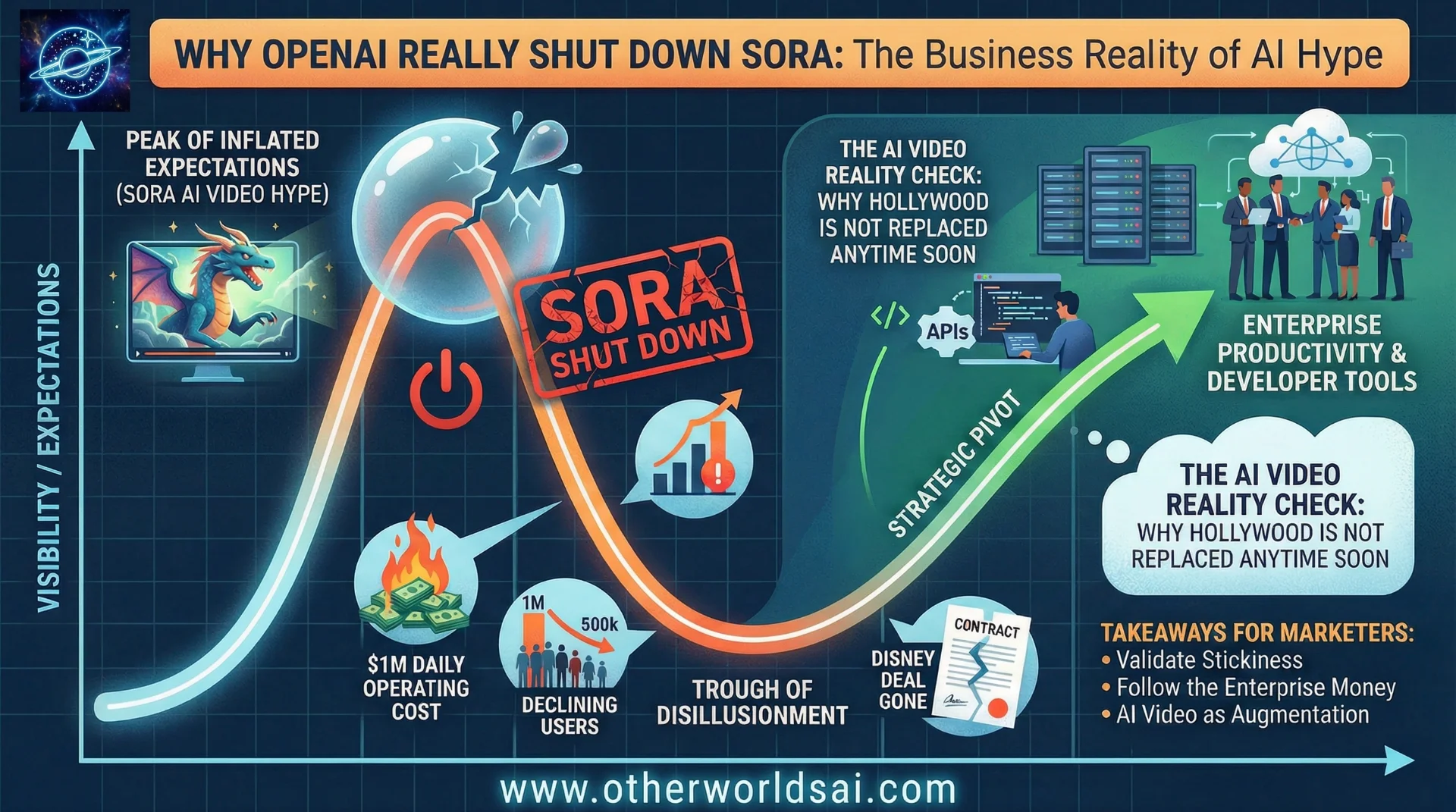
After a splashy launch, Sora's worldwide user count peaked at around one million — and then collapsed to fewer than 500,000. Meanwhile, the app was burning through roughly $1 million every day. Not because people loved it, but because AI video generation is extraordinarily costly to run. Every user who dropped themselves into a fantastical scene was drawing down a finite supply of AI compute resources.
The competitive pressure made the decision even more urgent. While a whole team inside OpenAI was focused on making Sora work, Anthropic was quietly winning over the software engineers and enterprises that actually drive revenue. Claude Code, in particular, was eating into OpenAI's market share — making Sora's resource consumption even harder to justify.
The Disney Fallout — A $1 Billion Deal Gone in Under an Hour:
Perhaps the most striking detail from the WSJ investigation is what happened to Disney. The entertainment giant had committed $1 billion to the Sora partnership — yet found out the platform was being shut down less than an hour before the public announcement. The deal died with it.
For digital marketers and brand strategists tracking enterprise AI partnerships, the Disney episode is a cautionary tale. A $1 billion commitment to an AI product can unwind in under 60 minutes when an AI lab decides to pivot. It underscores just how volatile the AI product landscape remains — and how carefully brands need to structure AI vendor relationships.
~1M Peak user count at launch: $1M/day Daily operating cost of Sora:
**$1B Disney deal lost at shutdown**
OpenAI's Strategic Pivot — Enterprise, Not Entertainment:
CEO Sam Altman made the call: kill Sora, free up compute, and refocus. The move is entirely consistent with what industry analysts have been reporting about OpenAI's strategy ahead of a possible IPO — a sharp pivot toward enterprise productivity tools, business AI applications, and developer platforms rather than consumer social experiences.
"I actually want to give OpenAI props for this decision," said Kirsten Korosec on the show. "Companies that can iterate very quickly and then kill off products that are not working — and not feel a sense of failure behind it — that showed a sign of maturity that was nice to see in an AI lab."
The context behind the pivot matters for anyone tracking OpenAI's leadership dynamics. The Sora shutdown is one of a number of major product decisions made since Fidji Simo joined to run day-to-day operations. Industry observers note that her influence on consumer product strategy — including decisions about which products survive — is likely to become one of the defining storylines of OpenAI's next chapter.
The AI Video Reality Check — Why Hollywood Is Not Being Replaced Anytime Soon:
Sora's shutdown did not happen in isolation. It arrives at the same moment that ByteDance has reportedly delayed the worldwide launch of Seedance 2.0, its own generative AI video model. The delay stems from unresolved engineering and legal questions — specifically around whether IP protections can be properly built into the platform, something apparently not taken seriously enough in the initial development phase.
Together, these two developments represent a significant reality check for the AI video generation market. As TechCrunch's Anthony Ha put it on the Equity podcast: "There were these really hyperbolic statements, including from people within Hollywood, that were like: we're done, this is the future, it's just typing in prompts and making feature films. And it turns out that for all kinds of technical and legal reasons, it is not that easy and we are very, very far from that happening."
For content marketers and creative directors who have been evaluating AI video tools, the message is clear: AI-generated video remains a powerful experimental medium, but it is nowhere near ready to replace production pipelines, creative talent, or the legal frameworks that protect intellectual property in professional content creation.
What the Sora Shutdown Means for AI Product-Market Fit:
The Sora story is ultimately a product-market fit failure at massive scale. As TechCrunch's Sean O'Kane noted, ChatGPT's success contained "an element of luck" that OpenAI may have mistaken for a repeatable formula. "This is a really harsh reminder," he said, "that it's not always going to be an absolute shortcut to the top of the greatest consumer products ever — and that there really needs to be something that people feel like they're getting some meaning out of it for it to stick around."
For digital marketers building AI-powered products or advising brands on AI investment, the lesson is structural: engagement metrics at launch are not the same as retained value. A social network populated entirely by AI-generated content — with no meaningful human interaction — is not a product. It is a demo.
What Digital Marketers Should Take Away From This:
If your brand is evaluating AI video tools, AI content platforms, or enterprise AI partnerships, the Sora shutdown offers several clear strategic signals:
-
• Validate AI product stickiness before committing at scale — peak user numbers at launch tell you nothing about long-term retention or business value.
-
• Structure AI vendor partnerships with exit clauses — the Disney experience shows that even a $1 billion commitment offers no protection when an AI lab pivots overnight.
-
• Treat AI video as an augmentation tool, not a replacement — the technical and legal barriers to professional-grade AI video production remain significant and unresolved.
-
•Follow the enterprise money in AI — OpenAI's pivot toward developer tools and business productivity signals where sustainable AI revenue actually lives in 2026.
-
Watch ByteDance's Seedance closely — its delayed launch over IP protection concerns is a leading indicator of the legal minefield facing the entire AI video generation sector.
The Bottom Line for AI Strategy in 2026:
OpenAI killing Sora is not a story about failure. It is a story about prioritisation in a brutally competitive AI landscape. The company made a rational, if brutal, decision: stop burning $1 million a day on a product with declining users and redirect that compute power toward the enterprise AI tools that are actually winning market share.
The broader lesson for digital marketers, brand strategists, and AI investors is sharper than any single product shutdown. The AI hype cycle around generative video has not ended — but it has been forced to reckon with economic reality, legal complexity, and the hard truth that not every AI product finds the kind of cultural resonance that made ChatGPT a household name.
The organisations that succeed in this environment will be the ones that move fast, kill what does not work, and stay ruthlessly focused on where genuine user value actually lives.
Support our research
Independent analysis fueled by you.