
Mantis Biotech's Digital Twins: Solving Medicine's Biggest Data Problem with AI and Synthetic Biology:
Mantis Biotech: The Startup That Wants You to "Smash" Digital Humans Like Toys.
The Data Crisis Holding Medicine Back:
Artificial intelligence is transforming healthcare — but there's a catch. Large language models (LLMs) trained on massive datasets are already showing potential to accelerate genomics research, streamline clinical documentation, improve real-time diagnostics, and supercharge drug discovery. The promise is immense. But the bottleneck is real: reliable, representative medical data is alarmingly scarce — especially for rare diseases and edge cases.
New York-based startup Mantis Biotech believes it has found the answer. By creating AI-powered "digital twins" of the human body — physics-based, predictive models of anatomy, physiology, and human behavior — the company is setting out to solve one of modern medicine's most pressing challenges: the data availability gap.
What Are Human Digital Twins: The Technology Explained:
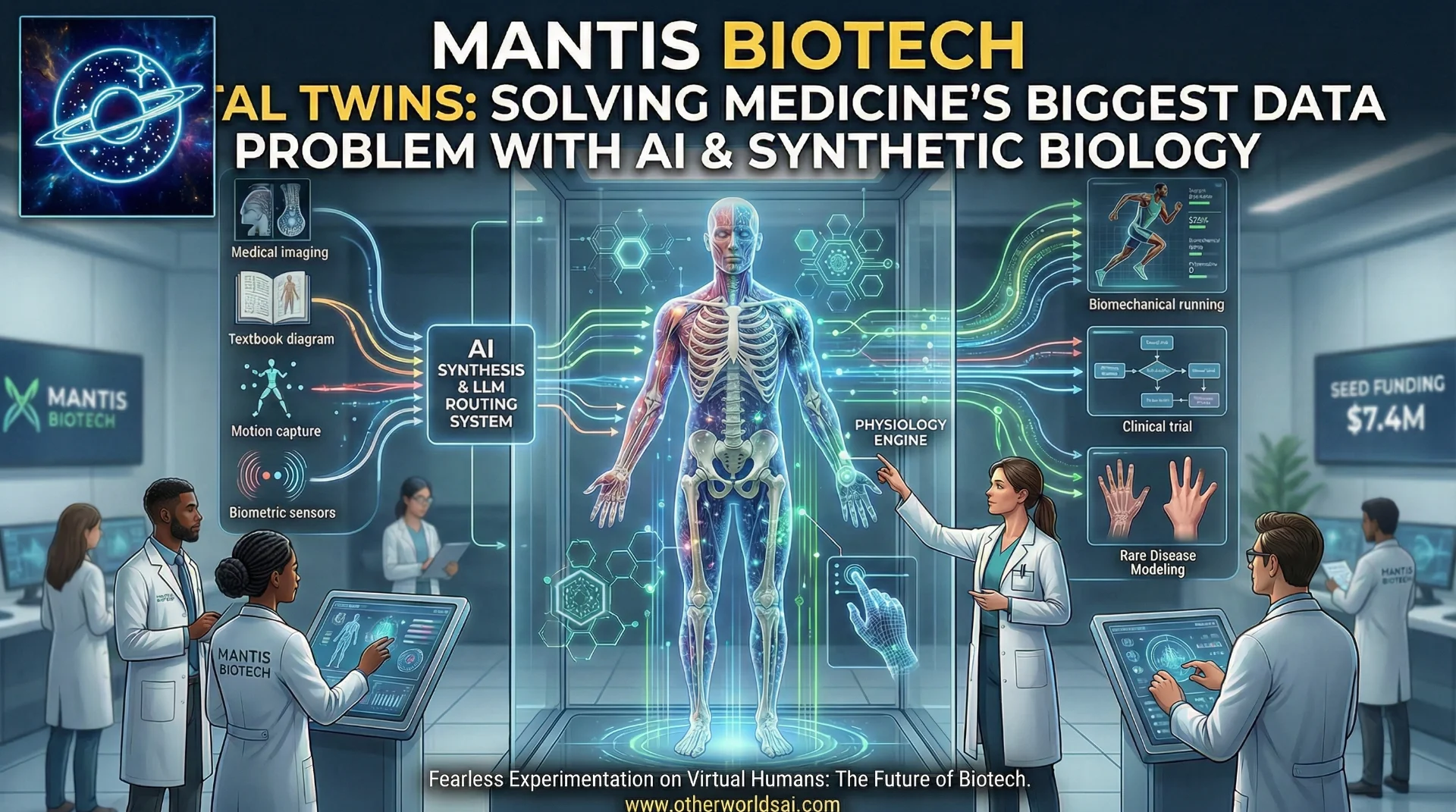
At their core, digital twins are virtual replicas of a physical system — and Mantis Biotech is applying this concept to the human body. The company's platform integrates disparate data sources — including medical textbooks, motion capture footage, biometric sensors, training logs, and medical imaging — and runs them through an LLM-based routing and synthesis system before feeding the output into a physics engine that generates high-fidelity renders of the human body in action.
This physics engine layer is what sets Mantis apart from generic AI data solutions. Rather than hallucinating or extrapolating data arbitrarily, Mantis' platform grounds its synthetic outputs in the laws of anatomy and physiology — making the generated data realistic, testable, and scientifically valid. The result is a platform capable of producing synthetic datasets that don't just look real, they behave real.
"We're able to take all these disparate data sources and then turn them into predictive models for how people are going to perform. Anytime you want to predict how a human being is going to be performing, that is a really good use case for our technology." —Georgia Witchel, Founder & CEO, Mantis Biotech
Solving the Rare Disease Data Problem: Where Synthetic Biology Meets AI:
Rare diseases represent one of the most underserved challenges in modern medicine. With limited patient populations and strict ethical and regulatory constraints around using patient data for AI training, researchers are often left working with datasets too small to produce reliable models. This is exactly the void Mantis Biotech is designed to fill. Consider a striking example offered by CEO Georgia Witchel: hand-pose estimation for individuals missing a finger.
No publicly available labeled dataset exists for this condition. But with Mantis' physics-based digital twin platform, generating one is straightforward — remove the finger from the model, regenerate, and the synthetic dataset is ready for use in training AI diagnostic tools. No patient data needed. No ethical gray areas. No delay.
This capability is transformative for biomedical AI development. The implications span everything from surgical robot training and AI-assisted diagnostics to clinical trial simulation and predictive treatment modeling — all without compromising patient privacy or waiting years for dataset accumulation.
From the NBA Court to the Operating Room: Real-World Use Cases:
Mantis Biotech has already found a thriving early market in professional sports. One of the startup's flagship clients is an NBA team, where the platform is being used to build detailed digital representations of athletes — tracking not just how they perform on any given day, but how their performance metrics have evolved over months and years.
The depth of insight these digital twins provide is remarkable. Imagine a platform that can show exactly how a player's jump has changed over 365 days, cross-referencing it against sleep patterns, frequency of overhead arm movements, dietary intake, and cumulative training load. That's precisely what Mantis delivers.
Beyond basketball, the sports injury prevention application is equally compelling. Witchel described a scenario in which a sports team could predict the likelihood of an NFL player developing an Achilles heel injury based on recent performance data, training load, diet, and years of activity. This kind of predictive sports medicine, powered by synthetic human modeling, represents a paradigm shift in athlete health management and performance optimization.
Rethinking Patient Privacy: The Barbie Test Approach to Medical Data:
One of Witchel's most memorable — and philosophically important — statements captures the ethos behind Mantis Biotech. She described wanting people to approach virtual human testing with the same fearless experimentation a three-year-old applies to a toy: "You know how when you see a three-year-old running around, and they have a Barbie, and they're holding it by one leg and smashing it against a table? I want people to have that mindset with our digital twins." — Georgia Witchel
This vision strikes at the heart of why digital twins matter so profoundly for medical innovation. Today, the healthcare and research communities operate with an understandably cautious mindset around human data — and rightly so. Patient privacy is sacrosanct. But that caution creates friction that slows life-saving research. Mantis Biotech's digital twins offer a path forward: rigorous scientific experimentation on virtual humans, leaving real patients' data untouched.
$7.4 Million Seed Round: What the Funding Means for the Future of AI in Medicine:
The market is beginning to take notice of Mantis Biotech's potential. The startup recently closed a $7.4 million seed funding round led by Decibel VC, with participation from Y Combinator, angel investors, and Liquid 2. The capital will be deployed toward hiring top talent, marketing, advertising, and go-to-market execution — signaling that Mantis is ready to move from early-stage validation into broader market penetration.
The backing of Y Combinator is particularly noteworthy. As one of the world's most prestigious startup accelerators, YC's involvement brings not just capital but credibility, a global network, and a powerful signal to the healthcare AI and biotech investment community that Mantis Biotech's approach to synthetic human data is worth taking seriously.
What's Next: Preventative Healthcare, Pharma, and the Public Platform:
Mantis Biotech's roadmap is ambitious — and spans multiple verticals across the healthcare ecosystem. The company's next major milestone is opening its platform to the general public, with a focus on preventative healthcare. By giving individuals and health practitioners access to personalized predictive models, Mantis could fundamentally shift the healthcare paradigm from reactive treatment to proactive prevention.
On the pharmaceutical and clinical research front, Mantis is actively courting pharmaceutical labs and researchers involved in FDA clinical trials. The ability to simulate how different patient populations respond to experimental treatments — without requiring actual patient data — could dramatically compress drug development timelines and reduce the cost and risk of clinical trials. For rare disease drug development in particular, where recruiting enough patients for a statistically significant trial is often near-impossible, this application could be genuinely game-changing.
Why Mantis Biotech Matters: The Bigger Picture for Healthcare AI:
The intersection of artificial intelligence, synthetic biology, and physics-based simulation is producing a new category of tool — and Mantis Biotech sits at its frontier. The problems it addresses — siloed medical data, rare disease research gaps, ethical barriers to AI training, and the need for scalable human performance modeling — are not niche concerns. They are fundamental constraints on the pace of medical progress.
By building digital twins that respect privacy while enabling bold experimentation, Mantis Biotech is crafting a new social contract for medical AI. One that doesn't force a trade-off between scientific ambition and human dignity. The technology promises to give researchers the freedom to test, iterate, and innovate — not on real patients, but on sophisticated virtual proxies that capture the full biological complexity of the humans they represent.
Conclusion: Digital Twins Are the Future of Biomedical Research:
Mantis Biotech is not just building software — it's building a new foundation for how AI-powered medical research can be conducted ethically and at scale. From NBA locker rooms to pharmaceutical labs, from rare disease simulations to preventative health platforms, the digital twin revolution is beginning — and Mantis Biotech is leading it.
With $7.4 million in fresh funding, the backing of Y Combinator, and a pipeline that stretches from professional sports to FDA trials,
Mantis Biotech is one of the most compelling and consequential startups operating at the intersection of artificial intelligence and human health today. Watch this space — the era of the human digital twin has arrived.
Support our research
Independent analysis fueled by you.