
The Manus Story: How China's Hottest AI Startup Walked Into a $2 Billion Trap:
The least surprising chapter of the Manus story is the one unfolding right now.
A $2 Billion Deal, a Singapore Relocation, and a Very Angry Beijing:
The United States and China are locked in an all-out race to build the most powerful artificial intelligence on the planet. Beijing is throwing billions at homegrown models, tightening its grip on the technology sector, and watching nervously as its best AI talent gravitates toward American companies. Against that backdrop, Manus — one of China's most buzzed-about AI startups — quietly relocated to Singapore and sold itself to Meta for $2 billion.
Did anyone genuinely believe there would not be a reckoning over this?
For those following the global AI race closely, the Manus story is not just a business headline. It is a case study in the extraordinary tensions now shaping how AI companies are built, funded, acquired, and — increasingly — controlled. And the latest chapter, with Manus's co-founders reportedly unable to leave China while Beijing conducts its "routine regulatory review," was visible from miles away.
Who Is Manus: The Chinese AI Startup That Took the World by Surprise:
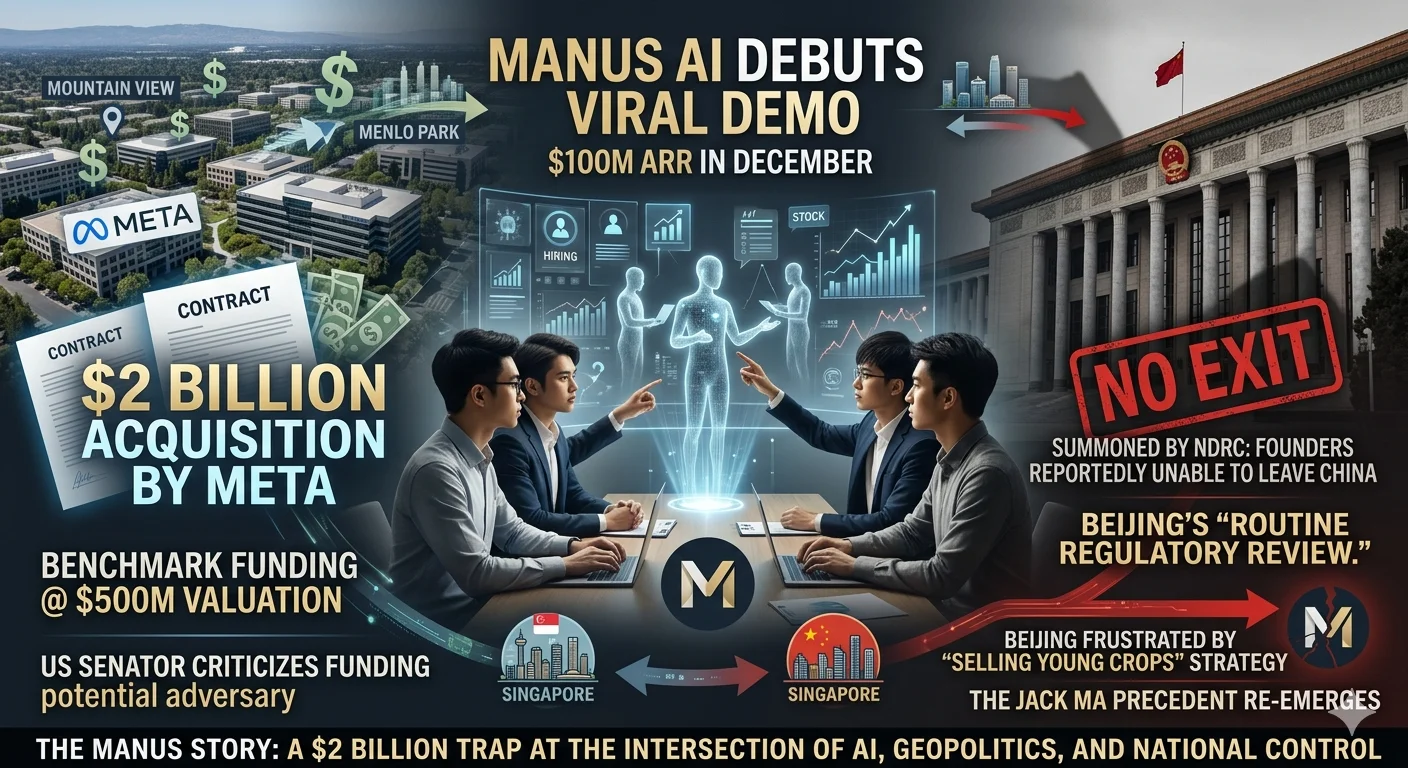
Manus burst onto the global AI scene in the spring of last year with a demo video that stopped the industry in its tracks. The footage showed an AI agent autonomously screening job candidates, planning vacations, and analysing stock portfolios — and the company cheekily claimed it outperformed OpenAI's Deep Research. In the crowded and competitive world of AI agents, that was a bold opening move.
The market responded almost immediately. Within weeks, Benchmark — one of Silicon Valley's most prestigious and discerning venture capital firms — led a $75 million funding round, valuing Manus at $500 million. That alone raised eyebrows. Senator John Cornyn made his position publicly clear, asking pointedly who thought it was a good idea for American investors to subsidise a potential adversary in AI, only for that technology to be used against the United States economically and militarily.
By December, the numbers were impossible to ignore. Manus had accumulated millions of users and was generating over $100 million in annual recurring revenue — remarkable traction for a startup of its age. Then Meta came calling, Mark Zuckerberg wrote the cheque, and a $2 billion acquisition was announced. That, too, was surprising. But perhaps not as surprising as what came next.
The Singapore Pivot: How Manus Tried to Step Outside China's Orbit:
It is worth understanding just how deliberately Manus tried to distance itself from its Chinese origins before the Meta deal was finalised. This was not a passive relocation or a cosmetic restructuring. The company moved its headquarters and core team from Beijing to Singapore, undertook a significant ownership restructuring, and — after the Meta acquisition was announced — Meta itself pledged to sever all ties with Manus's Chinese investors and shut down the startup's operations in China entirely.
By every conventional measure, Manus was engineering itself into a Singapore company. The leadership clearly understood that operating within China's regulatory and geopolitical orbit would make a deal with a major American technology company extremely difficult, if not impossible. The Singapore move was not incidental — it was strategic, deliberate, and executed over the better part of a year.
What the Manus team may have underestimated was how Beijing would view that strategy — not as a legitimate corporate restructuring, but as something far more provocative.
Selling Young Crops: Beijing's Deepest Fear About Its Own AI Industry:
** China has a phrase that captures exactly** what Beijing believes Manus did: "selling young crops." It refers to homegrown companies — nurtured on Chinese talent, Chinese capital, and Chinese infrastructure — that move abroad and sell themselves to foreign buyers before they have fully matured, taking their intellectual property, their engineering teams, and their competitive potential with them.
For Beijing, this is not merely a commercial concern. In the context of an existential AI race with the United States, homegrown AI startups are strategic national assets. Watching one of the most prominent and high-performing of those assets relocate to Singapore and hand itself to Meta represents precisely the kind of outcome that China's technology governance framework was designed to prevent.
The frustration in Beijing would have been visceral. China has spent years making clear, often brutally so, that no company operates outside its reach — regardless of where it technically incorporates.
The Jack Ma Precedent: Why No One Should Be Surprised by Beijing's Response:
If anyone needed a reminder of how Beijing handles technology companies that step out of line, the Jack Ma episode remains the defining case study. In 2020, Ma gave a speech mildly criticising Chinese financial regulators. What followed was swift and overwhelming: Ma disappeared from public life for months, Ant Group's blockbuster IPO was killed overnight, and Alibaba was handed a $2.8 billion fine. China then spent the next two years methodically dismantling its own booming technology sector, wiping out hundreds of billions in market value in the process.
Chinese regulatory power, when deployed against the technology sector, is not subtle. It is comprehensive, it is fast-moving, and it is designed to send messages that extend well beyond the company directly in the crosshairs. Every Chinese AI founder, every venture investor active in the China market, and every American company eyeing a Chinese acquisition is watching the Manus situation closely right now. That context makes the current Manus situation entirely predictable — even if the specific mechanism, a summons from the National Development and Reform Commission, carries its own distinct and chilling warning.
The Regulatory Reckoning: What Is Actually Happening to Manus's Founders:
On Tuesday, the Financial Times reported that Manus co-founders Xiao Hong and Ji Yichao were summoned to a meeting this month with China's National Development and Reform Commission. The message delivered was unambiguous: they would not be leaving the country for the foreseeable future.
No formal charges have been filed. Beijing is framing the situation as a routine inquiry into whether the Meta acquisition violated China's foreign investment rules — a description that few industry observers are taking entirely at face value given the circumstances and the timing.
The ambiguity is almost certainly deliberate. A formal charge would require a formal process, formal evidence, and a formal resolution. An open-ended regulatory inquiry, by contrast, allows Beijing to apply pressure, gather information, and signal its displeasure — all without committing to a specific legal outcome. It is a well-established tool in the Chinese government's regulatory arsenal.
What the Manus Story Means for the Global AI Race:
The Manus situation is not an isolated incident — it is a signal. For any Chinese AI startup currently weighing a relocation, a foreign funding round, or an acquisition by a Western technology company, the message from Beijing is now unmistakably clear: the state is watching, the state has long reach, and the state will act when it believes its strategic interests in artificial intelligence are being compromised.
For American companies and investors active in the AI space, the Manus case raises equally difficult questions about the risks embedded in cross-border AI deals involving Chinese talent, Chinese intellectual property, and Chinese regulatory exposure. Benchmark's $75 million bet, Meta's $2 billion acquisition, and the subsequent political and regulatory fallout represent a preview of the complications that will define AI investment and M&A for years to come.
For policymakers on both sides of the Pacific, Manus crystallises the central tension of the AI era: talent and technology do not respect borders, but governments increasingly insist that they should.
Key Takeaways: The Manus Story at a Glance:
Here is a summary of the key developments in the Manus story covered in this article:
-
Manus AI: One of China's most prominent AI agent startups, debuting with a viral demo claiming to outperform OpenAI's Deep Research.
-
Benchmark funding: A $75 million Series A at a $500 million valuation — raising immediate questions in Washington about American capital flowing into Chinese AI.
-
$100M ARR: Manus reached over $100 million in annual recurring revenue by December, making it one of the fastest-growing AI startups globally.
-
Meta acquisition: Mark Zuckerberg acquired Manus for $2 billion, with Meta pledging to cut all ties with Chinese investors and shut down China operations entirely.
-
Singapore relocation: Manus spent the better part of a year deliberately restructuring itself as a Singapore-headquartered company to step outside China's regulatory orbit.
-
Selling young crops: Beijing's term for homegrown AI companies that relocate abroad and sell to foreign buyers — taking intellectual property and talent with them.
-
NDRC summons: Co-founders Xiao Hong and Ji Yichao were told they cannot leave China pending a foreign investment inquiry.
-
The Jack Ma precedent: Beijing's dismantling of Alibaba and Ant Group remains the clearest illustration of how China treats companies that operate outside its expectations.
Conclusion: The Gamble That Was Always Going to Come Due:
At some point, someone at Manus probably thought they had gotten away with it. The Singapore incorporation was clean. The Meta deal was done. The $2 billion was on the table. Maybe the restructuring would be enough. Maybe Beijing would let it go.
The events of this week suggest otherwise. Given everything at stake in the global AI race — the technology, the talent, the strategic advantage, and the national pride — the idea that Beijing would simply watch one of its most prominent AI startups hand itself to Meta without consequence was always a significant gamble. Now Beijing wants answers, and Manus's founders are apparently not going anywhere until it gets them.
For AI founders, investors, and technology executives navigating the increasingly fractured global AI landscape, the message is clear:
the organisations that understand the full complexity of operating at the intersection of AI, geopolitics, and national regulation — and who plan accordingly — will be best positioned to lead the decade ahead.
Support our research
Independent analysis fueled by you.