
India's AI Boom Just Got Bigger: General Catalyst Commits $5B and Nvidia Goes All-In on Indian Startups:
The global race to dominate artificial intelligence just found its newest frontier — and it's India.
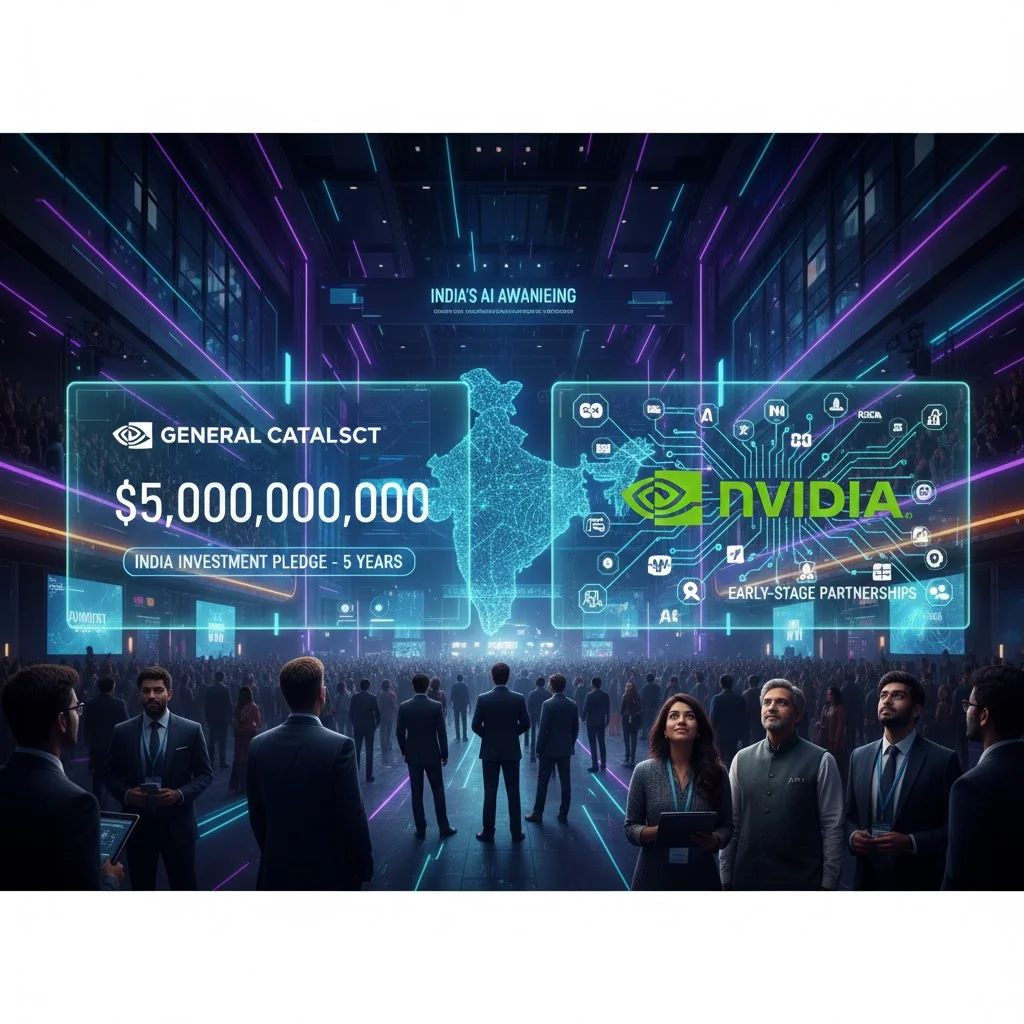
In a landmark week for India's technology ecosystem, two of the world's most influential names in tech and venture capital made sweeping commitments to the country's AI future. General Catalyst, one of Silicon Valley's premier venture firms, announced a staggering $5 billion investment pledge for India over the next five years.
Simultaneously, Nvidia — the undisputed king of AI chips — deepened its roots in India's startup landscape with a bold early-stage partnership strategy. Taken together, these moves send an unmistakable signal: India is no longer just a back-office for global tech. It's becoming the world's next great AI powerhouses.
General Catalyst's $5 Billion Bet on India's AI Future:
General Catalyst, a Silicon Valley-based venture firm managing over $43 billion in assets, dropped a bombshell at the India AI Impact Summit in New Delhi — a $5 billion commitment to invest in Indian startups over the next five years. To put that in perspective, the firm had previously earmarked just $500 million to $1 billion for India. This new pledge is a tenfold increase, and a clear declaration that India has moved from a regional afterthought to a global investment priority.
The announcement came less than two years after General Catalyst merged with local venture firm Venture Highway, giving it a strong on-the-ground presence in the Indian startup ecosystem. The firm's investment focus will span a wide range of sectors, including artificial intelligence, healthcare, defense technology, fintech, and consumer technology — all areas where India's rapidly expanding digital economy is producing world-class innovation.
"India will build the next generation of global platform companies," said General Catalyst CEO Hemant Taneja, pointing to Indian founders as uniquely positioned to build technology for enormous, underserved global markets.
What's particularly insightful about General Catalyst's India thesis is where they see the biggest AI opportunity. Rather than betting on frontier model development — the territory of OpenAI, Anthropic, and Google — the firm believes India's edge lies in large-scale, real-world AI deployment. The reasons are compelling:
India's government-built digital infrastructure (think UPI and Aadhaar), its vast domestic market of over a billion internet users, and one of the world's deepest pools of technology services talent.
General Catalyst is already building a portfolio that reflects this vision, with investments in companies like Zepto (fast delivery e-commerce), PB Health (health tech), Raphe, Jeh Aerospace (deep tech and defense), and Ayr Energy (clean energy). The firm is also developing a framework specifically designed to help convert AI pilot projects into full, large-scale deployments — bridging the gap between experimentation and real-world impact.
Neeraj Arora, General Catalyst's CEO for India, the Middle East, and North Africa, summarized the ambition succinctly: "This investment allows us to operate at a different scale in India," with an aim to support companies from early stage all the way through to public markets.
India's AI Infrastructure Explosion: The Context Behind the Commitment:
General Catalyst's $5 billion pledge doesn't exist in isolation — it's part of a broader, historic wave of AI investment in India that is reshaping the country's economic and technological landscape.
At the same India AI Impact Summit, Indian conglomerates Adani Group and Reliance Industries — led by billionaire Mukesh Ambani — announced plans to invest a combined $200 billion in AI data center infrastructure across the country. OpenAI has partnered with Tata Group's TCS to build a 100-megawatt AI data center as part of its Stargate infrastructure expansion. Meanwhile, global tech giants including Amazon, Google, and Microsoft have each outlined tens of billions of dollars in cloud and AI infrastructure investments in India.
New Delhi's goal? To attract over $200 billion in AI infrastructure investment over just the next two years — an ambition that, given recent commitments, is no longer as outlandish as it might have once seemed.

Move Over Nvidia: Anthropic and Samsung Team Up to Break the AI Chip Monopoly
Nvidia's Early-Stage Play: Backing Indian AI Startups Before They're Even Born:
While General Catalyst is writing large checks, Nvidia is taking a different but equally strategic approach: getting to India's best AI founders *before anyone else does.
The world's leading AI chipmaker unveiled a series of India-focused partnerships at the AI Impact Summit designed to engage founders at the very earliest stages of their journey — in some cases, even before their companies are formally incorporated. The strategy is deliberate: build deep relationships with tomorrow's AI-native companies today, and position Nvidia's computing infrastructure as the natural foundation those companies scale on.
The most notable new initiative is a partnership with Activate, an early-stage venture firm launching a $75 million debut fund targeting 25 to 30 AI startups. Portfolio companies will receive preferential access to Nvidia's technical expertise — a meaningful advantage in a space where compute access and engineering guidance can make or break a young company.
Activate's founder, Aakrit Vaish, describes the firm's approach as "inception investing" — engaging with technical teams months before company formation, then growing alongside them through the early stages. The firm's backers are a who's-who of India's tech elite, including venture capitalist Vinod Khosla, Perplexity co-founder Aravind Srinivas, Peak XV managing director Shailendra Singh, and Paytm CEO Vijay Shekhar Sharma.
Vaish noted that Nvidia's engagement with Indian startups has historically been lighter-touch compared to the U.S. market — but that's changing fast. The chipmaker is now actively seeking to work with Indian founders much earlier in their development, and Activate is designed to serve as a curated, high-signal front door to that engagement.
Support our research
Independent analysis fueled by you.
Nvidia's Broader India Ecosystem Push:
The Activate partnership is just one piece of Nvidia's rapidly expanding India strategy. This week alone, the chipmaker announced partnerships with some of India's most prominent venture firms — Accel, Peak XV, Z47, Elevation Capital, and Nexus Venture Partners — to identify and fund promising AI startups across the country.
Nvidia also teamed up with AI Grants India, co-founded by Vaibhav Domkundwar and Bhasker (Bosky) Kode, with a commitment to support more than 10,000 early-stage founders over the next 12 months. That's a remarkable scale of grassroots engagement for a company better known for supplying the hardware that powers large language models.
This builds on Nvidia's existing Inception program, which already supports more than 4,000 AI startups in India — one of the largest tech company startup programs in the country. In November 2025, Nvidia also joined the India Deep Tech Alliance, a consortium of U.S. and Indian investors including Accel, Blume Ventures, Premji Invest, and Celesta Capital, focused on providing strategic and technical guidance to emerging companies.
Notably, Nvidia CEO Jensen Huang was scheduled to attend the India AI Impact Summit in person but missed the event due to unforeseen circumstances. A senior delegation led by executive vice president Jay Puri attended in his place, meeting AI researchers, startups, developers, and partners across New Delhi — a sign of how seriously the company is taking its India commitments even in Huang's absence.
Why India, Why Now?
The convergence of these announcements points to something larger: a fundamental re-evaluation of India's role in the global AI ecosystem. The country offers a rare combination of advantages that few markets can match — a massive population of digital-native consumers, world-class engineering talent, ambitious government digital infrastructure, and a startup ecosystem that has already produced globally competitive companies.
For investors and tech giants alike, the calculus is shifting. India is no longer simply a market to sell into or a labor pool to draw from.
It is becoming an AI innovation hub in its own right — one where the next generation of globally relevant technology companies could be built, funded, and scaled.

Meta's Next Big Bet: This New App Lets You Build Games Simply by Typing a Prompt
Whether it's General Catalyst writing billion-dollar checks or Nvidia embedding itself into the founder journey before Day One, the message from the world's most sophisticated technology investors is remarkably consistent:
the India AI opportunity is real, it's massive, and the window to get in early is right now.