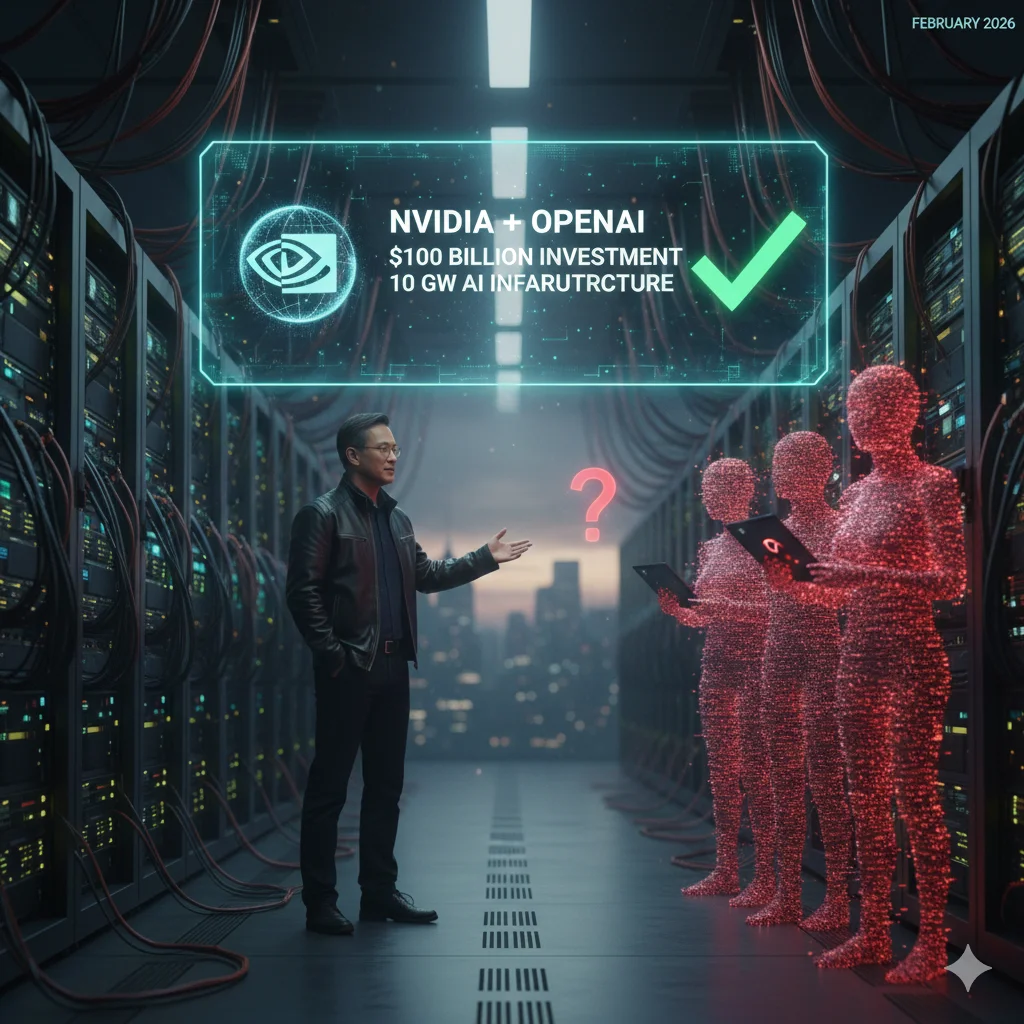

Speculation around Nvidia’s massive $100 billion OpenAI investment has intensified after a recent report suggested friction between the two AI giants.
However, Nvidia CEO Jensen Huang has firmly pushed back against those claims, calling reports of a stalled or scaled-back deal “nonsense” and reaffirming Nvidia’s strong belief in OpenAI’s future.
The controversy highlights not only the growing scrutiny around big-ticket AI investments, but also the immense stakes involved as artificial intelligence reshapes the global technology landscape.
The Report That Sparked the Debate:
Late Friday, The Wall Street Journal (WSJ) published a report claiming that Nvidia was reconsidering its planned investment in OpenAI. According to the article, Huang had begun emphasizing that the previously announced deal was nonbinding and had privately voiced concerns about OpenAI’s business strategy.
The WSJ also reported that Nvidia executives were increasingly cautious about the competitive AI environment, particularly as rivals like Anthropic and Google continue to invest heavily in their own models, infrastructure, and enterprise offerings.
These claims immediately raised questions across the tech industry: Was one of the largest AI partnerships in history beginning to unravel?
Nvidia and OpenAI’s Original $100 Billion Vision:
Back in September, Nvidia and OpenAI announced a landmark collaboration that captured global attention.
Under the proposed plan:
-
Nvidia would invest up to $100 billion in OpenAI.
-
Nvidia would help build 10 gigawatts of AI computing infrastructure.
-
The partnership would support OpenAI’s next-generation models and services.
At the time, the deal symbolized a near-perfect alignment. Nvidia dominates the global AI chip market, while OpenAI leads in large language models and generative AI systems. Together, the two companies appeared poised to define the next decade of artificial intelligence.
WSJ: A Relationship Under Review, Not Ending:
Despite the dramatic headlines, the WSJ report did not claim the partnership was collapsing. Instead, it suggested that Nvidia and OpenAI were rethinking the structure and scale of their relationship.
According to the report, recent discussions reportedly focused on a more limited equity investment in the tens of billions of dollars, rather than the full $100 billion initially floated. This nuance, however, was largely lost in early reactions, leading to widespread speculation about a breakdown between the two companies.
OpenAI Responds: Partnership Still Strong:
In response to the WSJ report, an OpenAI spokesperson emphasized that the relationship with Nvidia remains central to the company’s growth.
The spokesperson stated that OpenAI and Nvidia are “actively working through the details of our partnership,” adding that Nvidia:
“Has underpinned our breakthroughs from the start, powers our systems today, and will remain central as we scale what comes next.”
This statement reinforced Nvidia’s role not just as an investor, but as a foundational technology partner whose GPUs and AI infrastructure power OpenAI’s most advanced systems.
Jensen Huang Pushes Back Publicly:
The speculation reached a boiling point when Bloomberg reported that journalists questioned Jensen Huang directly during a visit to Taipei. Huang’s response was unequivocal. He dismissed the idea of friction between Nvidia and OpenAI, stating that Nvidia would “definitely participate” in OpenAI’s upcoming funding round.
“Because it’s such a good investment,” Huang said.
He went further, expressing strong confidence in OpenAI’s mission and impact.
“I believe in OpenAI. The work that they do is incredible. They’re one of the most consequential companies of our time.”
These comments directly contradicted claims that Nvidia was losing faith or backing away from its commitment.

Anthropic’s Surprise Double Launch Directly Targets OpenAI and Google’s AI Dominance
Why Huang Won’t Name a Dollar Figure:
While Huang was clear about Nvidia’s intent to invest heavily, he declined to specify the exact amount. Instead, he deferred that announcement to OpenAI CEO Sam Altman.
“Let Sam announce how much he’s going to raise—it’s for him to decide,” Huang said. This response suggests that negotiations are ongoing and that final figures may depend on broader fundraising dynamics rather than Nvidia alone.
Support our research
Independent analysis fueled by you.
OpenAI’s Historic $100 Billion Funding Round:
The timing of the controversy is significant. In December, the WSJ reported that OpenAI is seeking to raise up to $100 billion in a new funding round—a sum that would rank among the largest private capital raises in history.
More recently, The New York Times reported that several major players are in talks to invest, including:
-
Nvidia.
-
Amazon.
-
Microsoft.
-
SoftBank.
If successful, the funding round would further cement OpenAI’s valuation and influence, while also deepening ties between the AI company and the world’s most powerful technology firms.
Competitive Pressures in the AI Market:
The WSJ report touched on a real and growing issue: competition. OpenAI no longer operates in a vacuum. Companies like Google DeepMind, Anthropic, and Meta-backed AI labs are racing to build rival models, platforms, and ecosystems.
From Nvidia’s perspective, this competition matters. Nvidia supplies hardware across the AI industry, and its strategic investments must balance partnerships with maintaining neutrality and long-term market dominance.
That doesn’t mean Nvidia is retreating from OpenAI—but it does mean deals of this magnitude require careful structuring.
Infrastructure Is the Real Battleground:
Beyond equity investments, the most critical aspect of the Nvidia–OpenAI relationship may be infrastructure. The proposed 10 gigawatts of computing capacity would represent one of the largest AI infrastructure buildouts ever attempted.
As AI models grow more complex and resource-intensive, access to compute—not just capital—has become the defining competitive advantage. Nvidia’s GPUs, networking hardware, and AI platforms remain essential to OpenAI’s ability to scale.
What This Means for the AI Industry:
The broader takeaway is clear: despite rumors and reports, Nvidia and OpenAI remain deeply aligned. While deal terms may evolve, both companies have too much at stake to walk away.
For Nvidia, OpenAI represents a flagship customer and strategic partner. For OpenAI, Nvidia remains the backbone of its AI infrastructure.
Rather than signaling trouble, the debate reflects the sheer scale and complexity of modern AI partnerships, where hundreds of billions of dollars, massive energy demands, and global competition intersect.
Final Thoughts:
Claims that Nvidia’s $100 billion OpenAI investment has stalled appear overstated. Jensen Huang’s public comments, combined with OpenAI’s own statements, suggest a partnership that is very much alive—though still being finalized.
As OpenAI moves closer to completing one of the largest funding rounds in tech history, Nvidia’s participation seems not just likely, but foundational.
The exact numbers may change, but the strategic alliance remains a defining force in the future of artificial intelligence.