
Elon Musk's SpaceX-xAI Merger: The $800 Billion Tech Empire Reshaping Silicon Valley in 2025:
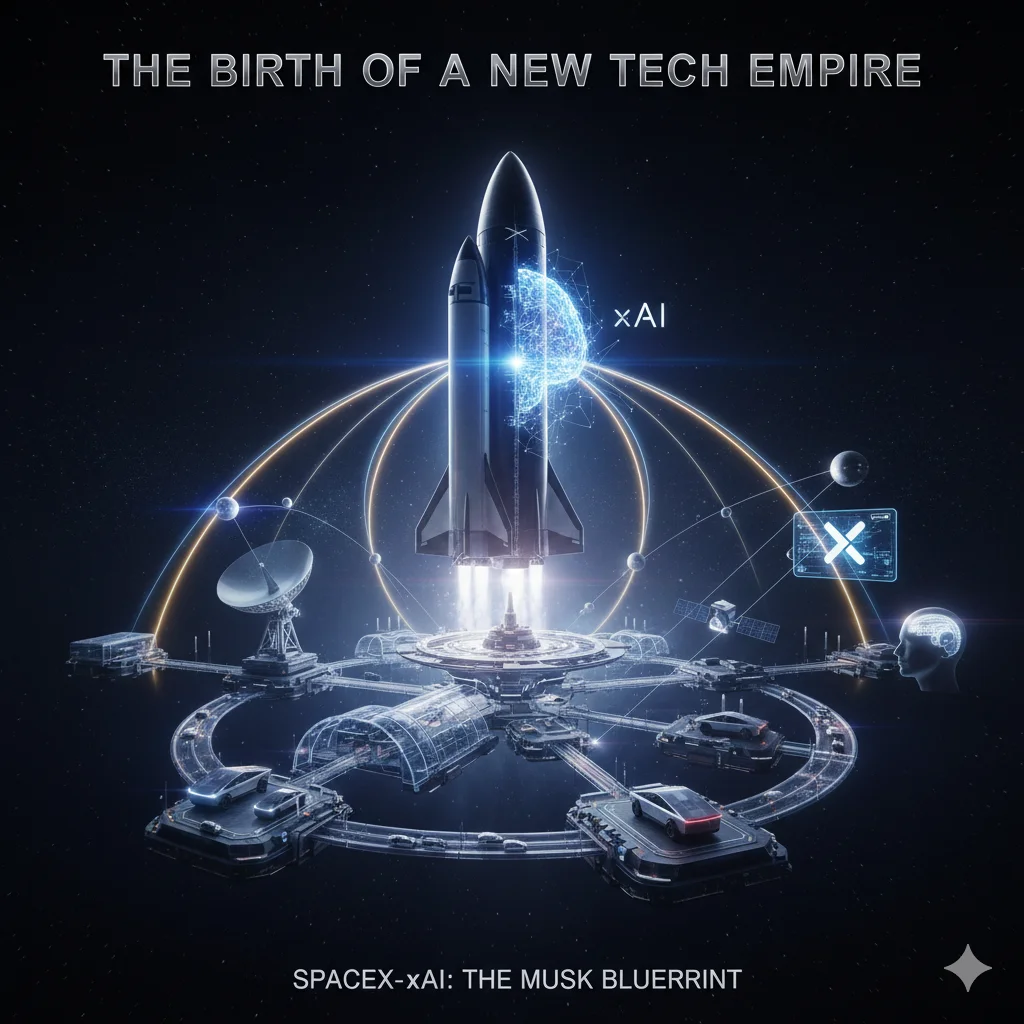
In a move that's sending shockwaves through Silicon Valley and beyond, Elon Musk has merged SpaceX and xAI, creating what many analysts believe could be the blueprint for an entirely new model of corporate power. This isn't just another business deal—it's a fundamental reimagining of how tech founders can leverage their resources, influence, and vision across multiple industries simultaneously.
With Musk's $800 billion net worth now rivaling the peak market capitalization of historic industrial giant General Electric, the world is witnessing the emergence of what can only be described as a personal conglomerate—a business empire built not around corporate structures but around the singular vision and control of one individual.
Why the SpaceX-xAI Merger Matters for the Future of Tech:
The "Everything" Business Model Takes Shape:
Musk has been vocal about his philosophy that "tech victory is decided by velocity of innovation." This merger between his aerospace company SpaceX and artificial intelligence venture xAI represents the practical application of that belief. By combining these complementary technologies under unified control, Musk can:
-
Accelerate cross-pollination of AI technology into space exploration.
-
Leverage shared resources across computing infrastructure and talent.
-
Eliminate bureaucratic friction that slows traditional corporate collaborations.
-
Deploy AI systems to optimize rocket design, launch logistics, and satellite operations.
-
Create synergies that would be impossible in separate corporate entities.
The question, as industry observers note, isn't whether a personal conglomerate of this scale can be built—Musk has already proven that. The real question is: how far will he take it?
Comparing Musk's Empire to Historical Conglomerates:
To understand the unprecedented nature of what Musk is building, consider that his $800 billion net worth rivals the peak market cap of General Electric, once America's most valuable and diversified company. But there's a crucial difference:
Traditional Conglomerates (like GE):
-
Multiple layers of corporate management.
-
Diverse shareholder bases with competing interests.
-
Slower decision-making processes.
-
Industry-specific expertise siloed across divisions.
-
Quarterly earnings pressure driving short-term thinking.
Musk's Personal Conglomerate:
-
Centralized vision and decision-making authority.
-
Single founder controlling strategic direction.
-
Rapid implementation of cross-company initiatives.
-
Shared technological infrastructure and talent pools.
-
Long-term focus unconstrained by traditional stakeholder demands.
The Broader Portfolio: Musk's Expanding Tech Empire:
Current Holdings Across Multiple Industries:
The SpaceX-xAI merger is just one piece of Musk's expanding empire, which now spans:
Space and Satellite Communications:
-
SpaceX: Revolutionizing space travel and satellite internet through Starlink.
-
Starlink: Global satellite internet network with millions of subscribers.
Artificial Intelligence:
-
xAI: Developing advanced AI systems to compete with OpenAI and Google.
-
AI integration across Tesla's autonomous driving systems.
Automotive and Energy:
-
Tesla: Electric vehicles, battery technology, and solar energy solutions.
-
The Boring Company: Infrastructure and tunnel construction technology.
Social Media and Communications:
- X (formerly Twitter): Social media platform and digital communications.
Neurotechnology:
- Neuralink: Brain-computer interface technology.
This portfolio creates unprecedented opportunities for technological convergence and innovation velocity that no traditional company structure could match.
Will Other Tech Founders Follow Musk's Blueprint?
Sam Altman and the Next Generation of "Everything" Businesses:
The success of Musk's personal conglomerate model raises an intriguing question: Will other prominent tech founders like Sam Altman follow suit?
Altman, CEO of OpenAI, already demonstrates similar tendencies:
-
Leading OpenAI in artificial intelligence.
-
Investing in nuclear energy through Oklo.
-
Previously led Y Combinator, shaping hundreds of startups.
-
Exploring universal basic income initiatives.
-
Involved in biotech longevity research.
The key difference? Altman operates more through investments and board positions, while Musk maintains direct operational control. However, the SpaceX-xAI merger might inspire Altman and others to pursue more integrated, Musk-style conglomerates.
Why This Model Appeals to Tech Visionaries:
Several factors make the personal conglomerate model attractive to ambitious founders:
-
Speed of execution: No need to negotiate partnerships or convince separate boards.
-
Resource sharing: Talent, technology, and infrastructure flow freely between ventures.
-
Long-term thinking: Freedom from quarterly earnings pressures.
-
Cross-industry synergies: AI improvements in one company benefit all divisions.
-
Competitive advantage: Integrated operations create moats competitors can't easily replicate.
Tech Industry Headlines: The Competitive Landscape:
Waymo's $16 Billion Funding Round:
In related news, Waymo secured $16 billion in new funding, with Alphabet maintaining its position as majority owner. This matters significantly for several reasons:
-
IPO positioning: Alphabet's continued control suggests Waymo is being groomed for a major public offering.
-
Autonomous vehicle race: The funding enables Waymo to compete with Tesla's self-driving initiatives.
-
AI integration: Self-driving cars represent a critical application of AI technology.
-
Market validation: The massive funding demonstrates investor confidence in autonomous transportation.
The timing is notable as Musk's integrated empire includes both AI (through xAI) and autonomous vehicles (through Tesla), giving him advantages in this competitive space.
The Battle for AI Chip Dominance:
Everyone from Intel to Tesla is mounting challenges to Nvidia's AI chip dominance, a development with major implications for Musk's ambitions:
Why AI chips matter for personal conglomerates:
-
Computing infrastructure: Both SpaceX and xAI require massive computational power.
-
Cost control: Developing proprietary chips reduces dependence on Nvidia.
-
Performance optimization: Custom chips can be designed for specific AI workloads.
-
Competitive advantage: Vertical integration in chip design creates barriers to competition.
Tesla's chip strategy already demonstrates this approach—the company develops its own AI chips for autonomous driving, giving it independence from external suppliers and potential performance advantages.
Intel's challenge to Nvidia comes as the traditional chip giant seeks relevance in the AI era, while Nvidia's dominance remains formidable with its GPU technology powering most AI training and inference.
ElevenLabs Reaches $11 Billion Valuation:
The voice AI company ElevenLabs achieving an $11 billion valuation shows investor appetite for specialized AI applications, with some investors doubling and quadrupling their positions as the company expands beyond voice technology.
Key insights:
-
AI specialization pays: Focused AI companies can command premium valuations.
-
Voice AI applications: Text-to-speech, voice cloning, and audio generation represent massive markets.
-
Expansion potential: Moving beyond voice into multimodal AI increases addressable market.
-
Investment confidence: Repeat backing demonstrates strong performance and growth trajectory.
This validates the broader AI innovation trend that xAI is positioned to capitalize on, particularly as Musk integrates AI capabilities across his various companies.
Positron's $230 Million Power-Efficiency Bet:
Positron raised $230 million to develop power-efficient AI chips, highlighting a critical challenge for the entire industry:
The power consumption problem:
-
Data centers running AI models consume enormous electricity.
-
Training large language models costs millions in energy.
-
Inference at scale requires sustainable power solutions.
-
Environmental concerns drive demand for efficiency.
Why this matters for Musk:
-
SpaceX satellite networks require power-efficient computing.
-
xAI's large language models need cost-effective inference.
-
Tesla's autonomous systems benefit from lower power consumption.
-
Sustainable energy aligns with Tesla's core mission.
The power-efficient chip market represents the "next frontier" in AI infrastructure, potentially creating new opportunities for vertical integration in Musk's conglomerate.
The Philosophy Behind Musk's Empire Building:
"Velocity of Innovation" as Competitive Strategy:
Musk's statement that "tech victory is decided by velocity of innovation" reveals the core philosophy driving his empire-building strategy. This belief manifests in several ways:
Rapid iteration cycles:
-
SpaceX launches, learns from failures, and improves quickly.
-
Tesla pushes over-the-air updates to millions of vehicles overnight.
- xAI can develop and deploy new models faster than traditional corporate AI labs.
Vertical integration:
-
Controlling the full stack from chips to applications.
-
Eliminating dependencies on external suppliers.
-
Optimizing every layer of technology for maximum performance.
Resource concentration:
-
Focusing enormous computational resources on specific problems.
-
Deploying top engineering talent wherever needed most urgently.
-
Sharing breakthroughs across all companies simultaneously.
The Risks and Challenges of Personal Conglomerates:
While Musk's approach offers advantages, it also presents significant risks:
Concentration risk:
-
Single point of failure if Musk's judgment falters.
-
Regulatory scrutiny of excessive power concentration.
-
Potential conflicts of interest across different ventures.
Management complexity:
-
Even Musk has limits on attention and decision-making capacity.
-
Coordinating across aerospace, AI, automotive, and social media requires superhuman effort.
-
Talent retention when competing with focused competitors.
Market volatility:
-
Stock prices tied to Musk's personal reputation and actions.
-
Twitter controversies affecting Tesla and SpaceX perception.
-
Political involvement creating business risks.
Regulatory challenges:
-
Antitrust concerns as the empire expands.
-
Government contracts (SpaceX) alongside consumer products (Tesla).
-
International complications as geopolitical tensions rise.
What This Means for Silicon Valley's Future:
The Changing Nature of Founder Power:
The SpaceX-xAI merger signals a fundamental shift in how founder power operates in Silicon Valley:
Old model:
-
Founders raise venture capital, dilute ownership.
-
Professional managers take over at scale.
-
Public markets demand governance structures.
-
Founders eventually step back or get pushed out.
New model (Musk blueprint):
-
Founders maintain control through multiple companies.
-
Personal wealth funds expansion without traditional financing.
-
Integration creates value investors can't replicate.
-
Founders remain central to strategy indefinitely.
This represents a return to the industrial baron model of the late 19th and early 20th centuries, but with technology replacing steel and railroads.
Implications for Competition and Innovation:
Positive effects:
-
Faster innovation cycles benefit consumers.
-
Cross-industry breakthroughs happen more readily.
-
Long-term thinking enables ambitious projects (Mars colonization, artificial general intelligence).
-
Proof that integrated approaches can outcompete specialists.
Concerning trends:
-
Smaller competitors struggle against integrated giants.
-
Talent concentrates in a few mega-companies.
-
Innovation potentially slows if consolidation reduces competition.
-
Regulatory capture becomes easier for powerful conglomerates.
Will We See More "Everything" Businesses?
The success of Musk's approach will likely inspire imitators, but several factors limit how many can succeed:
Required elements:
-
Extraordinary wealth to self-fund expansion.
-
Proven track record attracting talent and customers.
-
Vision compelling enough to unify disparate businesses.
-
Execution capability across multiple complex industries.
-
Risk tolerance for simultaneous large-scale ventures.
Potential candidates:
-
Sam Altman: AI expertise, investment track record, ambitious vision.
-
Jeff Bezos: Wealth, Blue Origin (space), diverse investments.
-
Mark Zuckerberg: Meta's VR/AR, AI research, social platforms.
-
Larry Page: Alphabet background, flying car investments, longevity research.
However, none currently demonstrate Musk's willingness to personally operate multiple major companies simultaneously.
The Investment and Market Implications:
What Investors Should Watch:
The emergence of personal conglomerates creates new investment considerations:
Valuation challenges:
-
How to value interconnected private companies?
-
What premium for integration benefits?
-
How to account for founder risk?
Portfolio exposure:
-
SpaceX investors indirectly get xAI exposure.
-
Tesla stock movements affected by Musk's other ventures.
-
X (Twitter) controversies impact the entire ecosystem.
IPO opportunities:
-
When will SpaceX go public?
-
Will xAI remain private or eventually list?
-
How would public markets value integrated operations?
Sector-Specific Impacts:
Aerospace and defense:
-
SpaceX dominance in launches affects entire industry.
-
Government contracts increasingly concentrated.
-
Traditional aerospace companies losing market share.
Artificial intelligence:
-
xAI competes directly with OpenAI, Google, Anthropic.
-
Integration with SpaceX and Tesla creates unique advantages.
-
Talent war intensifies as top researchers choose sides.
Automotive:
-
Tesla's autonomous driving benefits from xAI capabilities.
-
Traditional automakers struggle to compete on AI integration.
-
Electric vehicle market continues rapid evolution.
Social media:
-
X platform potentially becomes AI-powered in new ways.
-
Integration with other Musk ventures creates novel features.
-
Competition with Meta, TikTok intensifies.
Conclusion: The Future of Founder-Led Innovation:
The merger of SpaceX and xAI represents more than a business transaction—it's a declaration that the future of technology might belong to integrated, founder-controlled empires rather than traditional corporate structures.
Whether this model proves superior remains to be seen. Musk's "velocity of innovation" philosophy and $800 billion net worth give him unprecedented ability to test this hypothesis at scale. The personal conglomerate he's building could either become the dominant organizational form for the next generation of tech companies or serve as a cautionary tale about concentration of power.
For now, competitors, investors, and observers are watching closely. Will Sam Altman and other ambitious founders follow Musk's blueprint? Can traditional companies compete against integrated operations? Will regulators allow these empires to continue growing?
The answers will shape not just Silicon Valley, but the global technology landscape for decades to come. One thing is certain: Elon Musk is rewriting the rules on founder power, and the tech world will never be quite the same.
Support our research
Independent analysis fueled by you.