
The artificial intelligence landscape is shifting from a gold rush of "anything goes"
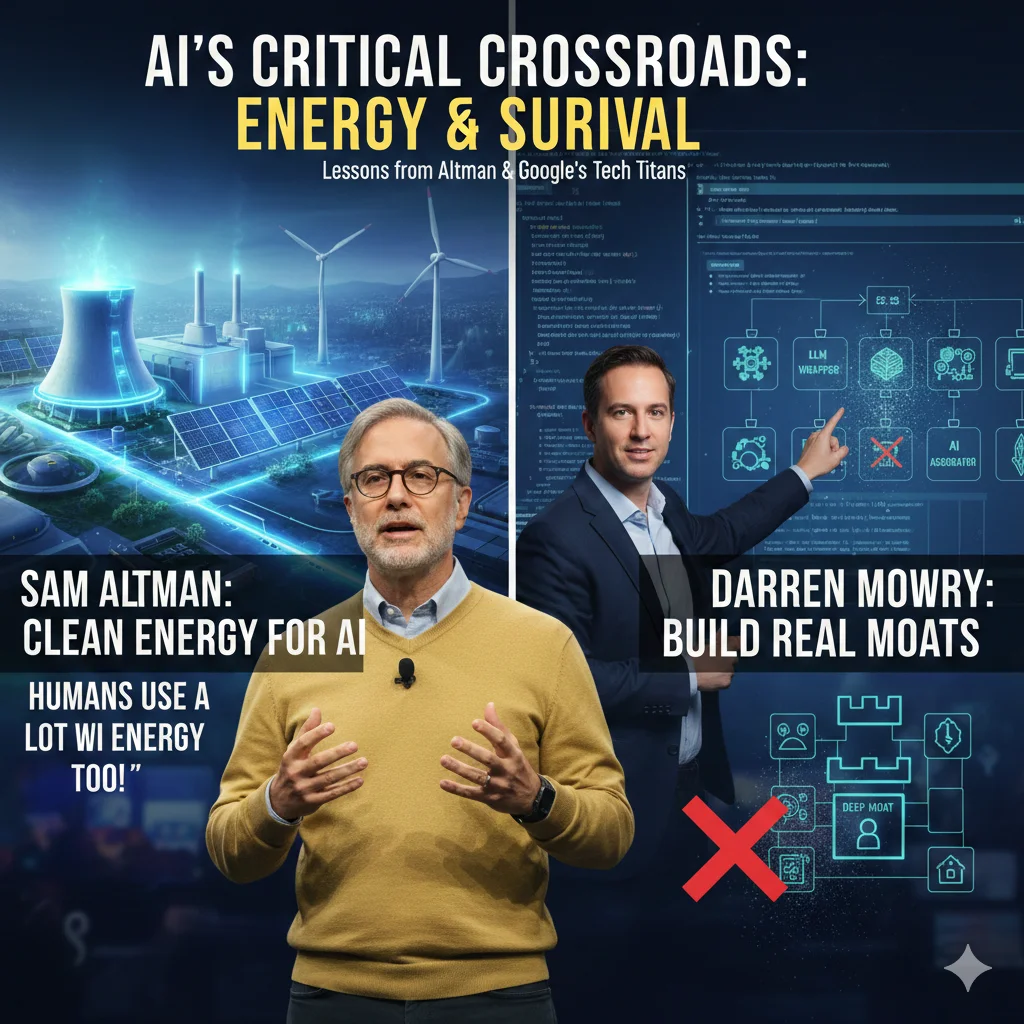
to a rigorous era of sustainability and substance. This week, two major industry titans—OpenAI CEO Sam Altman and Google VP Darren Mowry—offered a reality check on the two biggest hurdles facing the industry: its environmental footprint and its economic viability.
Redefining the "Cost" of Intelligence: Altman’s Provocative Stance:
One of the most persistent criticisms of AI is its perceived thirst for resources. However, speaking at a recent AI summit in India hosted by The Indian Express, Sam Altman didn't just defend ChatGPT’s energy usage; he reframed the entire conversation around human evolution.
Altman dismissed viral claims that a single AI query consumes gallons of water as "totally fake" and "insane," noting that the transition away from evaporative cooling in modern data centers has fundamentally changed the math. While he acknowledged that total aggregate energy consumption is a valid concern, he pushed back on the "unfair" comparisons between AI and humans.
"It takes like 20 years of life and all of the food you eat during that time before you get smart," Altman remarked, highlighting the "energy" required to train a human mind through evolution and education.
In Altman’s view, once a model is trained, the inference cost (the energy to answer one question) is likely already more efficient than a human’s cognitive output. To sustain this, he argues the world must "move towards nuclear or wind and solar very quickly." This vision positions AI not as an environmental villain, but as a catalyst for a global clean-energy transition.
The Death of the "Wrapper": Why Vibe Coding and Moats Matter:
While Altman focuses on the "how" of AI's power, Google’s Darren Mowry is looking at "who" will survive. Mowry, who leads Google’s global startup organization across Cloud and DeepMind, warns that the era of the LLM wrapper—startups that simply put a pretty UI over GPT-5 or Gemini—is effectively over.
According to Mowry, the industry has lost patience with "thin" intellectual property. If a startup is just white-labeling a backend model without adding unique vertical value, their "check engine light" is already blinking.
The Two Business Models at Risk:
-
LLM Wrappers: Startups that solve general problems (like basic study aids or simple text generators) without deep, proprietary moats.
-
AI Aggregators: Platforms that route queries between different models (like Perplexity or OpenRouter). Mowry warns that as model providers build their own enterprise tools, these middlemen face the same "squeezing out" that AWS infrastructure resellers faced a decade ago.
Instead of simple wrappers, Mowry is bullish on "vibe coding" and developer platforms like Cursor, Replit, and Lovable. These tools don't just use AI; they integrate it into the workflow in a way that creates a "deep moat" of user experience and specialized functionality.
The Shift to Vertical Markets and Real-World Utility:
The path forward for AI startups isn't just about better models; it's about context. Mowry points to companies like Harvey AI (legal) and Cursor (coding) as examples of "deep-moat" successes. These companies succeed because they don't just provide an interface; they provide a specialized service that understands the nuances of a specific industry.
Furthermore, Mowry highlights biotech and climate tech as the next frontiers. These sectors are currently seeing a surge in venture investment because they utilize "incredible amounts of data" to create real value that was previously impossible. This aligns with Altman’s call for specialized energy solutions—showing that the future of AI is deeply intertwined with the physical world.
Summary Table: The Future of AI Startups:
Factor : Legacy Approach (At Risk) Future Approach (Sustainable)
Anthropic’s Surprise Double Launch Directly Targets OpenAI and Google’s AI Dominance
Cooling: Evaporative (Water intensive )Closed-loop / Clean Energy focus
Support our research
Independent analysis fueled by you.
Software: Simple LLM Wrappers Deep, Vertical Moats (e.g., Harvey AI)
Business: General Aggregators Specialized Developer Platforms
Energy: Fossil Fuel reliance Nuclear, Solar, and Wind

Meta's Next Big Bet: This New App Lets You Build Games Simply by Typing a Prompt
Target: Horizontal "Catch-all" Vertical/Industry Specific
The consensus from both leaders is that AI is moving past its "novelty" phase. Success in 2026 requires two things: sustainable infrastructure and genuine innovation.
As the "dust starts to settle," only those building deep moats and leveraging clean energy will remain standing.