
Intel Enters the GPU Market, Taking on Nvidia’s AI Chip Dominance:
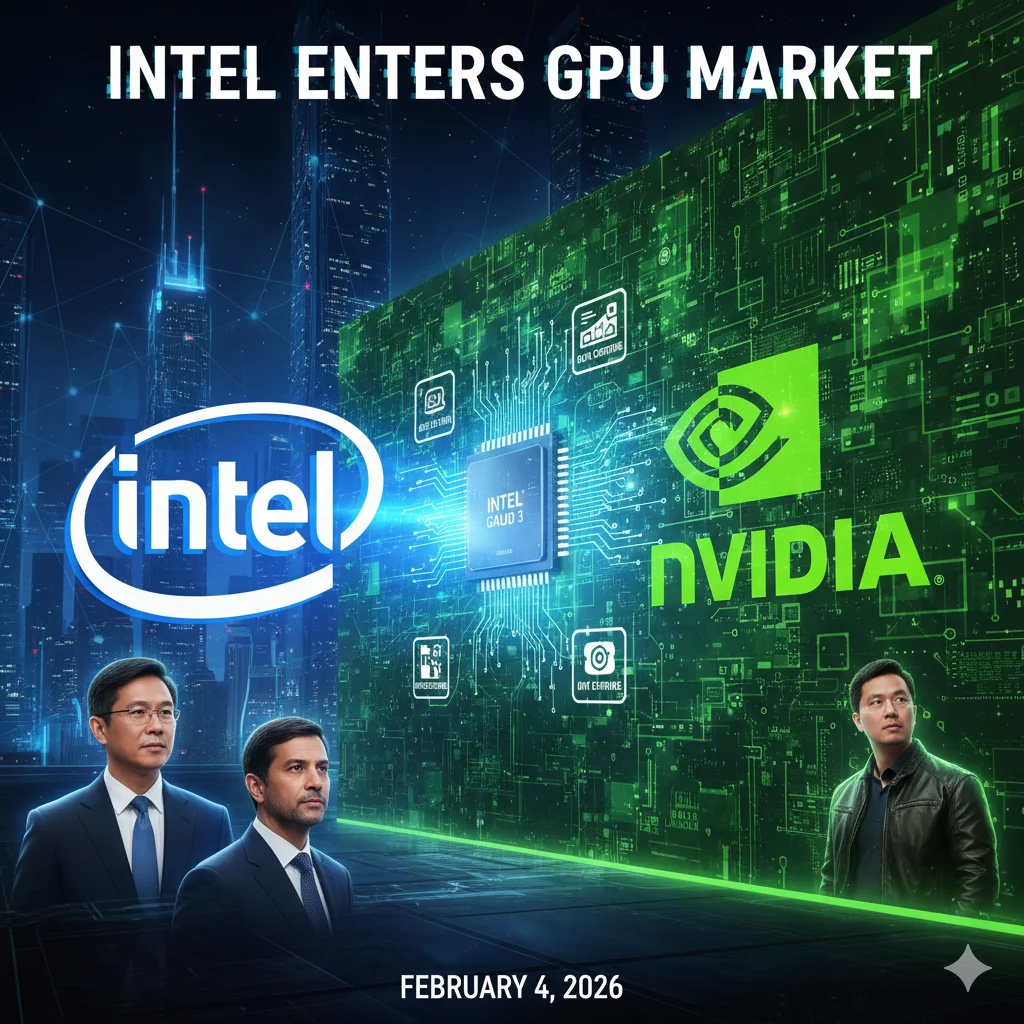
Intel, one of the world’s most recognizable semiconductor giants, is preparing to enter a market long dominated by Nvidia: graphics processing units (GPUs). As the company continues its multi-year turnaround strategy, Intel’s leadership has confirmed plans to begin manufacturing GPUs—specialized chips that play a critical role in gaming, data centers, and artificial intelligence (AI) workloads.
The announcement was made by Intel CEO Lip-Bu Tan during the Cisco AI Summit, signaling a potentially transformative shift in Intel’s long-term roadmap. Traditionally known for its central processing units (CPUs), Intel is now aiming to compete directly in a sector that has fueled Nvidia’s meteoric rise over the past decade.
Why GPUs Matter More Than Ever:
GPUs differ significantly from CPUs in how they process data. While CPUs handle general-purpose computing tasks, GPUs are designed for parallel processing, making them far more efficient for graphics rendering, machine learning, and training large AI models.
This capability has made GPUs indispensable in today’s AI boom. Nvidia’s GPUs, in particular, have become the backbone of modern AI infrastructure, powering everything from ChatGPT-like systems to enterprise-scale data centers.
As a result, Nvidia currently commands a dominant share of the AI chip market, leaving competitors struggling to catch up.
Intel’s decision to enter this space reflects the growing realization that AI-focused hardware is no longer optional for major semiconductor players.
Intel’s GPU Strategy Is Still Taking Shape:
According to Lip-Bu Tan, Intel’s GPU initiative is still in its early stages. Rather than rushing a product to market, the company plans to develop its GPU strategy based on customer needs and market demand. This suggests a more measured approach, potentially aimed at enterprise clients, cloud providers, and data centers rather than immediate consumer gaming dominance.
New Leadership to Drive Intel’s GPU Push:
To lead this ambitious effort, Intel has assembled a strong leadership team with deep industry experience.
The project will be overseen by Kevork Kechichian, Intel’s executive vice president and general manager of its data center group, according to reporting from Reuters. Kechichian joined Intel in September as part of a broader push to recruit engineering-focused leadership, a key pillar of Intel’s restructuring plan.
In January, Intel also hired Eric Demers, a semiconductor veteran who spent more than 13 years at Qualcomm, most recently as a senior vice president of engineering. Demers’ experience in high-performance chip design is expected to play a crucial role as Intel builds its GPU capabilities from the ground up.
Challenging Nvidia’s Market Lead Won’t Be Easy:
While Nvidia did not invent the GPU, it perfected its use for AI acceleration, creating a powerful ecosystem that includes hardware, software, and developer tools like CUDA. This tightly integrated stack has given Nvidia a massive competitive advantage and helped it become one of the world’s most valuable technology companies.
Breaking into this market will be challenging for Intel. Success will require not only competitive hardware but also robust software support, developer adoption, and long-term performance gains.
However, Intel’s vast manufacturing resources, global partnerships, and experience in large-scale chip production could give it a meaningful foothold—especially as customers look to diversify away from Nvidia due to supply constraints and high costs.
A Strategic Shift for Intel’s Turnaround Plan:
Intel’s GPU announcement is particularly noteworthy because Tan previously stated that the company would consolidate operations and focus on its core businesses after he became CEO in March last year. While GPUs still fall within the semiconductor domain, the move represents a strategic expansion rather than consolidation.
This shift underscores how AI has reshaped the semiconductor industry, forcing even established players like Intel to rethink their priorities. In a world where AI workloads drive revenue growth, ignoring GPUs is no longer an option.
What This Means for the AI Chip Industry:
Intel’s entry into the GPU market could have significant implications:
-
Increased competition in the AI hardware market.
-
Potential pricing pressure on Nvidia.
-
More options for cloud providers and enterprise customers.
-
Accelerated innovation in AI accelerators and data center chips.
While Intel is still far behind Nvidia in this space, its commitment signals that the battle for AI silicon is far from over.
Final Thoughts:
Intel’s plan to manufacture GPUs marks one of its most important strategic moves in recent years. As the AI revolution continues to accelerate, the semiconductor landscape is rapidly evolving—and Intel is clearly determined to remain a major player.
Whether Intel can truly challenge Nvidia’s dominance remains to be seen, but one thing is clear: the AI chip wars are entering a new phase, and Intel is officially back in the fight.
Support our research
Independent analysis fueled by you.