
MICROSOFT'S NEW "CLAW" AI AGENT: EVERYTHING YOU NEED TO KNOW BEFORE BUILD 2026:
How Microsoft Is Remaking Copilot Into a Powerful Local AI Agent — And Why It Matters:
Microsoft Build 2026: Is the Secret "Claw" AI Agent Finally Arriving?
Introduction: The AI Agent Race Is Heating Up:
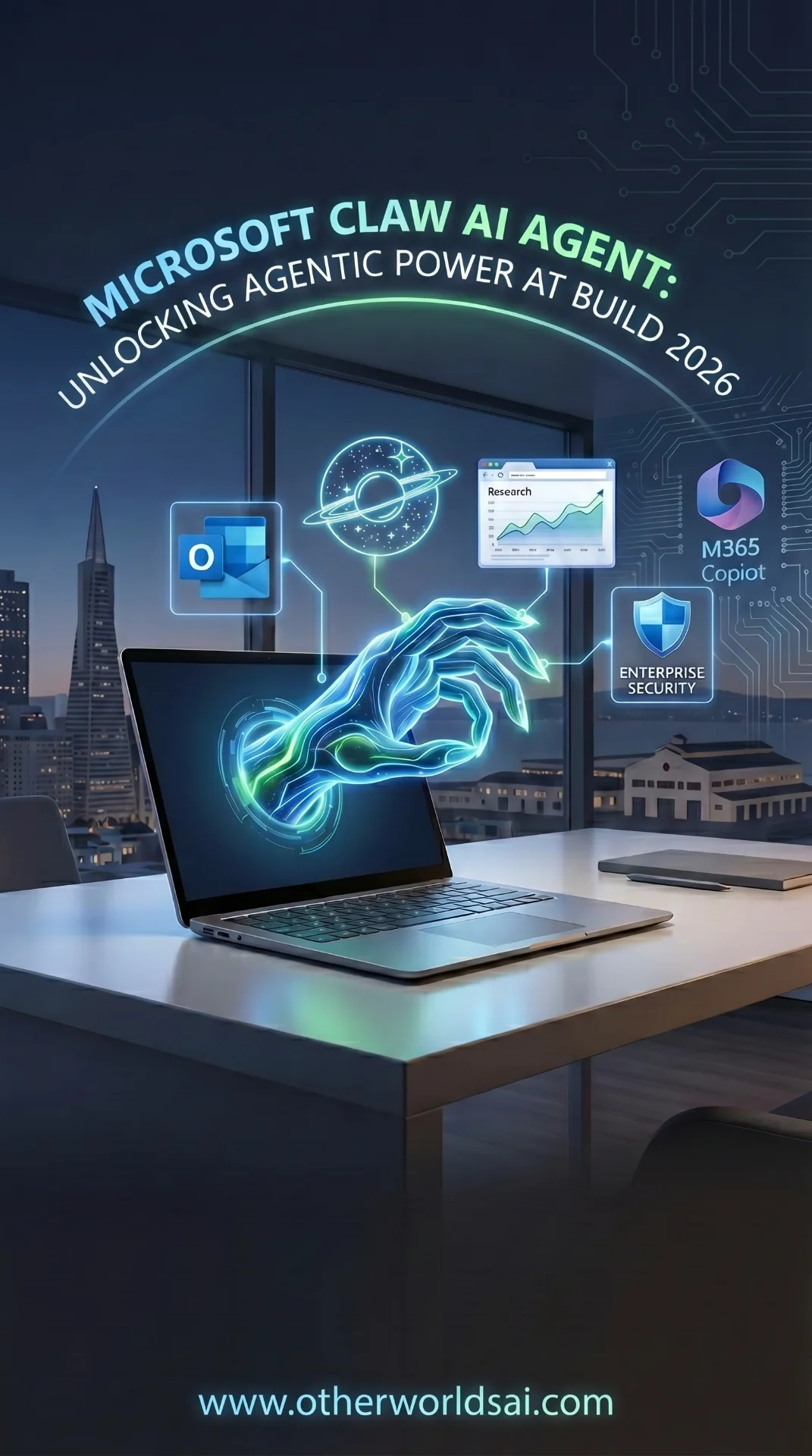
Microsoft is quietly preparing to change the way millions of people work — and it starts with a tool called Claw. According to a report by The Verge, Microsoft is actively working on a new AI agent inspired by the wildly popular open-source tool OpenClaw — and the company is expected to officially unveil this new Claw (or a significantly upgraded version of one of its existing Claw-like tools) at its flagship annual developer event, Microsoft Build, scheduled for June 2026 in San Francisco.
This is not just another incremental Copilot update. The move signals a fundamental strategic shift — Microsoft wants to bring the power of autonomous, task-executing AI agents directly into the enterprise, all wrapped in the security and compliance guardrails that business customers demand. Whether you're a developer, an IT administrator, or simply someone who lives inside Microsoft 365, what happens at Build 2026 could reshape how you work.
What Is OpenClaw — And Why Does Microsoft Want to Clone It?
To understand Microsoft's new Claw agent, you first need to understand what OpenClaw is and why it has captured the imagination of developers and enterprises alike. OpenClaw is an open-source AI agent tool that runs locally on a user's computer and creates autonomous agents capable of performing complex tasks on behalf of the user — from managing emails and organizing files to browsing the web and executing multi-step workflows — all without the user having to hover over it every step of the way.
The project began under a different name. Peter Steinberger, an Austrian software developer, originally launched the tool as "Clawdbot" in late 2025. After a trademark dispute with Anthropic, it was briefly renamed "Moltbot," before finally settling on OpenClaw in January 2026. Despite the identity crisis in its early weeks, the tool exploded in popularity, surpassing 100,000 GitHub stars by February 2026 and becoming one of the fastest-growing repositories in GitHub history.
The appeal of OpenClaw is simple but revolutionary. Unlike chatbots that merely answer questions, OpenClaw actually does things. Users interact with it through familiar messaging apps like WhatsApp, Telegram, or Slack, and the agent goes off and executes tasks in the background — booking appointments, drafting content, managing CRMs, sending emails — notifying users when the job is done. With over 44,000 skills listed on ClawHub as of April 2026, the ecosystem around OpenClaw has grown into a thriving marketplace of AI capabilities.
Microsoft's Claw Agent: What We Know So Far:
Microsoft has confirmed to The Information that it is working to integrate OpenClaw-like features into its Microsoft 365 Copilot platform. The new Claw agent is being designed specifically for enterprise customers, with enhanced security controls that address the well-documented vulnerabilities of the open-source OpenClaw project — including risks of prompt injection, malicious skills, and zero-click remote code execution exploits that have previously plagued the tool.
CEO Satya Nadella has reportedly made revamping Microsoft 365 Copilot a top internal priority. The company recognizes that competitors — including OpenAI, Anthropic, and the open-source community — are already enabling powerful agentic AI that can autonomously complete productivity tasks. Microsoft cannot afford to be left behind in its own core territory: the enterprise office suite.
One critical question remains unanswered. It is not yet clear whether Microsoft's new Claw agent will run locally on users' hardware — as OpenClaw does — or whether it will operate in the cloud like Copilot Cowork and Copilot Tasks. This distinction matters enormously for IT departments managing data residency requirements, and for users who want the speed and privacy benefits of local processing. Microsoft has not yet commented publicly on this detail.
Microsoft's Existing Agentic Tools: A Growing Arsenal:
Microsoft's Claw agent doesn't exist in a vacuum — it joins a rapidly expanding lineup of AI agent tools the company has released in recent months. Understanding these existing tools helps paint a picture of where the new Claw fits into Microsoft's broader agentic AI strategy.
Copilot Cowork, announced in March 2026, is perhaps the closest predecessor to what Microsoft's Claw agent aims to be. Cowork is designed to take direct actions inside Microsoft 365 apps — not just answer questions in a chat pane, but actually manipulate documents, manage emails, and interact with app interfaces on the user's behalf. What makes Cowork particularly noteworthy is its "Work IQ" technology — an intelligence layer that learns to personalize the experience across Microsoft 365 apps over time.
Microsoft has also integrated Anthropic's Claude as a model option within Cowork, a reflection of its partnership with the AI lab. However, Cowork runs in the cloud, not on local hardware.
Copilot Tasks, released in preview in February 2026, targets a broader prosumer audience. This agent is designed to handle a wider range of tasks — from organizing emails (within Microsoft's own app suite) to managing travel arrangements and appointments across third-party services. Like Cowork, Tasks runs in the cloud, which distinguishes it from the local-first philosophy of OpenClaw that many power users prefer.
The Microsoft Claw agent, if it runs locally, would fill a significant gap in this lineup. It would give enterprises the autonomous, always-on, local-execution model that OpenClaw users love — but with the enterprise-grade security, identity management, and compliance controls that corporate IT teams require before approving any AI agent deployment.
Microsoft Build 2026: What to Expect in San Francisco:
Microsoft Build 2026 is shaping up to be one of the most consequential developer conferences in the company's history. The event will be held at Fort Mason Center in San Francisco from June 2 to June 5, 2026 — a notable departure from Microsoft's traditional Seattle home base.
According to The Verge, Microsoft has deliberately chosen a smaller, more intimate venue that accommodates approximately 2,500 developers, roughly half the attendance of previous Build events. GitHub COO Kyle Daigle explained that the smaller setting is designed to create a more focused, hands-on experience.
The venue shift itself is strategic. By moving Build to San Francisco — the epicenter of AI research and startup culture — Microsoft is sending a clear message: it intends to compete for developer mindshare at the source, rather than asking the AI development community to travel to the Pacific Northwest. OpenAI, Anthropic, Google DeepMind, and hundreds of AI startups all call the Bay Area home.
The new Microsoft Claw agent is expected to be one of the headline announcements at Build 2026. The Verge reports that Microsoft is likely to either reveal a brand-new Claw tool or unveil significant upgrades to one of its existing agentic offerings. Given the competitive pressure from OpenClaw's explosive growth and enterprise interest from companies like Tencent, Alibaba Cloud, Nvidia, Adobe, and Salesforce, Microsoft has every incentive to make a major splash.
In-person tickets to Microsoft Build 2026 are priced at $1,099, but the main keynote and select sessions will be livestreamed free of charge. Developers who want to see Microsoft's Claw agent in action — and get hands-on time with the demos — should register sooner rather than later given the limited venue capacity.
Why Microsoft's Claw Agent Matters for Enterprise AI in 2026:
The timing of Microsoft's Claw agent announcement could not be more significant. We are living through what analysts at Andreessen Horowitz have described as an unprecedented surge in AI investment — global VC funding to AI companies reached $242 billion in Q1 2026 alone, driven by mega-rounds from OpenAI, Anthropic, xAI, and Waymo. Enterprise adoption of agentic AI is accelerating at every level of the market.
OpenClaw's viral growth has demonstrated conclusively that there is massive pent-up demand for AI agents that actually do things. Enterprises have watched their employees adopt OpenClaw informally — sometimes without IT approval — to automate repetitive tasks and boost productivity. Nvidia has already built an enterprise-grade security stack on top of OpenClaw called NemoClaw, while companies like Adobe, IBM's Red Hat, Box, and Salesforce have all expressed formal interest in the ecosystem.
Microsoft's opportunity is enormous — but so is the execution challenge. The company must deliver an agentic experience compelling enough to compete with OpenClaw's passionate user base and broad skills ecosystem, while simultaneously solving the security and compliance problems that have made IT departments wary of autonomous AI agents. If Microsoft gets this right, the Claw agent could become the infrastructure layer for how hundreds of millions of office workers interact with AI — a transformation that would dwarf anything Microsoft 365 has achieved to date.
Security: The Make-or-Break Factor for Enterprise Claw Agents:
Security is where Microsoft's Claw agent must differentiate itself — and where the stakes are highest. OpenClaw's rapid growth has been accompanied by serious security incidents. In early 2026, a critical zero-click remote code execution vulnerability (CVE-2026-25253) was discovered in the tool, allowing attackers to gain complete control of a user's agent simply by having them visit a malicious website — no authentication bypass required. Microsoft Security itself published an advisory urging immediate mitigation.
Supply chain attacks have also emerged as a major concern. Security researchers at Snyk discovered over 1,400 malicious skills in the OpenClaw skills registry that combined prompt injection techniques with traditional malware, with some malicious skills installed hundreds of thousands of times before detection. For enterprise IT teams managing thousands of endpoints, these risks are simply unacceptable.
Microsoft's approach, according to reports, focuses on implementing the strict security controls that enterprises need — including better access permissioning, identity management through Microsoft Entra, and a curated, reviewed skills ecosystem — while preserving the core appeal of agentic AI: the ability to take real actions on behalf of users without constant supervision. The integration of Entra Agent ID for managing AI agents' identities, announced at Build 2025, suggests Microsoft already has foundational pieces in place.
Conclusion: The Claw Is Coming — And It Could Change Everything:
Microsoft's new Claw agent represents more than just a new product feature. It is a declaration of intent — a statement that Microsoft is not content to let open-source tools and AI startups define the future of agentic computing inside the enterprise. By bringing a secure, scalable, enterprise-ready version of the OpenClaw experience into Microsoft 365 Copilot, the company has the potential to make autonomous AI agents a mainstream reality for hundreds of millions of knowledge workers worldwide.
Microsoft Build 2026 in San Francisco this June will be the moment of truth. Whether the company reveals an entirely new Claw tool or unveils upgraded versions of Cowork and Copilot Tasks, the message will be the same: the age of AI that merely advises is over. The age of AI that acts has begun.
Stay tuned to Microsoft Build 2026 — and watch this space.The Claw is coming.
Support our research
Independent analysis fueled by you.