
Elon Musk Unveils Terafab: Tesla and SpaceX's Bold Chip Manufacturing Plans That Could Reshape the Future of AI:
SpaceX and Tesla Are Building Their Own 2nm Chips—Here’s the Plan:
Introduction: The Chip Crisis Driving a New Era of Manufacturing:
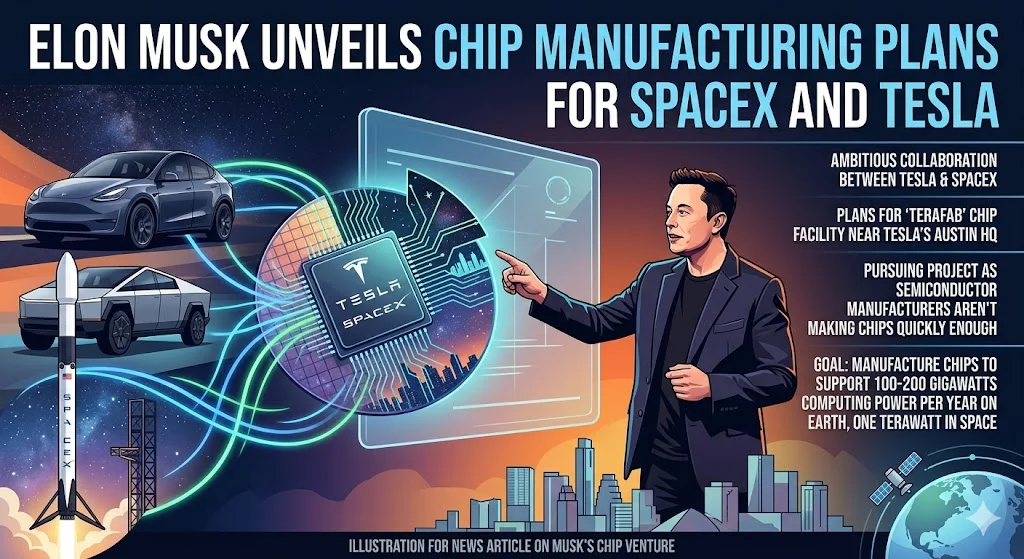
In a dramatic announcement that sent shockwaves through the tech and semiconductor industries, Elon Musk revealed sweeping plans for a joint chip manufacturing initiative between his two flagship companies — Tesla and SpaceX. The bold venture, called “Terafab,” was unveiled at a high-profile event held Saturday night in downtown Austin, Texas — setting the stage for what could become one of the most ambitious semiconductor projects of the decade.
The announcement comes at a time when global chip demand has reached unprecedented levels, driven largely by the explosive growth of artificial intelligence, machine learning, and autonomous robotics. For companies like Tesla and SpaceX — both of which are deeply invested in AI-powered systems — access to cutting-edge semiconductors isn't just a competitive advantage. It's a survival necessity.
What Is Terafab? Inside Musk's Semiconductor Vision:
According to reports from Bloomberg, the proposed Terafab facility is expected to be located near Tesla's Austin headquarters and Gigafactory, creating a vertically integrated tech campus that blends electric vehicle production, AI development, and now chip fabrication under one roof. Photos from the event suggest the facility will be tightly integrated with Tesla's existing Texas operations.
Musk laid out an ambitious target: manufacture chips capable of supporting 100 to 200 gigawatts of computing power per year on Earth, with an even more staggering goal of achieving one terawatt of computing power in space. These are numbers that dwarf the current output of most established chip manufacturers — and they underscore just how differently Musk thinks about scale.
The rationale behind Terafab is straightforward, in Musk's own words: Musk put it bluntly: "We either build the Terafab or we don't have the chips, and we need the chips, so we build the Terafab." It's a classic Musk-ian ultimatum -- identify a bottleneck, and build your way out of it.
Why Tesla and SpaceX Need Their Own Chips: The AI and Robotics Imperative:
The semiconductor shortage has long been a thorn in the side of high-tech manufacturers, but for companies like Tesla and SpaceX, the problem runs deeper than supply chain disruptions. These companies are developing next-generation AI systems — from Tesla's Full Self-Driving (FSD) software and Optimus humanoid robots to SpaceX's Starship navigation and Starlink satellite networks — all of which are incredibly compute-hungry.
Traditional semiconductor manufacturers, even the most advanced ones, are simply not scaling fast enough to meet the unique, large-volume, high-performance needs of companies pushing the frontier of AI hardware. Musk's frustration with the pace of chip production from existing vendors has been an open secret in Silicon Valley for years.
By building Terafab, Musk aims to bring semiconductor production in-house, much like Tesla did with battery manufacturing and SpaceX did with rocket engines. The strategy of vertical integration has been central to both companies' success — and now Musk is betting it will work in the chip world too.
A Terawatt in Space: SpaceX's Role in the Terafab Mission:
Perhaps the most audacious element of Musk's vision is the space-based computing goal. The plan to achieve one terawatt of computing power in orbit represents a quantum leap beyond anything currently in deployment. This kind of space-based processing power could support everything from global AI inference networks to real-time satellite intelligence systems, potentially operated through SpaceX's Starlink constellation.
SpaceX's involvement in the Terafab project hints at a future where computation itself becomes a space industry — where chips designed and built on Earth are launched into orbit to power the next generation of cloud computing, autonomous systems, and deep-space missions. While the timelines remain undefined, the ambition is unmistakable.
Can Musk Deliver? The Track Record of Bold Promises
Of course, any Elon Musk announcement must be filtered through the lens of his well-documented history of ambitious — and sometimes delayed — promises. Bloomberg itself noted that Musk has no prior background in semiconductor manufacturing, a field known for its extraordinary complexity, capital requirements, and long lead times. Building a world-class fab from scratch typically takes years and tens of billions of dollars.
Musk's track record is, to put it charitably, mixed when it comes to timelines. Tesla's Full Self-Driving promises have been perpetually deferred. The Cybertruck launch was delayed for years. Starship has seen repeated setbacks. And yet — SpaceX is now the world's leading private launch provider, Tesla is a global EV powerhouse, and both companies have fundamentally disrupted their respective industries.
The question with Terafab isn't whether Musk can dream big — it's whether the execution can match the vision. Chip manufacturing is one of the most technically demanding and capital-intensive industries on the planet. Companies like TSMC and Samsung have spent decades mastering it. Musk would be entering this arena as a newcomer — but he's been a newcomer before.
Industry Implications: What Terafab Means for the Semiconductor Landscape:
If Terafab becomes a reality, its impact on the global semiconductor industry could be profound. A new domestic chip manufacturer aligned with major AI and EV use cases could reduce US dependence on Asian semiconductor supply chains — a geopolitical priority that has gained urgency following the CHIPS Act and ongoing US-China tensions around Taiwan's chip industry.
For AI chipmakers like Nvidia, Intel, and AMD, Terafab represents a new kind of competitive threat — not from a traditional rival, but from a major customer who has decided to build his own solution. If Tesla and SpaceX vertically integrate chip production at scale, the ripple effects across the AI hardware supply chain could be enormous.
More broadly, Terafab could accelerate the trend toward custom silicon — chips designed specifically for particular AI workloads rather than general-purpose computing. Apple has shown this is possible with its M-series chips; Google has done it with TPUs. Musk is betting Tesla and SpaceX can do it at even greater scale.
Key Takeaways: What We Know About Terafab So Far:
Here's a quick summary of the confirmed details:
-
Location: Near Tesla's Austin headquarters and Gigafactory, Texas.
-
Partners: Tesla and SpaceX — a joint effort across Musk's two largest companies.
-
Goal: 100–200 gigawatts of computing power on Earth per year; 1 terawatt in space.
-
Motivation: Semiconductor suppliers aren't keeping pace with AI and robotics demands.
-
Timeline: Not yet announced.
-
Musk's semiconductor background: None — but vertical integration is a proven playbook.
Conclusion: A Moonshot With Real Stakes:
Elon Musk's Terafab announcement is equal parts visionary and audacious — a reminder that the man who built reusable rockets and mass-market electric vehicles doesn't see industry norms as constraints. Whether or not Terafab hits its targets on time, the announcement signals something important: the era of AI-driven vertical integration in hardware is just beginning.
For investors, tech enthusiasts, and industry analysts alike, Terafab is a project worth watching closely. If successful, it could give Tesla and SpaceX a decisive edge in the AI arms race — and potentially reshape the global semiconductor supply chain in the process. If it falls short, it will join a long list of Musk moonshots that were bold in concept but difficult in execution.
Either way, the chips are on the table. And Elon Musk is betting everything on building his own.
Support our research
Independent analysis fueled by you.