
OpenAI Codex-Spark Launch 2025: New Lightweight AI Coding Tool Powered by Cerebras WSE-3 Chip:
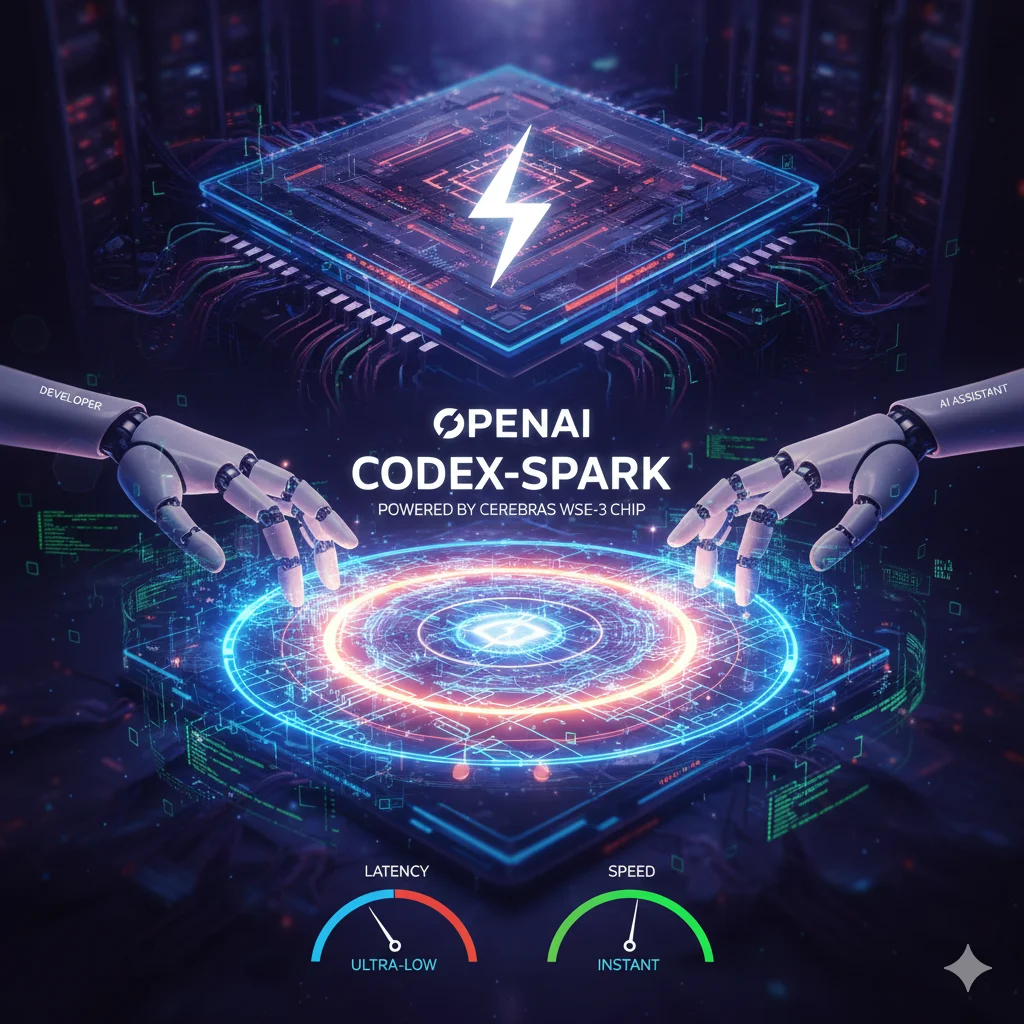
On Thursday, OpenAI announced the release of a lightweight version of its agentic coding tool Codex, the latest model of which OpenAI launched earlier this month. GPT-5.3-Codex-Spark is described by the company as a "smaller version" of that model, one that is designed for faster inference and real-time AI coding collaboration.
Revolutionary AI Chip Partnership: OpenAI and Cerebras Integration:
To power the new Codex-Spark's lightning-fast inference, OpenAI has brought in a dedicated chip from its hardware partner Cerebras, marking a new level of integration in the company's physical infrastructure. This represents a significant milestone in AI chip technology and developer tool optimization.
The partnership between Cerebras and OpenAI was announced last month, when OpenAI revealed that it had reached a multi-year agreement with the firm worth over $10 billion. "Integrating Cerebras into our mix of compute solutions is all about making our AI respond much faster," the company said at the time. Now, OpenAI calls Spark the "first milestone" in that relationship.
What is GPT-5.3-Codex-Spark? Understanding the Lightweight AI Coding Assistant:
Spark, which OpenAI says is designed for swift, real-time collaboration and "rapid iteration," will be powered by Cerebras' Wafer Scale Engine 3 (WSE-3). The WSE-3 is Cerebras' third-generation waferscale megachip, decked out with 4 trillion transistors—making it one of the most powerful AI inference chips available.
OpenAI describes the new lightweight tool as a "daily productivity driver, helping users with rapid prototyping" rather than the longer, heavier tasks that the original GPT-5.3 Codex is designed for. This dual-mode approach gives developers flexibility: use Spark for quick iterations and instant feedback, or switch to the full Codex model for complex, long-running coding tasks.
Spark is currently enjoying a research preview for ChatGPT Pro users in the Codex app, giving early adopters access to test the fastest AI coding assistant OpenAI has released to date.
Sam Altman Hints at Codex-Spark: "It Sparks Joy":
In a tweet in advance of the announcement, CEO Sam Altman seemed to hint at the new model with his characteristic cryptic style. "We have a special thing launching to Codex users on the Pro plan later today," Altman tweeted. "It sparks joy for me."
The playful reference to "sparks" turned out to be a direct nod to the product name, showcasing Altman's enthusiasm for the low-latency AI coding experience that Cerebras' chip technology enables.
Two-Mode Codex Strategy: Real-Time vs. Deep Reasoning:
In its official statement, OpenAI emphasized Spark as designed for the lowest possible latency on Codex. "Codex-Spark is the first step toward a Codex that works in two complementary modes: real-time collaboration when you want rapid iteration, and long-running tasks when you need deeper reasoning and execution," OpenAI shared.
The company added that Cerebras' chips excel at assisting "workflows that demand extremely low latency"—crucial for developers who need instant feedback while writing code, debugging, or prototyping new features. This positions Codex-Spark as the ideal AI pair programmer for agile development environments.
Cerebras' Rise in the AI Chip Industry: From Startup to $23 Billion Valuation:
Cerebras has been around for over a decade but, in the AI era, it has enjoyed an increasingly prominent role in the tech industry. The company's waferscale chip architecture—where an entire silicon wafer becomes a single chip—represents a radical departure from traditional GPU-based AI computing.
Just last week, the company announced that it had raised $1 billion in fresh capital at a valuation of $23 billion, cementing its position as a major player in AI infrastructure. The company has previously announced its intentions to pursue an initial public offering (IPO), which would be one of the most anticipated tech offerings in the AI chip sector.
What Makes Cerebras WSE-3 Different? Understanding Waferscale AI Chips:
The Wafer Scale Engine 3 represents cutting-edge AI hardware innovation. Unlike traditional chips that are cut from silicon wafers into small individual processors, Cerebras' WSE-3 uses an entire wafer as a single massive chip. This architecture provides:
-
Massive parallel processing capability with 4 trillion transistors working simultaneously.
-
Ultra-low latency for AI inference tasks, critical for real-time applications like Codex-Spark.
-
High memory bandwidth that eliminates bottlenecks in data transfer during AI model execution.
-
Energy efficiency compared to data centers filled with multiple smaller GPUs.
Industry Impact: The Future of AI Coding Assistants:
"What excites us most about GPT-5.3-Codex-Spark is partnering with OpenAI and the developer community to discover what fast inference makes possible—new interaction patterns, new use cases, and a fundamentally different model experience," Sean Lie, CTO and co-founder of Cerebras, said in a statement. "This preview is just the beginning."
This partnership signals a broader trend in the AI industry: the move toward specialized hardware optimized for specific AI workloads. While NVIDIA has dominated AI training chips, companies like Cerebras are proving that inference—the process of actually running AI models—requires different architectural approaches.
How Codex-Spark Changes Developer Workflows:
For developers using ChatGPT Pro, Codex-Spark represents a significant upgrade in coding assistant capabilities. The low-latency response times mean:
-
Instant code suggestions as you type, with minimal lag. Real-time error detection and fixes during active development.
-
Rapid prototyping cycles where ideas can be tested and iterated in seconds.
-
Seamless pair programming experience with an AI assistant that keeps pace with human thought.
-
Reduced context switching between thinking and coding, maintaining flow state.
The Competitive Landscape: OpenAI vs. GitHub Copilot and Others:
OpenAI's Codex-Spark enters a competitive market for AI coding assistants, including GitHub Copilot (powered by earlier Codex models), Amazon CodeWhisperer, Google's Duet AI, and emerging startups like Cursor and Replit. The Cerebras chip integration gives OpenAI a potential edge in response time and user experience.
The dual-mode strategy—Spark for speed, full Codex for depth**—also differentiates OpenAI's approach. Rather than forcing developers to choose between fast responses and intelligent output, the company offers both within the same platform.
Pricing and Availability: Who Can Access Codex-Spark?
Currently, GPT-5.3-Codex-Spark is available as a research preview exclusively for ChatGPT Pro subscribers using the Codex app. OpenAI has not announced pricing details for broader availability or whether Spark will eventually roll out to other subscription tiers.
ChatGPT Pro costs $200 per month and offers access to OpenAI's most advanced models and features. For professional developers who rely on AI coding assistants daily, the enhanced speed and capabilities of Codex-Spark may justify this premium tier.
What This Means for the Future of AI Development Tools:
The launch of Codex-Spark powered by dedicated Cerebras chips represents more than just a product update—it signals a strategic direction for OpenAI's infrastructure. By partnering with specialized chip manufacturers beyond NVIDIA, OpenAI gains:
-
Greater control over AI inference performance and cost structure.
-
Differentiated capabilities that competitors using standard cloud GPUs cannot easily replicate.
-
Flexibility to optimize different models for different hardware architectures.
-
Potential cost savings at scale, important as AI inference costs continue to climb.
Developer Community Reactions and Early Testing:
As with any research preview, early feedback from ChatGPT Pro developers will be crucial in shaping Codex-Spark's evolution. OpenAI has a track record of rapidly iterating based on user input, particularly with developer-focused tools.
The developer community will likely test Spark's limits across various programming languages, frameworks, and use cases—from web development to systems programming to data science workflows. This real-world testing will reveal where ultra-low latency provides the most value.
The Road Ahead: OpenAI's Vision for AI-Powered Development:
"Codex-Spark is the first step toward a Codex that works in two complementary modes," OpenAI stated, suggesting this is just the beginning of a more ambitious vision for AI-assisted software development.
Future developments might include:
-
More specialized variants optimized for specific programming languages or domains.
-
Deeper integration with IDEs and development environments beyond the Codex app.
-
Team collaboration features that allow multiple developers to work with AI assistance simultaneously.
-
Expanded model capabilities as both OpenAI's models and Cerebras' chips continue advancing.
Conclusion: A New Era of Lightning-Fast AI Coding:
The launch of GPT-5.3-Codex-Spark marks a significant milestone in AI-powered software development. By combining OpenAI's advanced language models with Cerebras' cutting-edge waferscale chip technology, developers gain access to unprecedented speed in AI coding assistance.
As the $10 billion partnership between OpenAI and Cerebras unfolds, we can expect more innovations that push the boundaries of what's possible with AI inference. For developers, the promise of real-time AI collaboration without perceptible lag brings us closer to truly seamless human-AI pair programming.
Whether Codex-Spark lives up to its promise will depend on how well it performs in real-world development scenarios.
But one thing is clear: the race to build faster, smarter, and more responsive AI coding assistants has entered a new phase, and OpenAI is betting big on specialized hardware to win it.
Support our research
Independent analysis fueled by you.