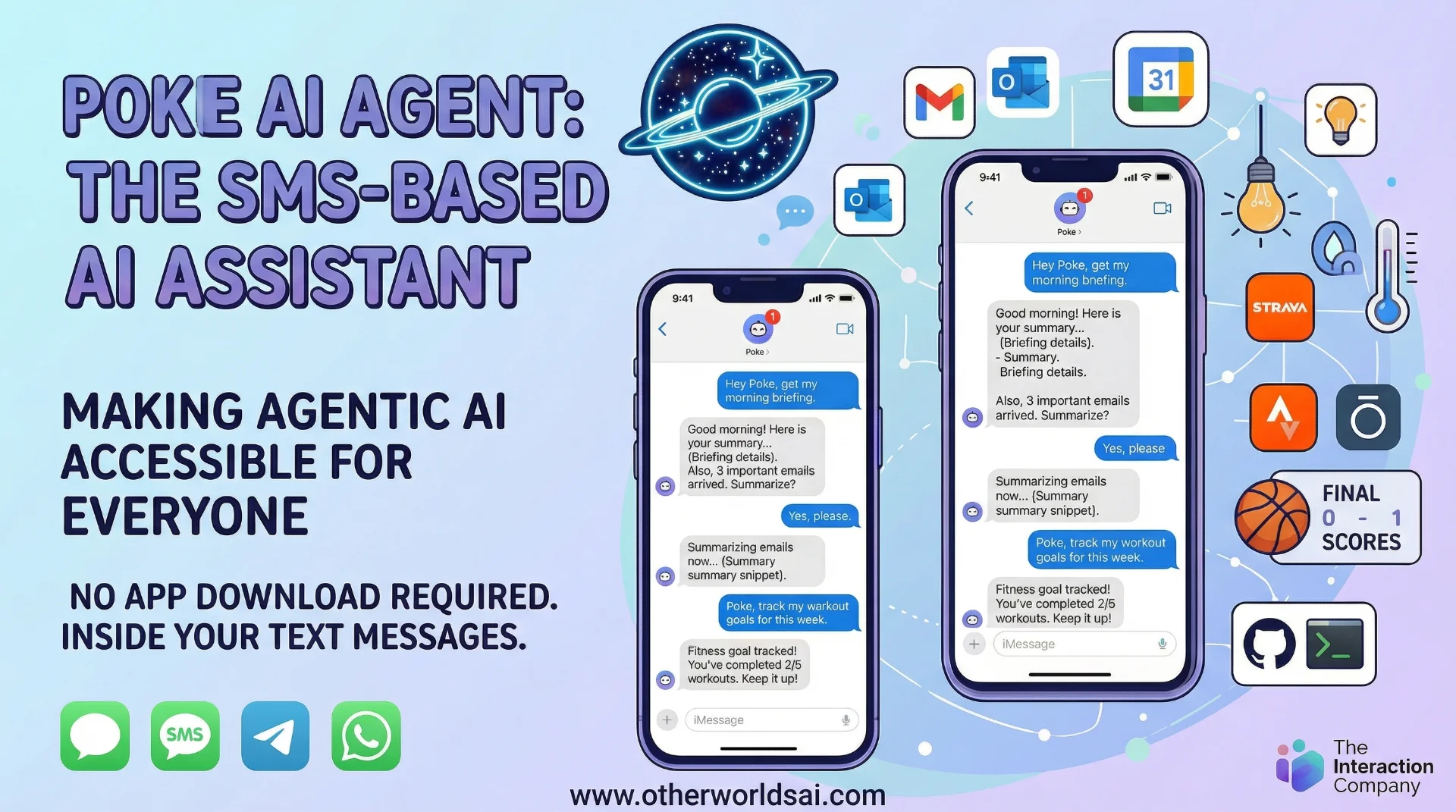

Poke AI Agent: The SMS-Based AI Assistant Making Agentic AI Accessible for Everyone:
How a $300M Startup Is Bringing Personal AI Agents to iMessage, SMS, and Telegram — No App Download Required:or "Inside Your Text Messages" address a common pain point (app fatigue).
The AI agent revolution is here — and it's arriving via text message. A new startup called Poke is betting that the future of agentic AI isn't locked inside complex developer tools or enterprise software suites. Instead, it lives where billions of people already spend their digital lives: in their messaging apps. Poke, the AI agent built by The Interaction Company of California, launched publicly in March and is rapidly becoming one of the most talked-about personal AI assistants in the tech world — and for good reason.
What Is Poke AI Agent: The SMS-Powered Personal Assistant Explained:
Poke is an AI-powered personal assistant that you access entirely through messaging — no app download, no terminal, no technical setup required. Available on iMessage, SMS, Telegram, and select WhatsApp markets, Poke lets everyday users harness the power of AI agents through a familiar interface they already use every day. Simply visit Poke.com, enter your phone number, and you're up and running within seconds.
The core value proposition is elegant in its simplicity: while AI chatbots like ChatGPT or Claude excel at answering questions and research tasks, Poke is purpose-built for taking action. Need to automate your morning briefing? Done. Want an alert whenever an important email lands? Easy. Looking to track your fitness goals, control your smart home, or catch last night's game scores? Poke handles it all — through a text message.
The $300 Million Valuation: How Poke Raised $25 Million and Caught Investor Attention:
Backed by some of Silicon Valley's most respected names, Poke has quickly become one of the most well-funded AI agent startups of 2025. The company closed a $15 million seed round followed by an additional $10 million injection, bringing its post-money valuation to $300 million. Lead investors include Spark Capital and General Catalyst — two firms with strong track records in consumer and enterprise technology.
The angel investor roster reads like a who's who of tech royalty. Patrick and John Collison (founders of Stripe), YouTube and social media personality Logan Paul, Logan Kilpatrick from DeepMind, and Joanne Jang of OpenAI have all backed Poke. Also on the cap table: Vercel co-founder Guillermo Rauch, PayPal co-founder Ken Howery, Dropbox co-founder Arash Ferdowsi, and Hugging Face co-founder Thomas Wolf — a constellation of believers that signals serious confidence in Poke's long-term potential.
Poke vs. OpenClaw: Why SMS-Based AI Agents Are Winning the Accessibility Battle:
The agentic AI space is heating up fast, with OpenAI's acquisition of OpenClaw's creator making headlines and Nvidia CEO Jensen Huang publicly urging every company to develop an AI agent strategy. But for most people outside Silicon Valley, terms like 'agentic AI' and 'OpenClaw' still feel abstract and inaccessible. Installing software through a terminal, managing dependencies, and navigating security risks are barriers that keep the technology firmly in the hands of developers.
Poke was designed from the ground up to eliminate those barriers. Where OpenClaw requires deep system access and technical know-how, Poke operates through the simplest interface imaginable: a text message. There's no software to install, no permissions to configure, and no learning curve to navigate. For the non-technical majority, Poke represents the most practical path to experiencing the benefits of agentic AI today.
From Email Assistant to General-Purpose AI: The Origin Story Behind Poke:
Poke didn't start out as a general-purpose AI assistant — and that origin story reveals a lot about why it's resonating so strongly with users. Co-founder Marvin von Hagen and the team at The Interaction Company of California initially built Poke as an AI-powered email assistant. The product showed promise, but something unexpected happened during beta testing: users started treating it like a universal personal assistant.
"What we noticed there was that people wanted to use Poke for everything… Even though it was only meant for email, people started asking Poke to remind them to take their medication. They asked Poke about sports results — 'Hey Poke, tell me every morning if I need a jacket or not.'" — Marvin von Hagen, Co-founder
That organic behavior told the team everything they needed to know. Users weren't just responding to the functionality — they were responding to the personality. The humanness of the interaction, the conversational warmth, the sense that Poke actually understood them, drove adoption far beyond the product's original scope. The team made the decision to pivot, expanding Poke into the general-purpose AI agent it is today.
Poke AI Features: Everything You Can Do With a Single Text:
The range of what Poke can do for you today is remarkably broad, spanning personal productivity, health, home automation, and developer workflows. At the heart of the product is a library of 'recipes' — pre-built automations that you install with a single click and authorize through a standard process. These cover categories including health and wellness, finance, scheduling, travel, smart home control, email management, and community tools.
Health and fitness users will find deep integration with popular wearables and platforms. Poke connects natively with Strava, Oura, Fitbit, and Withings, making it possible to track goals, log workouts, and receive proactive nudges without opening a single dedicated app. Smart home enthusiasts can control Philips Hue lighting and Sonos speakers directly through text commands.
Productivity integrations are equally impressive, covering the tools modern teams rely on daily. Gmail, Google Calendar, Outlook, Notion, Linear, and Granola are all supported out of the box. For software developers, the platform extends even further with integrations for PostHog, Webflow, Supabase, Vercel, Devin, Sentry, GitHub, and Cursor Cloud Agents — making Poke a legitimate power tool for technical professionals as well as everyday users.
Model-Agnostic AI: Why Poke's Multi-Provider Strategy Is a Competitive Moat:
One of Poke's most strategically significant technical decisions is its model-agnostic architecture — and von Hagen is direct about why this matters competitively. Rather than tying its performance to a single AI provider, Poke selects the best available model for each specific task, drawing from major commercial AI providers and open-source models alike. "Almost all of our competitors are just big tech and labs that are bound to a specific provider. Meta AI will only ever be able to use Meta models, and ChatGPT will only ever be able to use OpenAI models." — Marvin von Hagen
This flexibility positions Poke to continuously improve as the AI model landscape evolves. Rather than being locked into one provider's strengths and limitations, Poke can route tasks to whichever model performs best — today and in the future. It's a future-proof architecture that could prove to be one of the company's most durable competitive advantages.
Poke Pricing: Free to Start, Personalized to Your Usage:
Poke's pricing model is as unconventional as the product itself — and far more accessible than most AI subscription services. The service is free to start, and pricing scales based on actual usage rather than flat subscription tiers. Casual users who primarily ask questions that don't require real-time data may be able to use Poke entirely for free.
What drives cost is real-time inference — automations that trigger on every incoming email, live flight tracking, or other tasks that require constant data processing. The company has given Poke itself guidance on its own cost structure, enabling the AI agent to determine personalized pricing for each user. During beta, users actually negotiated their monthly price directly with the AI, landing on figures ranging from $10 to $30 per month. Monetization is explicitly not the priority right now, and von Hagen makes no bones about it.
"We really don't want to make money, but we really want to grow. We want to build a product for a billion people and monetization is really secondary." — Marvin von Hagen
Poke Security and Privacy: Multi-Layered Protection for Your Personal Data:
Trust is non-negotiable when an AI agent has access to your email, calendar, and smart home devices — and Poke has built its security model accordingly. The platform employs multi-layered security architecture including regular penetration testing, automated security checks, and strict permission limiting for both AI agents and human employees.
By default, even Poke's own team cannot see what's inside user tokens. Access to usage logs or analytics is entirely opt-in — users must manually flip a switch in their settings to share this information. This privacy-first approach stands in contrast to the opaque data practices of many AI platforms and could be a meaningful differentiator as consumer awareness of AI data handling continues to grow.
Poke's WhatsApp Problem — and the Antitrust Fight That Could Change Everything:
Poke's messaging platform strategy hit a significant obstacle when Meta barred third-party general-purpose chatbots from WhatsApp last fall. With WhatsApp holding dominant market share in key regions including Brazil and the European Union, this restriction directly limits Poke's addressable user base in some of the world's most important markets.
But regulatory pushback is already creating openings. Antitrust regulators in the EU, Italy, and Brazil have launched investigations into Meta's decision, and Poke has already returned to Brazil as a result. Von Hagen describes Meta's high fees for WhatsApp access as 'malicious compliance,' predicting that pricing and access policies will be forced to change as regulatory pressure mounts. If those investigations succeed, Poke could rapidly expand to hundreds of millions of additional users.
Community-Powered Automation: How Poke Users Are Building the Future Together:
One of the most exciting aspects of Poke's product vision is its community-driven recipe ecosystem — and it's already taking off in ways the team didn't fully anticipate. Over the past few weeks, Poke users have created thousands of custom recipes and automations, which the company plans to feature in a public discovery directory in the near future.
To accelerate this ecosystem, Poke is paying creators for growth — literally. The company offers between 10 cents and one dollar (adjusted by geography) for every new user who signs up for Poke through a creator's shared recipe. It's a creator economy model applied to AI automation, and it aligns incentives perfectly: creators build better recipes, new users discover Poke through relevant use cases, and the overall product becomes more valuable for everyone.
The Verdict: Is Poke the AI Agent That Finally Works for Everyone?
Poke represents something genuinely new in the AI agent landscape — not because its underlying technology is more advanced, but because its delivery mechanism is radically more human. By meeting users where they already are (their messaging apps), removing every technical barrier to entry, and building an experience warm enough that beta users started treating an email assistant like a life coach, Poke has found a product-market fit that larger, better-resourced AI players have struggled to replicate.
The company's 10x user growth over the past two months, its appearance at the top of Vercel's AI Gateway leaderboard, and its ability to attract investors from Stripe, PayPal, Dropbox, and DeepMind all suggest Poke is onto something real. Whether it can scale to the billion users von Hagen envisions remains to be seen —
but as AI agents move from developer curiosity to everyday utility, Poke is currently one of the most compelling answers to the question: 'What does AI that actually works for normal people look like?'
The answer, it turns out, looks a lot like a text message.
Support our research
Independent analysis fueled by you.