
The World Economic Forum (WEF) in Davos
has long been associated with discussions on climate change, global inequality, geopolitics, and economic stability. However, Davos 2026 marked a clear turning point. This year, the Swiss mountain town felt less like a diplomatic summit and more like a high-powered global AI and technology conference, dominated by some of the world’s most influential tech CEOs.
Executives including Elon Musk (Tesla), Jensen Huang (Nvidia), Satya Nadella (Microsoft), and Dario Amodei (Anthropic) took center stage, turning artificial intelligence into the defining theme of the week. While they promoted AI’s transformative promise, they also openly clashed, criticized each other, and revealed growing anxiety about an AI investment bubble.
Davos Transformed Into an AI Showcase:
One of the most striking changes at Davos 2026 was visual. According to TechCrunch reporters Kirsten Korosec and Sean O’Kane, traditional global policy discussions struggled to draw crowds, while AI and tech companies dominated attention.
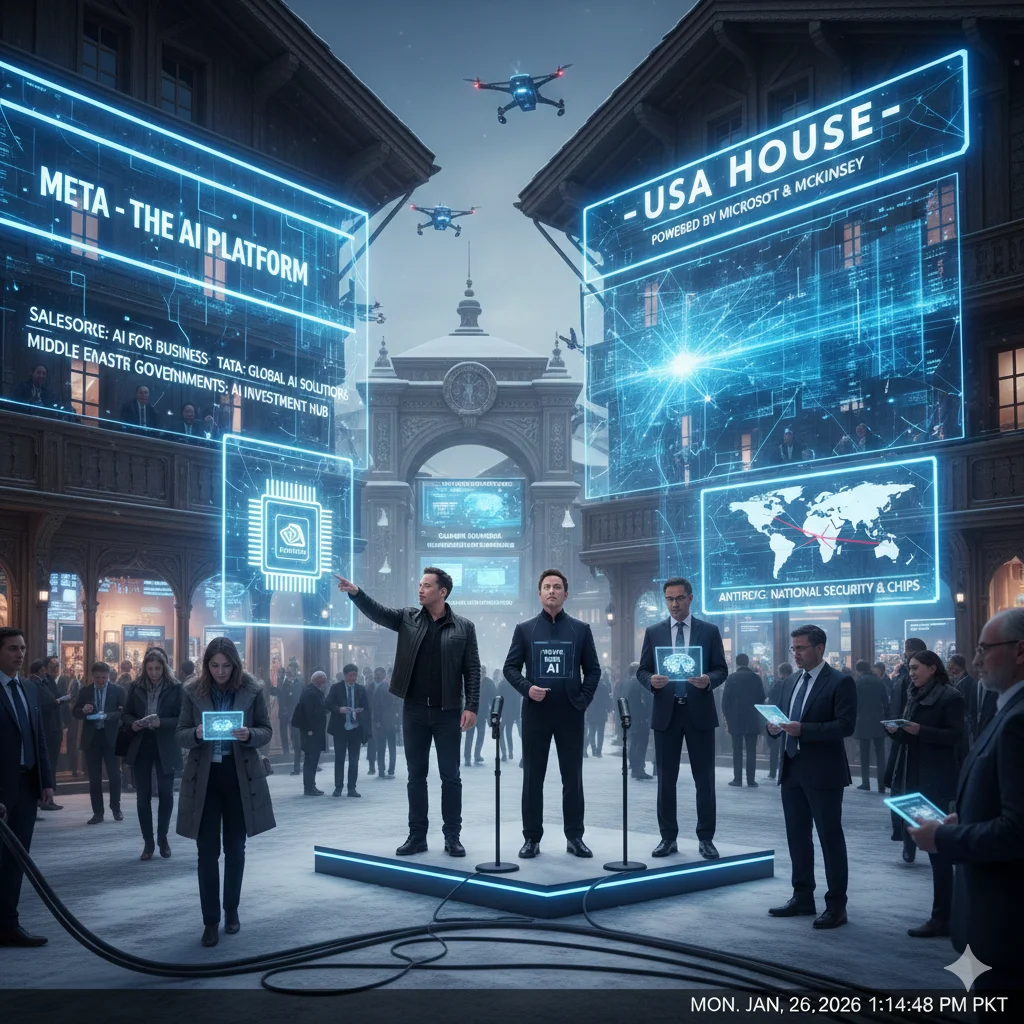
Major storefronts along the Davos promenade were taken over by Meta, Salesforce, Tata, and Middle Eastern governments, while the USA House—sponsored by McKinsey and Microsoft—was the largest presence on the strip. Climate change panels, poverty discussions, and humanitarian topics, once central to Davos, were notably sidelined.
This shift reflects a broader reality: AI is no longer just a technology story—it is a geopolitical, economic, and cultural force.
Elon Musk’s Rare Appearance at Davos:
Elon Musk’s attendance alone signaled how significant AI has become. Historically skeptical of Davos, Musk surprised many by showing up in person. While critics noted that his comments lacked substance, his presence underscored the event’s growing relevance to the tech elite. More importantly, Musk’s appearance reinforced the idea that AI leadership now equals global influence, a theme echoed repeatedly throughout the conference.
Anthropic vs Nvidia: AI, Chips, and Geopolitics:
One of the biggest headlines came from Dario Amodei, CEO of Anthropic, who sharply criticized a U.S. policy decision allowing Nvidia to sell AI chips to China. His argument went beyond technology and directly into national security and international trade.
Amodei famously described AI data centers as “a country full of geniuses”, arguing that exporting advanced AI chips was equivalent to transferring immense intellectual power abroad. The remark sparked controversy—not least because Anthropic itself relies heavily on Nvidia GPUs, highlighting the complex interdependencies within the AI ecosystem.
This moment perfectly captured the contradiction at Davos: AI companies are partners, competitors, and political actors—all at once.
Satya Nadella and the Fear of an AI Bubble:
Microsoft CEO Satya Nadella took a more pragmatic tone but revealed a deeper concern shared by many executives: AI adoption must scale rapidly, or the entire sector risks collapse.
Nadella repeatedly referred to data centers as “token factories”, framing AI infrastructure as a production engine that only works if demand continues to grow. His message was clear—if people and businesses do not use AI at scale, the hype will collapse into a popped bubble.
At the same time, Nadella emphasized equitable AI access, arguing that AI should not remain concentrated in wealthy regions but be distributed globally. This positioned Microsoft as both a commercial player and a moral advocate, even as it aggressively pushes AI usage across its platforms.
Jensen Huang: More Investment, More Jobs, More AI:
Nvidia CEO Jensen Huang echoed similar concerns but focused heavily on investment and job creation. According to Huang, the world is not investing enough in AI infrastructure, and sustained capital is required to unlock AI’s full potential.
However, critics note a glaring omission: no one at Davos discussed what happens when AI infrastructure buildouts slow down. The assumption of endless growth remains largely unchallenged, raising questions about long-term sustainability.
CEOs Sniping in the Same Room—for the First Time:
Perhaps the most revealing aspect of Davos 2026 was the visible tension between AI leaders sharing the same stage. Historically, these CEOs appear separately at conferences, carefully managing narratives. At Davos, they were side by side, openly critiquing each other’s strategies, policies, and assumptions.
This public friction reflects deeper realities:
- Fierce competition for AI talent.
- Massive infrastructure costs.
- Pressure to justify valuations.
- Fear of overspending ahead of real-world demand.
For the first time, the rivalry behind the AI boom became unmistakably public. AI at Davos: Vision or Vulnerability?
Davos 2026 revealed a paradox at the heart of the AI revolution. On one hand, CEOs painted AI as the solution to productivity, innovation, and global growth. On the other, their comments betrayed deep uncertainty about demand, regulation, geopolitics, and sustainability.
What emerged most clearly is this: AI’s future depends less on technical breakthroughs and more on real-world adoption, trust, and global cooperation.
As the tech world moves forward, Davos may be remembered as the moment when AI leaders stopped pretending everything was aligned—and started showing the cracks beneath the hype.
Support our research
Independent analysis fueled by you.