
What Snowflake’s $200 Million OpenAI Deal Reveals About the Intensifying Enterprise AI Race
The battle for dominance in enterprise artificial intelligence is accelerating, and Snowflake’s latest strategic move underscores just how competitive the market has become.
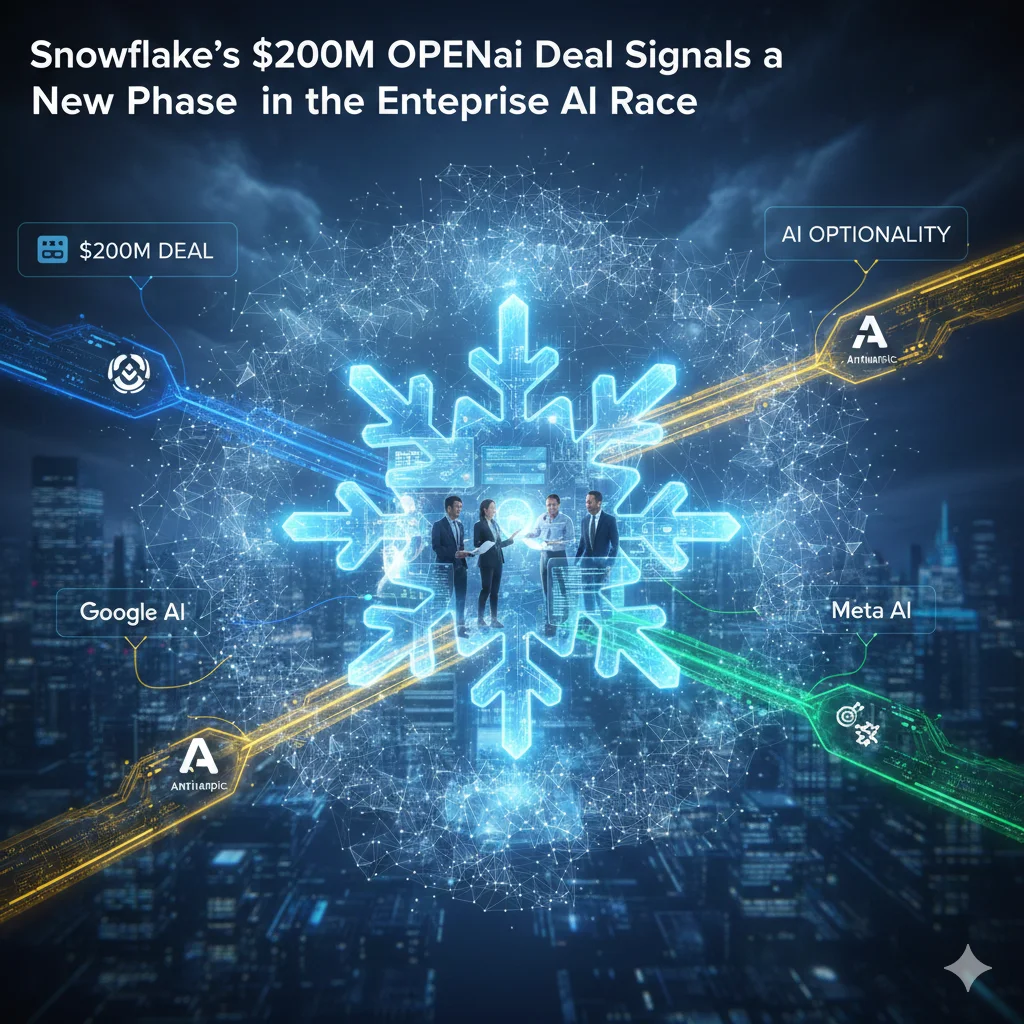
On Monday, cloud data giant Snowflake announced a $200 million, multi-year AI partnership with OpenAI, reinforcing a critical trend shaping enterprise technology in 2026: companies are no longer choosing a single AI provider—they are choosing AI optionality.
This deal gives Snowflake’s 12,600 global customers access to OpenAI’s large language models across all three major cloud platforms. In addition, Snowflake employees will gain access to ChatGPT Enterprise, OpenAI’s secure, business-grade AI solution. The partnership also includes plans to jointly develop AI agents and enterprise AI products, allowing organizations to deploy AI directly on top of governed and compliant enterprise data.
Why This Deal Matters for Enterprise AI Adoption:
Snowflake CEO Sridhar Ramaswamy framed the agreement as a way to merge enterprise data with cutting-edge AI intelligence in a responsible and secure manner. By embedding OpenAI models directly into Snowflake’s platform, enterprises can build AI-powered workflows, automate decision-making, and unlock insights without compromising security or compliance. This approach addresses one of the biggest barriers to enterprise AI adoption: trust.
Enterprises are less concerned with raw AI capability and more focused on governance, data control, and reliability. Snowflake’s value proposition lies in acting as a trusted data layer, while partners like OpenAI provide advanced AI reasoning and generative capabilities.
A Familiar Strategy: Snowflake’s Anthropic Partnership:
The OpenAI partnership closely mirrors Snowflake’s $200 milli on enterprise AI deal with Anthropic, announced just months earlier. At the time, Snowflake leadership highlighted how Anthropic’s Claude models would give customers another powerful option for building AI applications using enterprise data.
The similarity between the two deals is not coincidental. According to Baris Gultekin, Snowflake’s Vice President of AI, the company is intentionally model-agnostic. Snowflake wants customers to choose the best AI model for each use case rather than forcing them into a single ecosystem. Today, Snowflake supports models from OpenAI, Anthropic, Google, Meta, and other frontier AI labs.
Enterprise AI Is Not a Winner-Take-All Market:
Snowflake’s strategy reflects a broader industry pattern. In January, ServiceNow announced multi-year partnerships with both OpenAI and Anthropic, citing the same rationale: different AI models excel at different tasks. Some are better at reasoning, others at speed, cost efficiency, or structured workflows.
This multi-provider approach suggests that enterprise AI will evolve differently from consumer AI. Instead of one dominant platform, the enterprise market may resemble ride-hailing services like Uber and Lyft, where users switch providers based on convenience, performance, or cost at a given moment.
Conflicting Data on Enterprise AI Market Leadership:
Determining which AI company leads enterprise adoption remains difficult. A Menlo Ventures survey from late 2025 suggested Anthropic holds a commanding enterprise market share, while a recent Andreessen Horowitz report concluded that OpenAI is leading the pack. These conflicting findings highlight the lack of transparent, standardized metrics for enterprise AI usage.
What is clear, however, is that enterprises are experimenting aggressively. Most organizations are still in the early stages of identifying where AI delivers measurable business value, from customer support and coding assistance to analytics and workflow automation.
The Future of Enterprise AI Partnerships:
For now, enterprises are likely to continue signing large, multi-year AI contracts with multiple providers. This reduces vendor risk, increases flexibility, and allows businesses to adapt as AI capabilities evolve rapidly.
While it’s possible that a clear enterprise AI winner may emerge in the future, Snowflake’s OpenAI deal suggests that choice, interoperability, and governance will remain central to enterprise AI strategies. Rather than betting on a single AI lab, enterprises are building ecosystems that let them switch, combine, and scale AI models as needed.
In that sense, Snowflake’s partnership with OpenAI isn’t about picking a side—it’s about positioning itself at the center of the enterprise AI universe.
Support our research
Independent analysis fueled by you.