
Microsoft has just delivered one of its strongest financial quarters in recent history—
But Wall Street isn’t convinced that the company’s massive AI spending spree will pay off quickly enough. As Microsoft pours tens of billions of dollars into data centers and artificial intelligence infrastructure, CEO Satya Nadella is pushing back hard against growing investor concerns, insisting that Microsoft Copilot AI adoption is accelerating across consumers, enterprises, developers, and healthcare professionals.
The debate centers on a single question that now defines Big Tech in 2026: Will massive AI investment translate into sustained growth and profits—or become an expensive gamble? Microsoft Earnings Beat Expectations, But the Stock Falls
Microsoft reported $81.3 billion in quarterly revenue, marking a 17% year-over-year increase, while net income surged to $38.3 billion, up 21%. The company also posted record cloud revenue exceeding $50 billion, underscoring its dominance in enterprise cloud computing.
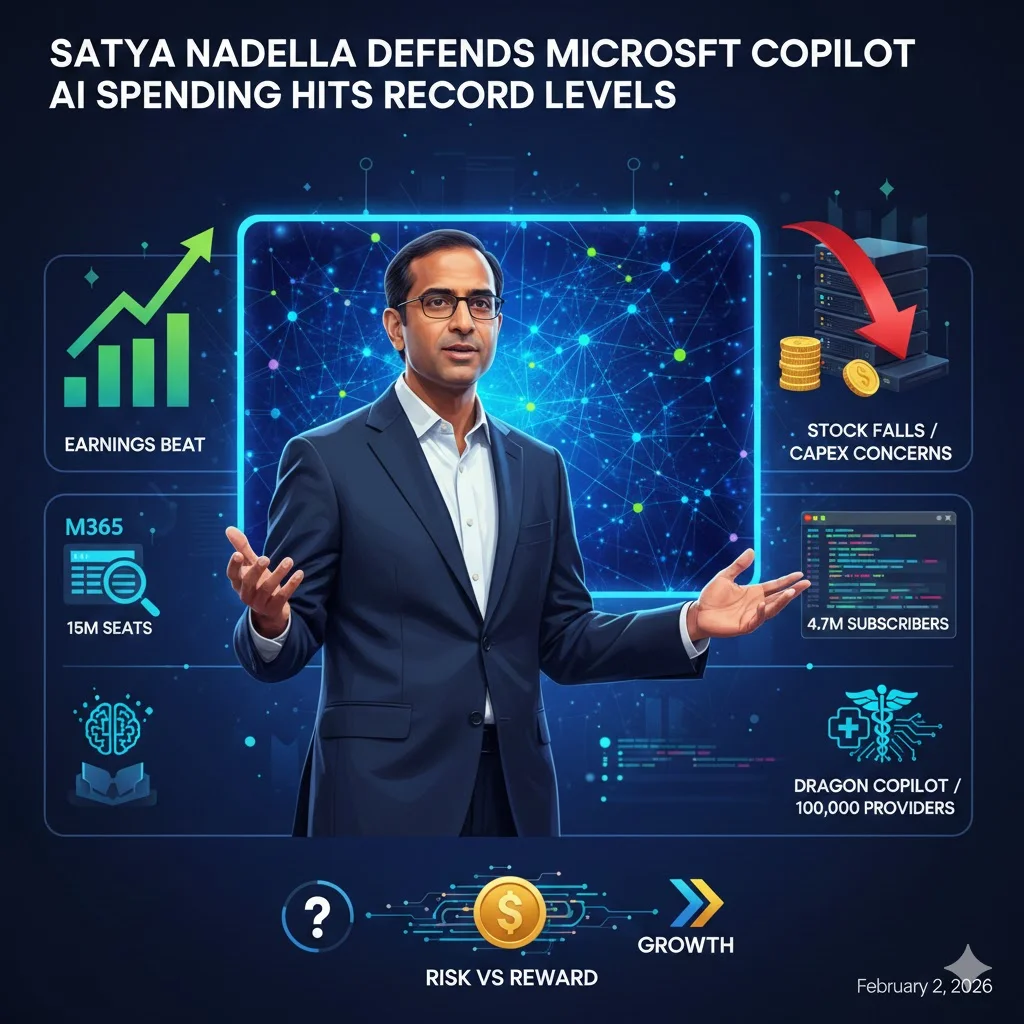
Despite these headline-grabbing figures, Microsoft shares fell sharply the following day. Investors focused less on past performance and more on the sheer scale of Microsoft’s capital expenditures, particularly those tied to AI infrastructure.
The market reaction highlights a growing tension in the tech sector: strong earnings are no longer enough if investors believe spending is outpacing returns.
Microsoft’s AI Spending Is Massive—and Still Growing:
Microsoft’s capital expenditure numbers are staggering by any standard. The company spent $88.2 billion on capital expenditures last fiscal year, and in just the first half of the current fiscal year, it has already spent $72.4 billion.
Most of this investment is going toward data centers, AI accelerators, cloud infrastructure, and advanced compute capacity designed to support large language models and AI services. These facilities power not only Microsoft’s own AI products like Copilot, but also serve OpenAI, Anthropic, and other major AI labs.
This scale of spending has raised concerns among investors who fear diminishing returns if demand doesn’t keep pace.
Azure and Microsoft 365 Growth Sparks Investor Anxiety:
One of the main reasons behind the stock’s decline was slower-than-expected growth in Azure and Microsoft 365, two of Microsoft’s most critical enterprise businesses. Wall Street analysts noted that both Azure cloud growth and Microsoft 365 revenue came in slightly below expectations, fueling fears that enterprise customers may be slowing AI adoption or becoming more cautious with spending.
UBS analyst Karl Keirstead summarized the sentiment bluntly, stating that both segments falling short was the key negative for investors. However, Keirstead maintained a bullish outlook, reiterating a buy rating and suggesting that the slowdown may be temporary rather than structural.
Satya Nadella Pushes Back: “Copilot Usage Is Surging”
During the earnings call, Satya Nadella spent a significant portion of his time defending Microsoft’s AI strategy and emphasizing what he described as rapid and widespread Copilot adoption.
Nadella framed Microsoft’s AI investments as a necessary response to overwhelming demand rather than speculative spending. According to him, AI usage across Microsoft’s ecosystem is growing faster than supply can keep up, a point echoed by CFO Amy Hood. Their message was clear: the data centers are not sitting idle—they are already fully booked.
Consumer Copilot Growth: Big Claims, Few Details:
One of the most talked-about statements from Nadella was his claim that daily users of Microsoft’s consumer Copilot products have nearly tripled year over year. These products span a wide range of use cases, including:
-
AI chat experiences.
-
Search and browsing.
-
News feeds and shopping tools.
-
Deep integrations into Windows and the operating system.
However, Nadella stopped short of providing specific user numbers, a move that left analysts wanting more clarity. Microsoft declined to break out exact figures when asked.
In its previous annual report, Microsoft disclosed that it had surpassed 100 million monthly active Copilot users, combining both consumer and commercial accounts. A company spokesperson later confirmed that the number has now reached 150 million total users, though the lack of segmentation continues to raise questions.
GitHub Copilot Emerges as a Clear AI Success Story:
Where Microsoft was far more transparent was in discussing GitHub Copilot, its AI coding assistant—and the numbers suggest a genuinely strong business.
GitHub Copilot now boasts 4.7 million paid subscribers, representing a 75% year-over-year increase. This makes it one of the most commercially successful AI developer tools on the market today.
Microsoft previously reported 20 million total GitHub Copilot users, including free-tier users, indicating a strong conversion funnel from free to paid plans.
For investors, GitHub Copilot serves as a tangible example of AI monetization done right, helping validate Microsoft’s broader AI strategy.
Microsoft 365 Copilot: Early, But Promising:
Microsoft also revealed that Microsoft 365 Copilot has reached 15 million paid enterprise seats, purchased by organizations deploying AI tools to their workforce.
While impressive on its own, that figure represents just a small fraction of Microsoft’s 450 million paid Microsoft 365 seats globally. This suggests that Microsoft 365 Copilot adoption is still in its early stages, leaving significant room for expansion.
The slow but steady rollout may reflect cautious enterprise decision-making, as companies evaluate ROI, compliance, and workforce readiness before committing fully to AI assistants.
Dragon Copilot Gains Momentum in Healthcare:
One of the most compelling AI growth stories came from the healthcare sector. Nadella highlighted strong adoption of Dragon Copilot, Microsoft’s AI assistant for medical professionals.
According to the company:
-
Dragon Copilot is now available to 100,000 medical providers.
-
It documented 21 million patient encounters during the quarter.
-
Usage grew threefold year over year.
This positions Dragon Copilot as a serious competitor to healthcare AI startups and reinforces Microsoft’s strategy of targeting industry-specific AI solutions, where willingness to pay is often higher.
Is Microsoft’s AI Investment Worth the Risk?
The central concern remains whether Microsoft’s unprecedented AI spending will deliver long-term returns. Nadella and Hood were unequivocal on the earnings call, stating that demand for AI services far exceeds current data center capacity.
They emphasized that new infrastructure is effectively pre-sold for its entire operational lifespan, suggesting that utilization risk is minimal.
This argument aligns with Microsoft’s long-term vision: dominate AI infrastructure today to secure pricing power, ecosystem lock-in, and enterprise loyalty tomorrow.
The Bigger Picture: Microsoft’s AI Bet:
Microsoft is not just betting on AI—it is rearchitecting its entire business around it. From Windows and Office to GitHub, Azure, and healthcare, Copilot is becoming the connective tissue across the company’s product portfolio.
While investors may remain cautious in the short term, Microsoft’s leadership believes the company is laying the groundwork for the next decade of growth.
If AI adoption continues to scale as Nadella predicts, today’s massive spending could look like a bargain in hindsight.
Support our research
Independent analysis fueled by you.