
As enterprises race to adopt generative AI without compromising data security,
privacy-first, on-device AI is emerging as a critical solution—especially in highly regulated industries. In a major signal of this shift, Qualcomm Ventures has invested $8 million in SpotDraft, a legal technology startup focused on offline, on-device contract AI, nearly doubling the company’s valuation to around $380 million.
The funding comes as a strategic Series B extension, following SpotDraft’s $56 million Series B raised last year, which valued the company at $190 million post-money. With this latest round, SpotDraft is positioning itself as a leader in enterprise AI that works without sending sensitive documents to the cloud.
Why Enterprises Are Turning to On-Device AI:
Across industries, companies have moved quickly to test generative AI tools. However, privacy, security, and data governance concerns continue to slow adoption for sensitive workflows. This challenge is especially pronounced in legal departments, where contracts often contain privileged communications, intellectual property, pricing structures, and confidential deal terms.
Multiple industry studies have consistently identified data security risks as one of the biggest barriers to enterprise GenAI deployment. As a result, vendors like SpotDraft are pursuing edge AI architectures that keep core intelligence on the user’s device rather than relying on cloud-based large language models.
This approach aligns closely with Qualcomm’s broader strategy to scale AI workloads on Snapdragon-powered PCs, enabling low-latency, high-performance AI that remains under enterprise control.
Snapdragon X Elite Powers Offline Contract AI:
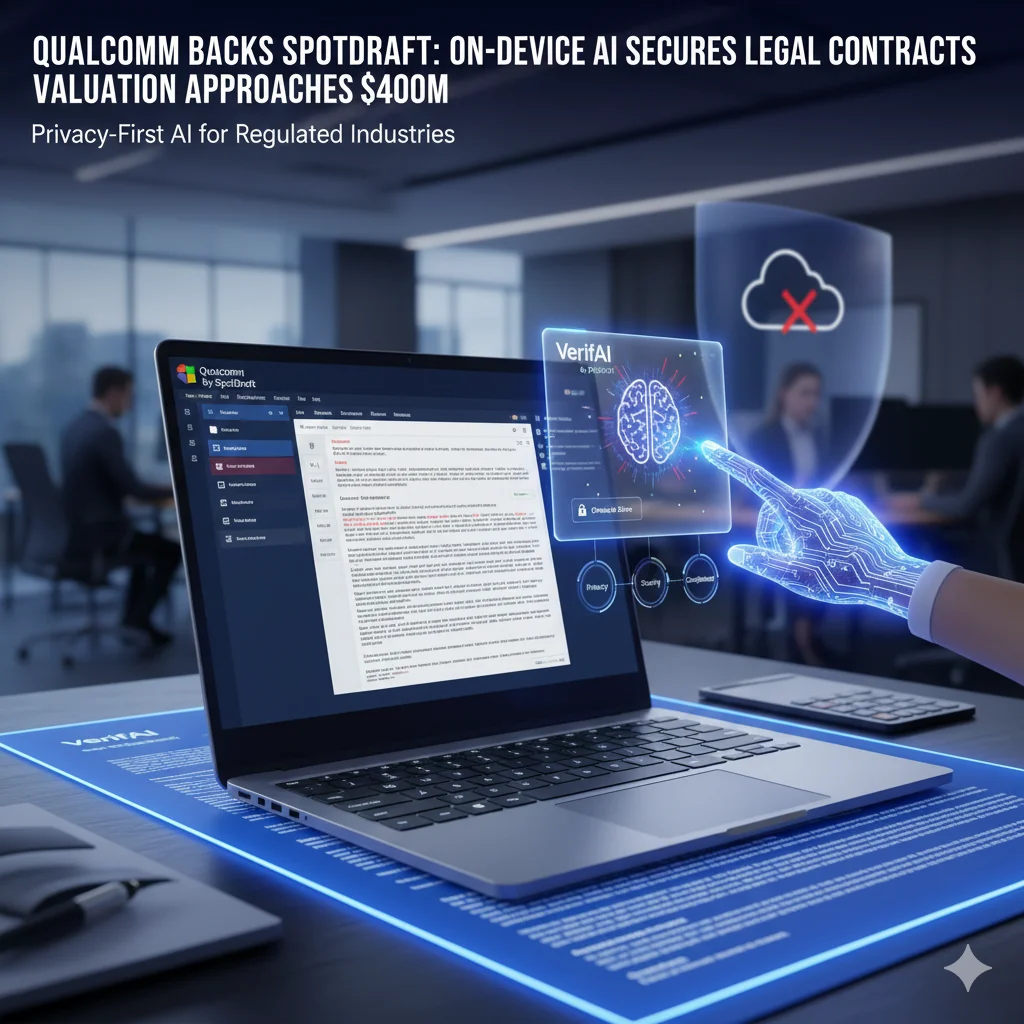
At Snapdragon Summit 2025, SpotDraft demonstrated its VerifAI contract review workflow running end-to-end on Snapdragon X Elite laptops. The demo showed legal professionals reviewing and editing contracts entirely offline, with documents staying on the local machine at all times.
While internet access is still required for user authentication, licensing, and collaboration, SpotDraft confirmed that contract review, risk scoring, and redlining can run fully offline. This architecture makes the platform especially attractive for regulated enterprises that cannot legally send sensitive documents to external cloud services.
Legal Teams as the Front Line of Enterprise AI Adoption:
SpotDraft sees the legal sector as a proving ground for the future of enterprise-grade AI deployment. Unlike customer service or marketing, legal workflows are latency-sensitive, privacy-critical, and compliance-heavy, making them ideal candidates for on-device AI solutions.
“The future of enterprise AI is going to be AI that is close to the document,” said Shashank Bijapur, co-founder and CEO of SpotDraft. “These workflows are privacy critical, legally sensitive, and not always suitable for the cloud.”
This perspective reflects a growing belief across the enterprise AI landscape that not all intelligence belongs in centralized cloud models.
VerifAI Works Inside Microsoft Word:
One of SpotDraft’s biggest differentiators is how VerifAI integrates directly into Microsoft Word, the tool most legal teams already rely on. Instead of forcing users into new interfaces, VerifAI embeds AI-powered analysis directly into existing workflows.
According to Madhav Bhagat, co-founder and CTO of SpotDraft, VerifAI goes beyond summarization. The system compares contracts against a company’s custom legal playbooks, internal policies, and historical agreements, applying recommendations and redlines directly within the document.
This design significantly lowers adoption friction while maintaining enterprise-grade compliance and security.
What This Means for the Future of Enterprise AI:
SpotDraft’s rising valuation—approaching $400 million—highlights growing investor confidence in privacy-preserving, on-device AI. As regulatory pressure increases and enterprises demand tighter control over their data, AI models that run locally are becoming a strategic advantage rather than a limitation.
For Google Discover readers, this development reflects a broader trend reshaping enterprise technology: the future of AI may be decentralized, secure, and embedded directly into the devices professionals already use.
Support our research
Independent analysis fueled by you.