
Sam Altman's World ID Is Taking Over the Internet — And It's Starting with Tinder:
How Tools for Humanity's human-verification technology is reshaping dating apps, concert tickets, Zoom calls, and the agentic web:
The question that defines our era: Are you talking to a human or an AI? At a packed event near the San Francisco pier, Sam Altman stepped on stage to answer that question — and announced an ambitious plan to bring human verification technology to nearly every corner of digital life. The project is called World (formerly Worldcoin), and its first major consumer move is a partnership with Tinder.
World, operated by Tools for Humanity (TFH), is one of the most ambitious identity-verification projects in the world today. Backed by OpenAI CEO Sam Altman, the platform aims to solve a problem that will only grow more urgent as AI becomes more capable: verifying that the person on the other side of a screen is actually a person.
What Is World ID: The 'Proof of Human' Technology Explained:
At the core of World's technology is a deceptively simple idea: prove you are human without revealing who you are. This is called "proof of human" verification, and it is powered by zero-knowledge proof-based authentication — a form of advanced cryptography that allows a system to confirm a user's identity without storing or exposing any personal data.
The flagship verification tool is the Orb — a spherical digital scanner that reads a user's iris and converts it into a unique, anonymous cryptographic identifier known as a World ID. Unlike traditional biometric systems, the Orb does not store your image. Instead, it produces an irreversible mathematical fingerprint that can be used to access World's services while keeping your real identity completely private.
"The world is getting close to very powerful AI," Altman told the crowd. "We are also heading to a world now where there's going to be more stuff generated by AI than by humans. I'm sure many of you have had moments where you're like, 'Am I interacting with an AI or a person, or how much of each, and how do I know?'"
World ID on Tinder: Human Verification Comes to Online Dating:
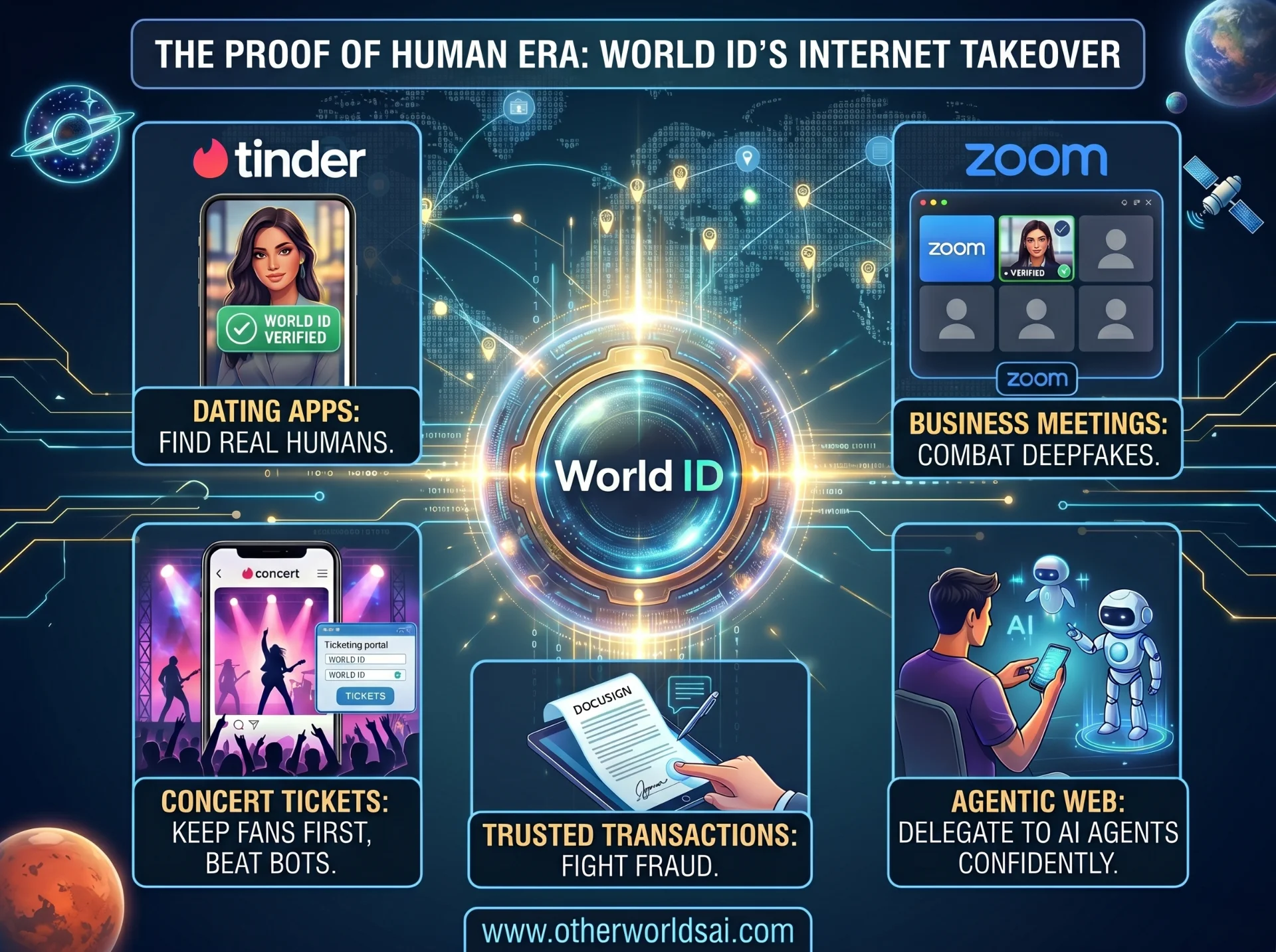
Perhaps the most headline-grabbing announcement was the global rollout of World ID verification on Tinder. After a successful pilot program in Japan, Tinder is now integrating World's verification emblem directly into user profiles — a small but powerful signal that tells potential matches: this is a real, verified human being, not a bot, scammer, or catfish.
The integration addresses one of the most persistent pain points in online dating: trust. Romance scams, fake profiles, and AI-generated personas have become increasingly sophisticated. A World ID badge on a Tinder profile offers a verified layer of assurance that no amount of clever profile writing or reverse image searching can provide. As AI-generated deepfakes and chatbot-driven scams grow more convincing, tools like World ID are likely to become a standard feature of responsible dating platforms.
Concert Kit: Keeping Real Fans First with Anti-Bot Ticketing:
Ticket scalping bots have long been the bane of live music fans, snatching up concert seats within milliseconds of release and reselling them at sky-high markups. World's new Concert Kit feature offers a novel countermeasure: artists can now reserve a portion of their tickets exclusively for World ID-verified humans.
Concert Kit is compatible with major ticketing platforms including Ticketmaster and Eventbrite, and has already attracted high-profile partners. Both 30 Seconds to Mars and Bruno Mars have announced plans to use Concert Kit for their upcoming tours — signaling that the music industry sees real value in verified human-only ticket allocation.
This is a landmark moment for the live entertainment industry. As automated ticket-buying bots grow more sophisticated, platforms that can guarantee human buyers offer a fundamentally fairer experience. World's entry into the ticketing space could pressure other platforms to adopt similar human-verification standards.
Zoom, Docusign, and the Fight Against Deepfakes in Business:
World's ambitions extend well beyond consumer apps. The company announced a World ID integration with Zoom, designed to combat the growing threat of deepfake impersonation on video calls. As AI-generated video becomes increasingly realistic, verifying the identity of participants in sensitive business meetings is no longer a paranoid concern — it is a genuine enterprise security need.
A partnership with Docusign adds another layer of trust to digital transactions. By verifying that e-signatures come from authenticated human users, World and Docusign aim to make contract fraud significantly harder. Together, these business integrations reflect a broader strategy: embedding human verification into the infrastructure of professional digital life.
Preparing for the Agentic Web: AI Agent Delegation and Okta Partnership:
One of the most forward-looking announcements concerns the rise of AI agents — autonomous software programs that browse the web, make purchases, send emails, and carry out complex tasks on behalf of their users. World is developing an "agent delegation" feature that allows a verified human to tie their World ID to a specific AI agent, so that when the agent acts on their behalf online, websites can confirm that a real human authorized the activity.
In partnership with identity and access management firm Okta, World has built a system — currently in beta — that verifies an agent is acting on behalf of a verified human. "When the agent goes out into the web to operate on that person's behalf, websites will know a verified person is behind the behavior," said Okta's chief product officer Gareth Davies at the event. This infrastructure could become the foundational trust layer for the entire agentic internet.
Three Tiers of Verification: From Orb Scans to Selfies:
Scaling a biometric verification system is no small challenge. For most of World's history, earning a gold-standard World ID meant physically traveling to one of the company's offices to have your eyes scanned by an Orb — an experience many users found inconvenient, unfamiliar, and in some cases unsettling. To broaden its reach, World has now introduced a tiered verification system:
-
Tier 1 — Orb Verification: The highest-security option. An iris scan creates an anonymous, irreversible cryptographic identifier. World is significantly expanding Orb availability in New York, Los Angeles, and San Francisco, and now offers a concierge service where an Orb can be brought directly to your location.
-
Tier 2 — Government ID (NFC Scan): A mid-level option that uses an anonymized scan of an official government ID via the card's NFC chip — no physical Orb required.
-
Tier 3 — Selfie Check: A new low-friction option that requires only a selfie. World acknowledges this tier has limits and is vulnerable to spoofing, but it is designed with privacy-first architecture: image processing happens locally on the user's device and images are never uploaded to World's servers. "Selfie is private by design," said TFH executive Daniel Shorr. Developers can choose which tier to require based on the sensitivity of their application.
Why World ID Matters: Digital Identity in the Age of Generative AI:
The broader context here is critical to understand. We are entering an era where generative AI makes it trivially easy to create convincing fake identities, fabricate video footage of real people, automate large-scale scam operations, and flood digital platforms with synthetic content. The ability to verify that any given actor online is a real human being — without compromising their privacy — is arguably one of the most important infrastructure problems of the next decade.
World's approach is technically sophisticated and philosophically interesting. Unlike government-issued digital IDs that tie verification to a real name and address, World ID is anonymous by design. You can prove you are human without revealing anything else about yourself. This privacy-preserving architecture is what sets it apart from most competitors in the digital identity verification space.
That said, World is not without controversy. Critics have raised concerns about the centralization of biometric data, the risks of iris-scanning technology, and the geopolitical implications of a single private company building what amounts to a global identity registry. As World scales, these questions will only become more pressing — and more important to get right.
The Bottom Line: World Is Building the Trust Layer for the Internet:
From Tinder profiles to Bruno Mars concerts, from Zoom boardrooms to AI agents browsing the web, World is quietly embedding itself into the fabric of how humans interact online. If its technology works as promised — and if it can do so without compromising user privacy or concentrating too much power in a single organization — it could become one of the most consequential digital infrastructure projects of our time.
The internet has needed a reliable proof-of-human layer for a long time. CAPTCHAs were a band-aid. Email verification is trivially spoofed. Phone number verification is sold in bulk. World is attempting something far more durable — and far more ambitious. Whether you find that exciting or alarming probably depends on how much you trust Sam Altman, cryptography, and the idea that a private company should hold the keys to the digital identities of billions of people.
One thing is certain: the age of assuming the person on the other side of the screen is human is over. World is betting the future on what comes next.