
🚀 For the "Tech Visionary" (Focus on the 1GW Scale)
OpenAI's India Expansion: Tata Group Partnership, 1GW AI Data Center, and Pine Labs Fintech Deal Signal a New Era for AI in India:
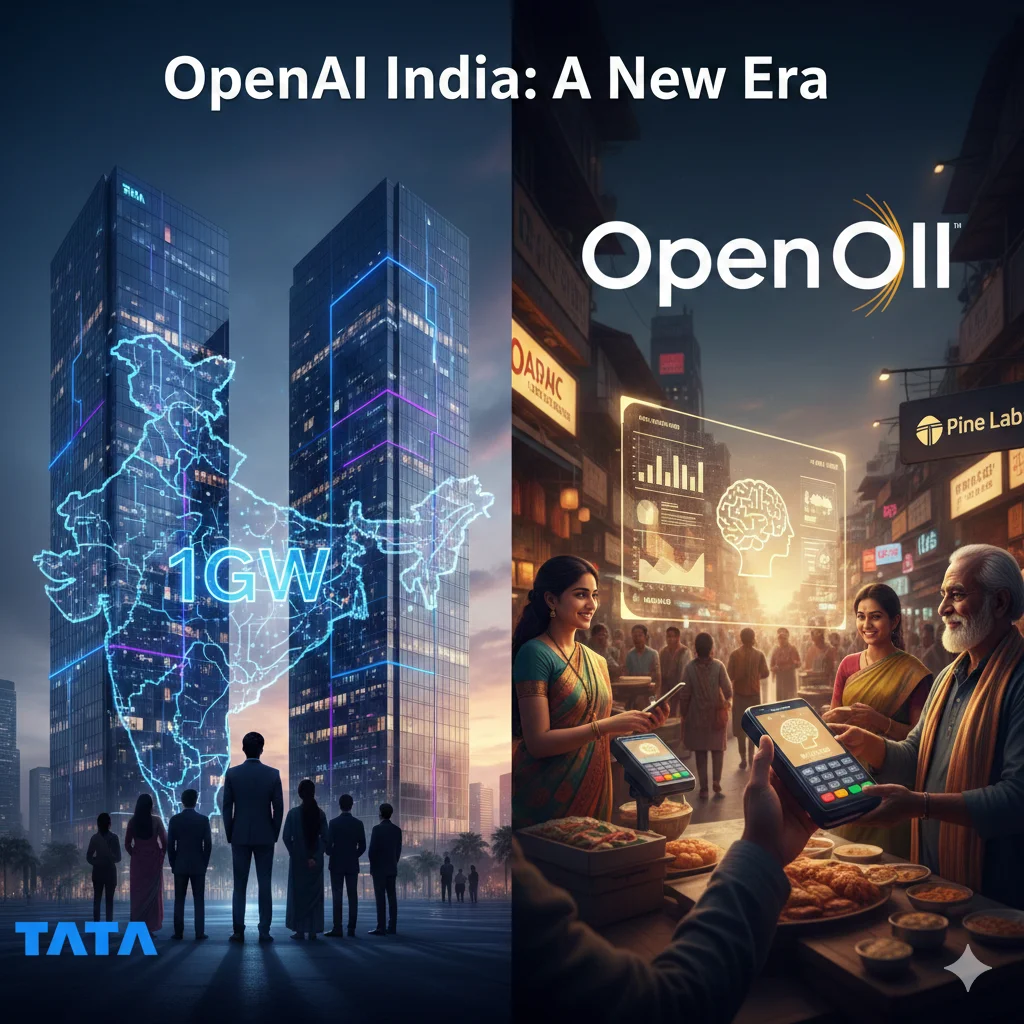
OpenAI is placing its biggest bet yet on India. In a pair of landmark announcements made at the AI Impact Summit in New Delhi, the company revealed a sweeping infrastructure and enterprise partnership with the Tata Group — including plans to scale to 1 gigawatt of AI-ready data center capacity — alongside a fintech collaboration with Pine Labs to bring AI-driven payments and commerce automation to one of the world's largest digital economies.
Together, these deals represent the most comprehensive AI infrastructure and enterprise push OpenAI has made in any single emerging market, and they signal India's growing importance in the global artificial intelligence landscape.
OpenAI and Tata Group: Building India's AI Infrastructure Backbone:
At the core of OpenAI's India strategy is a landmark partnership with the Tata Group, one of India's most iconic conglomerates. Under the agreement, OpenAI will become the first customer of Tata Consultancy Services' (TCS) HyperVault data center business, initially securing 100 megawatts of AI-ready data center capacity — with long-term plans to scale to 1 gigawatt.
The deal is part of OpenAI's Stargate project, a global initiative to build AI-ready infrastructure and expand enterprise AI adoption. The India chapter — branded "OpenAI for India" — represents one of the most significant investments in AI infrastructure in the Asia-Pacific region.
Why 1GW Matters for AI Infrastructure in India:
To appreciate the scale of this commitment, context helps. AI workloads — from model training to real-time inference — are extraordinarily power-intensive, relying on dense clusters of GPUs that demand massive amounts of electricity and cooling. A 100MW facility is already a major deployment by global standards. Scaling to 1 gigawatt would place Tata's HyperVault among the largest AI-focused data center deployments in the world.
HyperVault is backed by roughly ₹180 billion (approximately $2 billion) in planned investment and received backing from private equity firm TPG in late 2025. The platform is purpose-built to support large-scale compute workloads for hyperscalers and enterprise customers — precisely what OpenAI needs to run its most advanced models locally within India.
Data Residency, Latency, and Compliance: The Business Case:
Hosting compute capacity inside India is not just a matter of scale — it's a strategic necessity. By running models within the country, OpenAI can significantly reduce latency for Indian users while meeting critical data residency, security, and compliance requirements that apply to regulated sectors including banking, healthcare, and government services. For enterprises handling sensitive data under India's data localization rules, local AI infrastructure is no longer optional — it's a prerequisite for adoption.
This infrastructure investment could dramatically widen OpenAI's access to enterprise customers in regulated sectors that previously couldn't use cloud AI services hosted abroad.
ChatGPT Enterprise Across Tata's Workforce: One of the Largest AI Deployments Globally:
Beyond infrastructure, the OpenAI-Tata partnership includes a major enterprise AI deployment.Tata Group plans to roll out ChatGPT Enterprise across its workforce in the coming years, beginning with hundreds of thousands of employees at TCS — a move that would rank among the largest enterprise AI deployments globally.
TCS also intends to use OpenAI's Codex tools to standardize AI-native software development across its engineering teams, transforming how one of the world's largest IT services firms builds and ships software.
N Chandrasekaran, Chairman of Tata Sons, said the partnership would help build "state-of-the-art AI infrastructure in India" while supporting efforts to upskill the country's workforce for the AI era.
Expanding Skills and Offices Across India:
OpenAI is also expanding its certification programs in India, with TCS becoming the first participating organization outside the United States— a signal of how seriously the company is treating the Indian market. These certifications are designed to help professionals across roles and industries build practical AI skills.
Operationally, OpenAI plans to open new offices in Mumbai and Bengaluru later this year, supplementing its existing presence in New Delhi. These offices will support enterprise partnerships, developer engagement, and local regulatory coordination.
India's scale makes this investment logical:according to OpenAI CEO Sam Altman, India now has more than 100 million weekly ChatGPT users spanning students, teachers, developers, and entrepreneurs — one of the largest user bases of any country in the world.
OpenAI and Pine Labs: Bringing AI to India's Payments and Fintech Ecosystem:
Alongside the Tata announcement, OpenAI revealed a strategic partnership with Pine Labs, one of India's leading fintech companies, to embed AI-driven reasoning into Pine Labs' payments and commerce infrastructure.
The collaboration will see Pine Labs integrate OpenAI's APIs into its existing systems to enable AI-assisted settlement, reconciliation, and invoicing workflows — transforming processes that once took hours of manual work into automated, near-instant operations.

Anthropic’s Surprise Double Launch Directly Targets OpenAI and Google’s AI Dominance
Cutting Settlement Times from Hours to Minutes:
Pine Labs CEO B Amrish Rau explained that the company has already been using AI internally to automate parts of its settlement process, cutting the time needed to clear daily settlements from hours to minutes. Previously, dozens of employees manually checked funds from multiple banks before markets opened each morning — a workflow now largely handled by AI systems.
Support our research
Independent analysis fueled by you.
The new partnership with OpenAI is designed to extend these AI-driven efficiencies beyond internal operations, reaching Pine Labs' 980,000+ merchants, 716 consumer brands, and 177 financial institutions across 20 countries.
B2B Commerce: Where AI Agents Are Making the Fastest Impact:
Rau highlighted that enterprise and B2B workflows — not consumer payments — are where AI adoption is moving fastest. "If you look at invoicing and settlement, those are workflows where agents can actually drive the process end to end, and that's where adoption can happen faster," he said.
Pine Labs is already prototyping agent-driven payments in the Middle East and Southeast Asia, where regulations are more permissive. In India, the rollout is expected to be more gradual, focused on AI-assisted commerce rather than fully autonomous agent-initiated payments, given tighter regulatory requirements from the Reserve Bank of India.
An Open, Non-Exclusive Partnership:
Notably, the Pine Labs-OpenAI agreement does not involve revenue sharing and is non-exclusive — Pine Labs remains free to work with other AI providers. Rau compared it to OpenAI's partnership with Stripe in the United States. The arrangement prioritizes embedding AI capabilities into Pine Labs' commerce platform to increase merchant stickiness and expand the company's role from a payments processor to a broader AI-powered commerce platform.
OpenAI's Broader India Ecosystem: A Growing Partner Network:
The Tata and Pine Labs announcements are part of a much broader enterprise push in India. OpenAI has been rapidly building out a local partner ecosystem, with collaborations already in place across sectors including:
- Fintech: Pine Labs, PhonePe, CRED
- E-commerce and travel: Cars24, MakeMyTrip, Eternal
- Media and entertainment: JioHotstar
- IT services: HCLTech, TCS
This expanding partner network signals OpenAI's ambition to embed its models across consumer platforms, enterprise systems, and digital payments infrastructure in one of the world's largest internet economies.
Meta's Next Big Bet: This New App Lets You Build Games Simply by Typing a Prompt
What This Means for India's AI Future:
The announcements at the AI Impact Summit — where OpenAI's Sam Altman appeared alongside Anthropic CEO Dario Amodei and Google CEO Sundar Pichai — underline India's emergence as a critical battleground for global AI companies seeking to establish leadership in high-growth markets.
For India, the stakes are significant. Domestic AI infrastructure reduces dependence on foreign compute, creates local jobs, and positions India as a genuine participant in the global AI supply chain — not just a consumer of AI services built elsewhere. The combination of world-class data center infrastructure, enterprise AI deployments at scale, developer skilling programs, and fintech integration gives India a real foundation to become one of the world's most sophisticated AI markets.
For OpenAI, India represents a massive growth opportunity that the company is now pursuing with its deepest investment in any single market. With 100 million weekly users already, a thriving developer ecosystem, a fast-growing enterprise sector, and one of the world's youngest and most digitally engaged populations,
India is not just OpenAI's fastest-growing market — it may well be its most important one.