
Luma AI Launches Innovative Dreams: How AI-Powered Filmmaking Is Reshaping Hollywood and Faith-Based Entertainment:
Hollywood’s Newest Studio Isn’t in LA—It’s Powered by Luma’s AI Agents.
AI video generation startup Luma teams with Wonder Project to debut a real-time hybrid filmmaking studio — and the implications for the entire entertainment industry are enormous.
The Dawn of a New Filmmaking Era:
A seismic shift is underway in Hollywood. AI video generation startup Luma AI has officially launched Innovative Dreams, a groundbreaking production company built in partnership with Wonder Project — a faith-focused streaming service producing religious films and TV content on Amazon Prime. This landmark move signals more than just a new studio: it marks the beginning of a new chapter in AI-powered filmmaking, generative AI entertainment, and the future of content production.
The partnership's debut project is already turning heads. Their first collaboration, "The Old Stories: Moses," stars acclaimed British actor Sir Ben Kingsley and is set to premiere this spring on Prime Video. The combination of a legendary Hollywood actor and cutting-edge AI production technology makes this one of the most closely watched projects in the AI filmmaking space today.
What Is Innovative Dreams and How Does It Work:
Innovative Dreams is not simply another production company — it's a paradigm-shifting creative engine. According to Luma, it is "a production services company where seasoned filmmakers from director Jon Erwin's team and Luma's creative technologists work with great studios and filmmakers to help them realize ambitious ideas."
At its core, the studio leverages Luma Agents — the company's recently launched suite of tools purpose-built for end-to-end creative work across text, image, video, and audio generation.
The real-time collaboration capability is what sets this apart. Creative teams can work alongside Luma Agents live to modify sets, adjust props, shift lighting, and integrate footage of human actors — all in the moment. As Luma stated:
"This is a significant improvement over the current virtual production and performance capture processes where things come together only in post. This is the leverage of AI — not just faster or cheaper, but better than what came before."
Real-Time Hybrid Filmmaking: The Technology Explained:
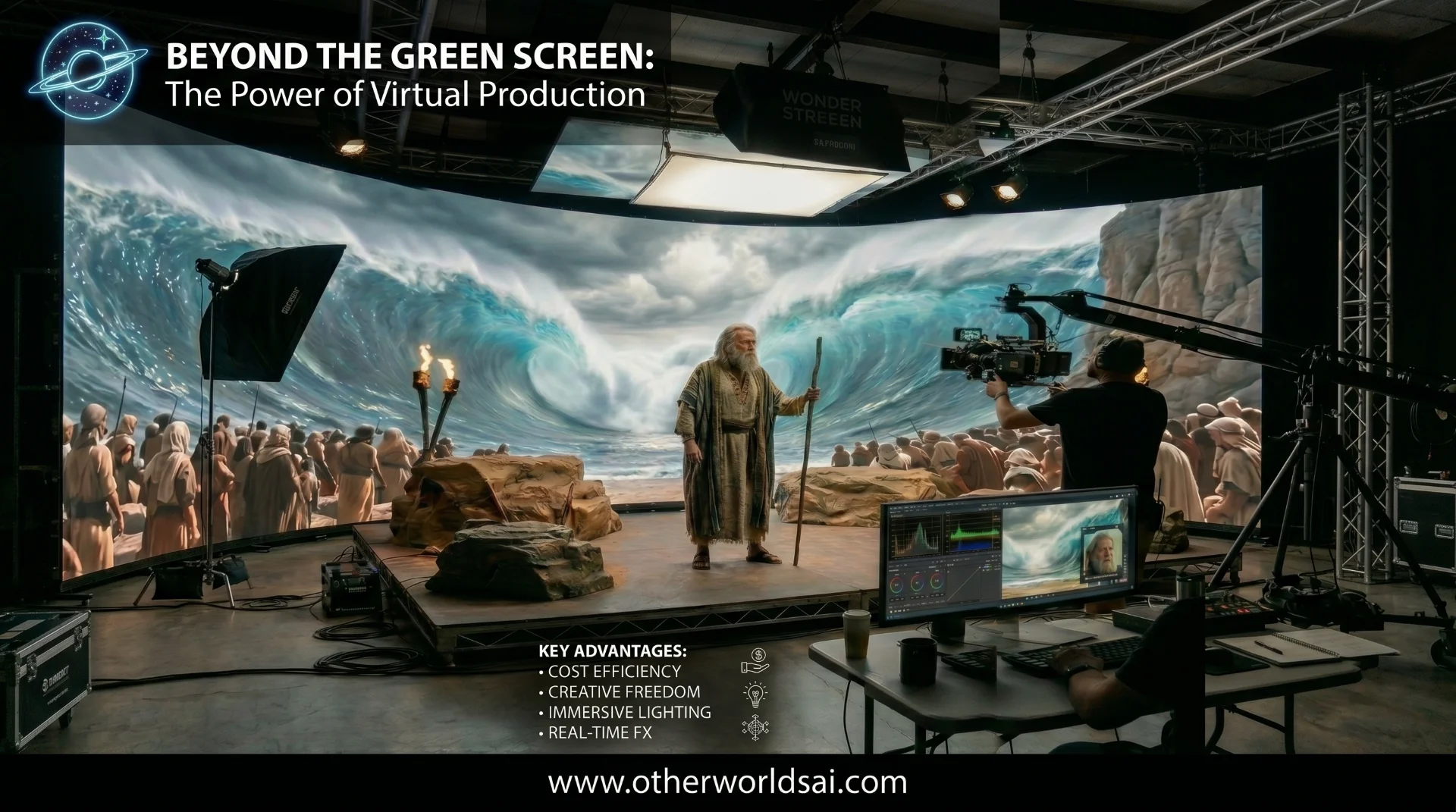
Director Jon Erwin describes the studio's core approach as 'real-time hybrid filmmaking' — a revolutionary fusion of two established cinematic techniques. The first is performance capture, the same technology used in blockbusters like Avatar, where actors wear suits with facial markers in a green-screen environment, allowing their movements and expressions to be digitally captured and transformed. The second is virtual production, as seen in The Mandalorian, where actors perform in front of massive LED screens with real-time game-engine graphics building the world around them.
What Luma brings to this equation is a dramatic reduction in cost and a quantum leap in flexibility. Using Luma's AI filmmaking tools, a production team can film a human actor in any location and seamlessly transport that performance into a fully photorealistic AI-generated scene. Even more striking: the technology can generate an entirely new face that maps onto the actor's movements and expressions — enabling unprecedented storytelling possibilities in AI-driven character creation
Faith-Based Storytelling Meets Generative AI:
Wonder Project, founded in 2023, brings a clear and passionate mission to this partnership. Run by director Jon Erwin and former Netflix executive Kelly Hoogstraten, the company exists to serve the faith and values audience globally. Their debut project, "House of David" — a Biblical drama series about the life of King David — was released on Amazon Prime in 2025, establishing the studio's creative credibility in the faith-based streaming content market.
The creative and commercial logic of the partnership is compelling. Faith-based content has historically been underserved by Hollywood's major studios, yet it commands a loyal and sizable global audience. By deploying AI-powered production technology to create high-quality religious and values-driven films at a fraction of traditional costs, Innovative Dreams is betting it can serve this audience better — and more frequently — than any prior studio. Whether the company will expand beyond faith-based content remains an open question that Luma has yet to answer publicly.
Luma AI Is Not Alone: The Broader AI Filmmaking Revolution:
The launch of Innovative Dreams is part of a sweeping industry transformation that is impossible to ignore. Luma is one of several AI video generation startups making the leap from building tools to actually producing original content. Higgsfield AI launched an original series last week, beginning with a 10-minute sci-fi episode, while London-based Wonder Studios is collaborating with Campfire Studios on a documentary — all powered by generative AI.
Perhaps the most provocative voice in this conversation belongs to Runway's co-founder and co-CEO, Cristóbal Valenzuela. He has publicly argued that film studios should take the $100 million they currently spend on a single blockbuster and use AI film production to make 50 films instead — dramatically increasing their statistical chances of producing a hit. According to Valenzuela, cost reductions from AI are happening across every stage of production:
"It's everywhere. It's in the pre-production side, it's in scripting, it's in planning, it's in execution, visual effects — this is already beginning to be deployed at scale."
Luma CEO Amit Jain's Vision for the Future of Film:
Luma's founder and CEO Amit Jain has articulated a vision that directly challenges Hollywood's incumbent model. He has told TechCrunch that Hollywood's soaring production costs have made filmmaking increasingly constrained — limiting which stories get told, which audiences get served, and how often studios can take creative risks.
Generative AI, in his view, doesn't just speed things up: it fundamentally changes the economics of content creation, making high-quality storytelling accessible to a much wider range of creators.
This philosophy is the bedrock on which Innovative Dreams is built. Rather than positioning AI as a threat to filmmakers, Luma frames it as an amplifier of human creativity — a tool that allows visionary directors like Jon Erwin to achieve ideas that would otherwise be financially impossible. It's a narrative that is increasingly common in AI entertainment technology circles, and one that is beginning to find real traction in the industry.
The Core Debate: Will AI Scale Creativity — Or Dilute It:
Not everyone is convinced that flooding the market with AI-generated content is a recipe for creative greatness. Critics argue that the tech industry's belief in scaling creativity with AI will not automatically produce more great art — and that quantity is no substitute for the conditions that allow genuine storytelling to emerge. The distinction between AI-assisted filmmaking and fully AI-generated content remains a critically important one for audiences, critics, and regulators alike.
Runway's Valenzuela has pushed back against this skepticism with a book publishing analogy. He suggests that just as the world benefits from having more books — even if most go unread — more films mean more voices and more stories. He envisions a world where billions of people who have never had access to filmmaking tools can finally tell their stories through AI. Even James Cameron, no stranger to blockbuster filmmaking, has publicly expressed support for AI as a means of sustaining large-scale productions without workforce layoffs.
Why the Luma and Wonder Project Partnership Matters for the Industry:
The Innovative Dreams launch is significant for several intersecting reasons.**
First, it demonstrates that AI production studios are now ready to compete — not just experiment — in the mainstream content marketplace. A show starring Ben Kingsley on Prime Video is not a niche experiment; it's a direct play for mainstream attention and audience trust.
Second, the faith-based angle opens a genuinely underserved market to AI-powered storytelling. If Innovative Dreams can deliver compelling, high-quality faith-based films and series at scale — faster and more affordably than traditional studios — it could establish a template that other AI entertainment companies follow across other underserved genres and communities globally.
Third, the 'real-time hybrid filmmaking' model represents a genuine technological milestone. By combining performance capture and virtual production with live AI generation, Innovative Dreams is not just making films — it's building the workflow architecture that could define how content is made for the next decade.
Looking Ahead: The Age of AI Cinema Is Here:
The entertainment industry is at a genuine inflection point, and launches like Innovative Dreams are the clearest evidence yet that the change is real. Whether the films that emerge from AI-powered studios can match the emotional depth and craft of traditionally produced work remains to be seen. But the economic logic is undeniable, the technology is rapidly maturing, and the first major AI-produced content is already on its way to your screen.
Runway's internal motto may say it best: "The best movies are yet to be made" — and for the first time in cinematic history, the people making them might not be who you expect.