
The artificial intelligence industry is entering a new phase—
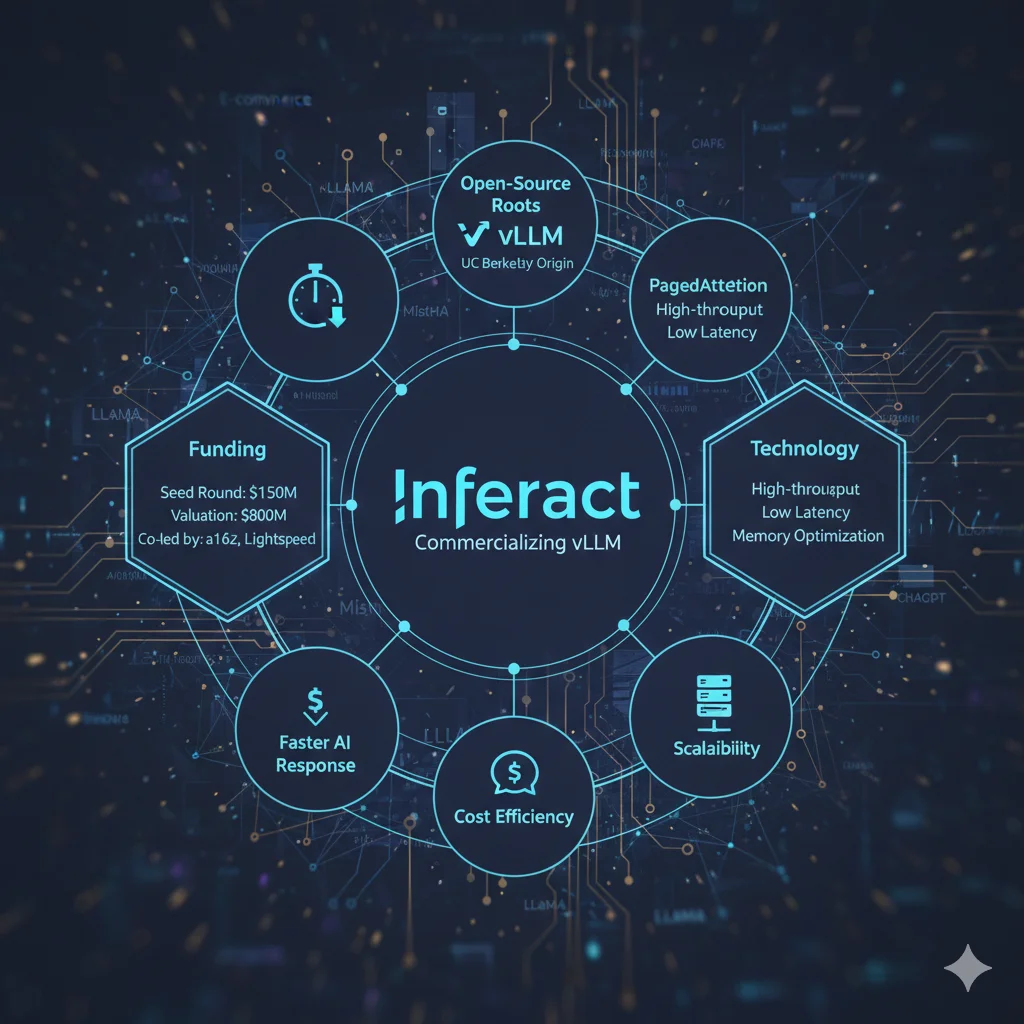
one where model deployment and inference efficiency matter more than simply training larger models. Reflecting this shift, Inferact, a newly formed AI startup founded by the creators of the open-source project vLLM, has raised $150 million in seed funding at an impressive $800 million valuation.
The funding round was co-led by Andreessen Horowitz (a16z) and Lightspeed Venture Partners, signaling strong investor confidence in the future of AI inference infrastructure.
This development marks one of the largest seed rounds ever raised by an AI infrastructure startup and highlights the growing importance of high-performance inference engines in the generative AI ecosystem.
What Is Inferact and Why It Matters:
Inferact is the commercial entity formed to scale and monetize vLLM, one of the most widely adopted open-source LLM inference frameworks. Originally launched as a research-driven project, vLLM quickly gained traction among developers and enterprises for its ability to run large language models faster, cheaper, and more efficiently than traditional inference stacks.
With the formal launch of Inferact, the team aims to transform vLLM from a community-driven open-source tool into a production-grade, enterprise-ready AI inference platform—while continuing to support open innovation.
The company is led by Simon Mo, one of vLLM’s original creators, who now serves as CEO. According to Mo, vLLM already powers inference workloads for major users, including Amazon’s cloud services and a large-scale e-commerce shopping application, underscoring its real-world adoption.
Why AI Inference Is the New Battleground:
In recent years, the AI industry focused heavily on training foundation models, spending billions of dollars on GPUs, data, and research. However, as these models mature, the economic reality has shifted. Today, the true cost—and competitive advantage—lies in inference: the process of running trained models in real-time applications.
Inference determines:
- How fast an AI responds.
- How much it costs per query.
- How well it scales under heavy traffic.
- Whether AI products are commercially viable.
Technologies like vLLM and SGLang directly address these challenges by optimizing memory usage, batching, and parallelism. This is why inference-focused startups are now attracting massive venture capital investments.
vLLM: The Technology Behind Inferact:
vLLM is best known for introducing PagedAttention, a memory-efficient attention mechanism that dramatically improves GPU utilization during inference.
Key advantages of vLLM include:
- High-throughput LLM inference.
- Lower latency for real-time AI applications.
- Reduced GPU memory fragmentation.
- Support for popular open-source models such as LLaMA, Mistral, and others.
- Scalable serving for production workloads.
These capabilities make vLLM a preferred choice for companies deploying chatbots, AI assistants, recommendation systems, and enterprise AI tools.
Inferact’s commercialization strategy is expected to include managed services, enterprise support, cloud integrations, and advanced optimization features—similar to how companies like Red Hat monetized Linux while keeping it open source.
Investor Confidence and Market Momentum:
The participation of Andreessen Horowitz and Lightspeed Venture Partners places Inferact among the most strategically backed AI infrastructure startups. a16z has been particularly vocal about the importance of AI “picks and shovels”—the infrastructure layers that power applications rather than consumer-facing tools.
Inferact’s launch closely follows another notable move in the inference space: the commercialization of SGLang as RadixArk, which reportedly raised capital at a $400 million valuation led by Accel. Together, these developments suggest that AI inference is becoming a distinct and highly valuable market segment.
UC Berkeley’s Role in the AI Infrastructure Boom:
Both vLLM and SGLang were incubated in 2023 at the UC Berkeley lab led by Ion Stoica, co-founder of Databricks and a prominent figure in distributed systems research. Berkeley has increasingly become a breeding ground for foundational AI infrastructure projects, blending academic research with real-world scalability.

Meta's Next Big Bet: This New App Lets You Build Games Simply by Typing a Prompt
This academic-to-startup pipeline reinforces a broader trend: many of the most important AI technologies today originate in open research environments before being commercialized at scale.
Support our research
Independent analysis fueled by you.
What Inferact’s Rise Means for the AI Industry:
Inferact’s $150 million seed round signals several key shifts in the AI landscape:
- Inference is now a top investment priority.
- Open-source AI can generate massive enterprise value.
- Performance and cost efficiency are critical for AI monetization.
- Infrastructure startups are becoming AI unicorns faster than ever.
As enterprises move from experimentation to full deployment, tools like vLLM will determine which AI products succeed commercially.
Final Thoughts:
Inferact’s emergence represents a pivotal moment in the evolution of artificial intelligence—from building smarter models to running them efficiently at scale.

Move Over Nvidia: Anthropic and Samsung Team Up to Break the AI Chip Monopoly
With deep technical roots, strong investor backing, and a proven open-source foundation, Inferact is well positioned to become a cornerstone of the global AI inference ecosystem.