
AI Model Showdown
Gemini 3.1 Pro vs. Claude Sonnet 4.6: Which AI Model Should You Be Using Right now:
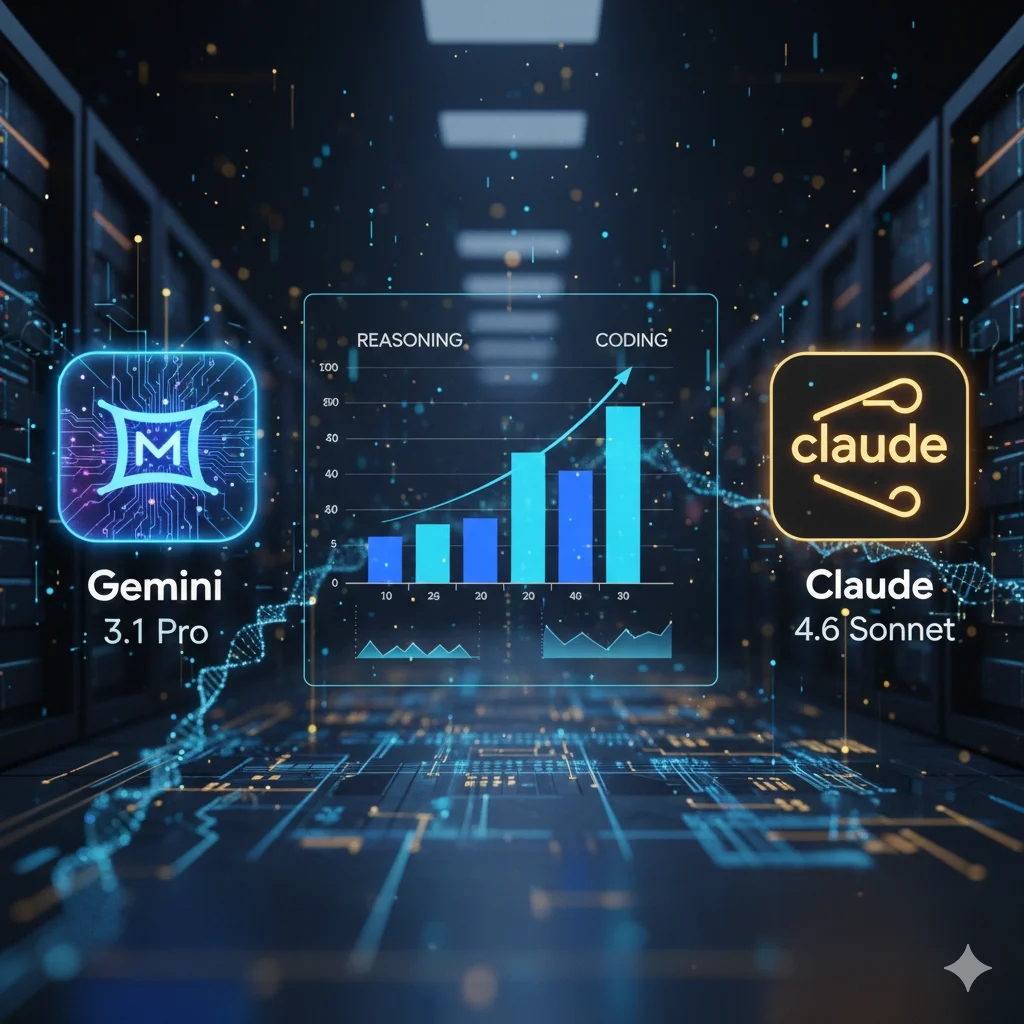
The AI model wars are officially heating up — and this week, things got a lot more interesting. Google just dropped Gemini 3.1 Pro, its most powerful reasoning model yet, boasting benchmark scores that are turning heads across the industry. Meanwhile, Anthropic's Claude Sonnet 4.6 has been holding its own as one of the most capable and well-rounded models on the market.
So which one is actually better for you? Let's break it down.
🆕 What Is Gemini 3.1 Pro?
Gemini 3.1 Pro is Google's latest update to its flagship Gemini 3 series — and it's not a minor refresh. Google describes it as "a step forward in core reasoning," and the numbers back that up. The model is currently available in preview via the Gemini API, Google AI Studio, Vertex AI, Gemini Enterprise, and NotebookLM, with general availability rolling out soon.
The headline stat? On the ARC-AGI-2 benchmark — designed to test entirely new logic patterns the model has never seen before — Gemini 3.1 Pro scored 77.1%, compared to just 31.1% for its predecessor, Gemini 3 Pro. That's more than double the reasoning performance, essentially overnight.
📊 Features & Specs at a Glance:
Google Gemini 3.1 Pro
| Feature | Detail |
|---|---|
| Context Window | Up to 1 million tokens |
| Modalities | Text, images, video, audio, PDF, code |
| Reasoning | Advanced multi-step reasoning with configurable thinking levels (LOW / MEDIUM / HIGH) |
| Agentic Capabilities | Improved SWE (software engineering), finance, and spreadsheet agents |
| Coding | LiveCodeBench Pro Elo: 2887 / SWE-Bench Verified: 80.6% |
| Scientific Knowledge | GPQA Diamond: 94.3% |
| Multimodal Understanding | MMMLU: 92.6% |
| ARC-AGI-2 | 77.1% |
| API Pricing | $2.00/1M input tokens (up to 200k); $12.00/1M output tokens |
| Availability | Gemini app, Vertex AI, Google AI Studio, GitHub Copilot, VS Code, NotebookLM |
| Best For | Complex reasoning, enterprise agentic tasks, coding, multimodal analysis |
Anthropic Claude Sonnet 4.6:
| Feature | Detail |
|---|---|
| Context Window | 200,000 tokens |
| Modalities | Text, images, documents (PDF) |
| Reasoning | Strong multi-step reasoning; extended thinking mode available |
| Agentic Capabilities | Computer use, tool use, multi-step task execution |
| Coding | High-performing on SWE-Bench Verified (top scores retained in several categories) |
| Humanity's Last Exam | Top-tier results (Opus 4.6 leads this benchmark) |
| API Pricing | $3.00/1M input tokens; $15.00/1M output tokens |
| Availability | Claude.ai, Anthropic API, Claude Code, Claude in Chrome/Excel/PowerPoint |
| Best For | Writing, nuanced reasoning, coding, enterprise workflows, safe and reliable outputs |
🧠 Benchmark Battle: How Do They Stack Up?
Here's what the numbers actually show:
Gemini 3.1 Pro leads in:
- ARC-AGI-2 (abstract logic / novel problem-solving)
- GPQA Diamond (scientific knowledge)
- MMMLU (multilingual multimodal understanding)
- Overall coding performance (LiveCodeBench Pro)
Claude Sonnet 4.6 / Opus 4.6 leads in:
- Humanity's Last Exam (Full Set) — Anthropic's models hold the top spot here.
- SWE-Bench Verified — Opus 4.6 retains the crown.
- τ²-bench (tool-use and agentic reliability)
The takeaway? Google has made a massive leap in raw reasoning and problem-solving. But Anthropic's models — particularly Opus 4.6 and Sonnet 4.6 — still lead in some of the most demanding real-world agentic and coding benchmarks.
💼 Real-World Performance: What Users Are Saying:
On Gemini 3.1 Pro, Brendan Foody, CEO of AI startup Mercor, confirmed it has hit the top of the APEX-Agents leaderboard, which measures how well AI models handle real professional tasks. JetBrains reported up to 15% improvement over Gemini 3 Pro in their evaluations, noting it was "stronger, faster, and more efficient." Databricks praised its grounded reasoning over tabular and unstructured enterprise data.
On Claude Sonnet 4.6, users consistently highlight its reliability, nuanced understanding of instructions, safety guardrails, and exceptional writing quality. It continues to be a top pick for developers and enterprises that need a model they can trust for complex workflows, especially in coding and multi-agent system.
🔍 Which Model Is Right for You?
Choose Gemini 3.1 Pro if you:
- Need cutting-edge reasoning on abstract or scientific problems.
- Work heavily with multimodal inputs (video, audio, images, PDF together)
- Want a massive 1M token context window for extremely long documents or codebases.
- Are already embedded in the Google Cloud / Vertex AI ecosystem
- Are a developer who wants the best benchmark-to-dollar value at $2/1M input tokens.
Choose Claude Sonnet 4.6 if you:
- Prioritize safe, predictable, and nuanced outputs.
- Do a lot of writing, editing, or content creation.
- Need strong agentic tools (computer use, code execution, file creation)
- Want a model with a well-established track record on real-world coding tasks.
- Prefer a clean, accessible chat interface with strong privacy practices.
🏁 The Verdict:
It's genuinely close— and that's what makes this moment in AI so exciting. Gemini 3.1 Pro has made a jaw-dropping leap in benchmark reasoning, especially on tasks requiring novel problem-solving. If raw cognitive horsepower and multimodal depth are your priority, Google's newest release is hard to beat right now.
But Claude Sonnet 4.6 remains a powerhouse for real-world usability. Its balance of performance, reliability, thoughtful output, and strong agentic tooling means it's still the go-to for countless developers, writers, and enterprises who need a model they can depend on day in and day out.

Anthropic's Claude Mythos 5 Restored for 100+ U.S. Orgs After Unprecedented Ban
In 2026, you might not need to pick just one. The best AI users are learning to use these models strategically — switching between them based on the task at hand. And with the pace of releases we're seeing, the next big update is probably just weeks away.
Support our research
Independent analysis fueled by you.