
🚀 The "SpaceX to Silicon Valley" Angle:
Consuming hundreds of megawatts of power and costing hundreds of millions of dollars to build.
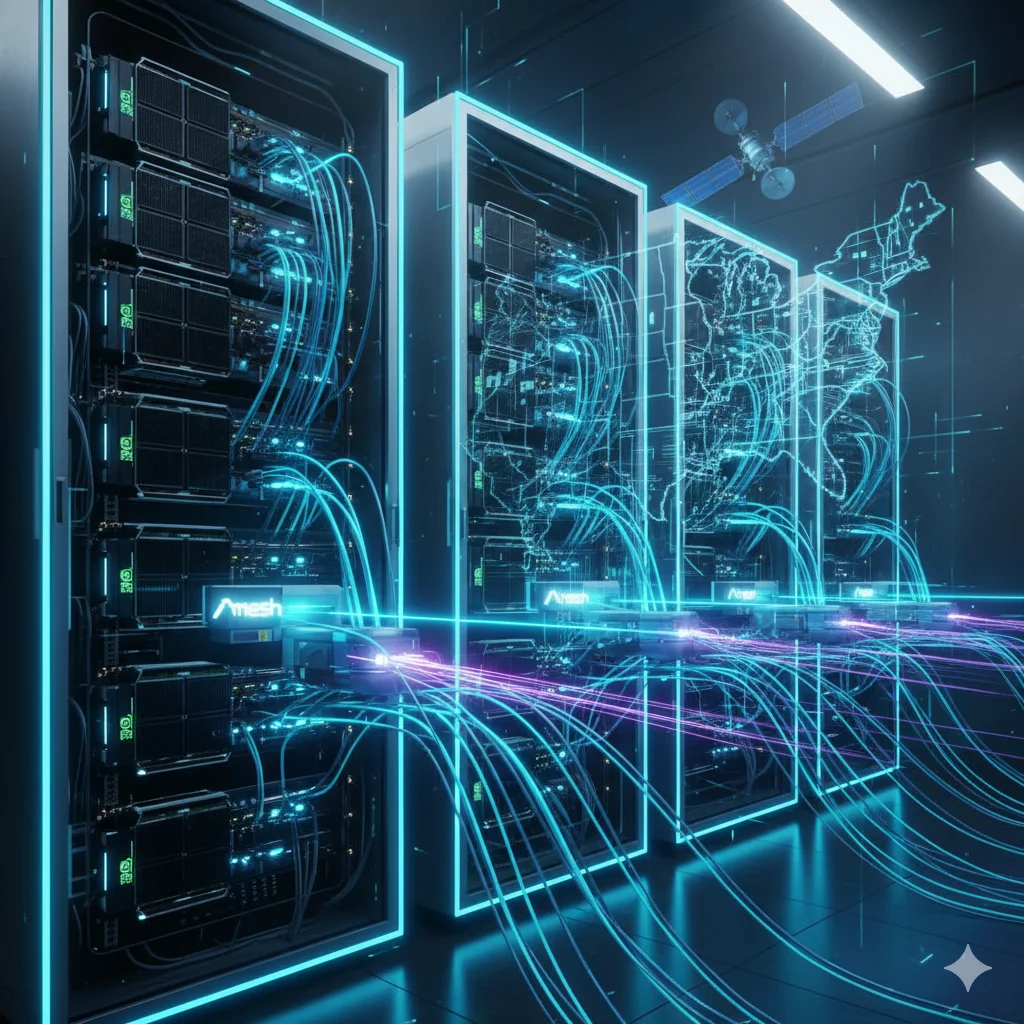
But GPUs alone aren't enough. To train these models effectively, those GPUs need to communicate with each other at incredibly high speeds, exchanging gradient updates, model weights, and training data continuously. That's where optical transceivers come in — they're the connective tissue that allows modern AI infrastructure to function.
The market for these components is massive and growing rapidly. Last year, AOI — one of the few established U.S. suppliers in the space — won a contract worth $4 billion to provide optical transceiver components for Amazon Web Services (AWS) data centers. That single contract underscores the scale of demand hyperscalers like AWS, Google Cloud, Microsoft Azure, and Meta are facing as they race to build out AI infrastructure.
The China Problem: National Security and AI Supply Chain Risks:
One of the most compelling aspects of Mesh Optical's pitch is national security. The optical transceiver market is currently dominated by Chinese firms and suppliers, creating a strategic vulnerability that the U.S. government, AI companies, and venture capitalists are increasingly concerned about.
"If AI is the most important technology in several generations (which we believe to be true), to have critical parts of AI data center capex run through misaligned/competitive countries is a problem," wrote Philip Clark, partner at Thrive Capital, in a statement to TechCrunch. "In the immediate term, Mesh is solving our need for better ways to do interconnect if we want to keep scaling AI."
While trade restrictions haven't yet significantly impacted the optical transceiver market, the Mesh team and their investors see themselves as getting ahead of what could become a critical national security dilemma. As U.S.-China tensions continue to escalate, particularly around semiconductor and AI technology, having a reliable domestic supply chain for these essential components becomes strategically important.
Building that supply chain in the United States, however, is easier said than done. So much manufacturing expertise in optical components is concentrated in China that even European equipment suppliers assume Chinese customers — one German firm's standard customer intake form reportedly asks for a Chinese company registration number by default.
Mesh's Manufacturing Strategy: Lights-Out Automation and Co-Located Design:
The biggest challenge Mesh Optical faces isn't designing better optical transceivers — it's executing lights-out, automated manufacturing at scale. "Lights-out manufacturing" refers to fully automated production facilities that can operate 24/7 without human intervention, a capability that's common in Chinese manufacturing but relatively rare in the U.S. industrial base.
The company's ambitious goal is to manufacture 1,000 optical transceiver units per day within the next year, positioning them to begin qualifying for bulk orders from hyperscale data center operators in 2027 and 2028. Achieving that production capacity will require building out sophisticated automated manufacturing infrastructure and supply chain partnerships — no small feat for a startup.
By co-locating design and production, the Mesh team hopes to achieve more efficient iteration cycles and ultimately produce lower-cost, higher-performance components than competitors who separate R&D from manufacturing. Their current optical transceiver design has already demonstrated meaningful advantages: by removing one commonly used but power-hungry component, Ramos said Mesh's transceivers could reduce GPU cluster power consumption by 3% to 5%.
That efficiency improvement might sound modest, but for hyperscalers operating data centers consuming hundreds of megawatts, a 3-5% reduction in power usage translates to millions of dollars in annual energy savings — and significant reductions in carbon emissions.
Beyond Data Centers: Mesh's Long-Term Vision for Optical Communications:
While AI data centers are Mesh Optical's immediate focus, the founders have much bigger ambitions. They see optical wavelength communications — using lasers and photonics rather than traditional radio frequency (RF) signals — as the next fundamental paradigm shift in global communications infrastructure.
"The world has primarily focused on [radio frequencies] for a long time," Brashears told TechCrunch. "We want to be at the precipice of transition from RF to photonics…we want to interconnect everything, and not just computers, but that's where we're starting."
This vision extends well beyond connecting GPUs in data centers. Future applications could include satellite-to-satellite communications (building on the team's Starlink experience), autonomous vehicle networks, telecommunications infrastructure, and even consumer devices. Photonics-based communications offer massive bandwidth advantages, lower latency, and reduced power consumption compared to traditional RF systems.
The Competitive Landscape: Who Else Is Building Optical Transceivers for AI?:
Mesh Optical is entering a competitive market, but one with significant room for new entrants — particularly American ones. Established players include Chinese manufacturers that dominate global market share, as well as companies like AOI (which recently won the massive AWS contract) and various startups focusing on silicon photonics and optical interconnect technologies.
However, the sheer scale of AI infrastructure buildout means there's more than enough demand for multiple suppliers. Hyperscalers are desperate to diversify their supply chains, particularly away from geopolitically risky sources, and are willing to pay premium prices for reliable, high-performance American alternatives.
The $50 million Series A led by Thrive Capital signals strong investor confidence in both the market opportunity and the founding team's ability to execute. Thrive has been one of the most active investors in AI infrastructure, and this investment aligns with a broader trend of venture capital flowing into the physical infrastructure layer supporting AI — data centers, power generation, cooling systems, networking hardware, and now optical transceivers.
The Bottom Line: Why Mesh Optical Could Be Critical to America's AI Future:
Mesh Optical Technologies sits at the intersection of three of the most important technology trends shaping the next decade: the explosive growth of artificial intelligence, the strategic imperative of domestic semiconductor and hardware supply chains, and the transition from radio frequency to photonics-based communications.
The founding team brings world-class credentials from their work building Starlink's optical communications systems at SpaceX — one of the most ambitious and successful deployments of optical satellite communications in history. Their deep understanding of both the technology and the manufacturing challenges gives them a genuine edge over competitors who may understand optics but lack production expertise.
With $50 million in Series A funding, ambitious production targets, and a massive addressable market driven by insatiable demand for AI infrastructure, Mesh Optical is well-positioned to become a critical supplier to the hyperscalers building the next generation of AI data centers.
Whether they can successfully execute on lights-out manufacturing, compete on cost with Chinese suppliers, and scale production to meet hyperscaler demand remains to be seen.
But if they succeed, Mesh Optical won't just be a lucrative business — it will be a strategically important piece of American AI infrastructure.
Support our research
Independent analysis fueled by you.