
Industry Shake-Up: Modal Labs Eyes $2.5B Valuation as OpenAI Restructures Mission Alignment Team:
The artificial intelligence industry continues its rapid evolution with significant developments emerging from two major players. Modal Labs, a rising star in AI infrastructure, is reportedly in advanced funding discussions that could more than double its valuation, while OpenAI undergoes internal restructuring that signals shifting priorities in how the company approaches its core mission.
Modal Labs Pursues Massive Valuation Jump in New Funding Round:
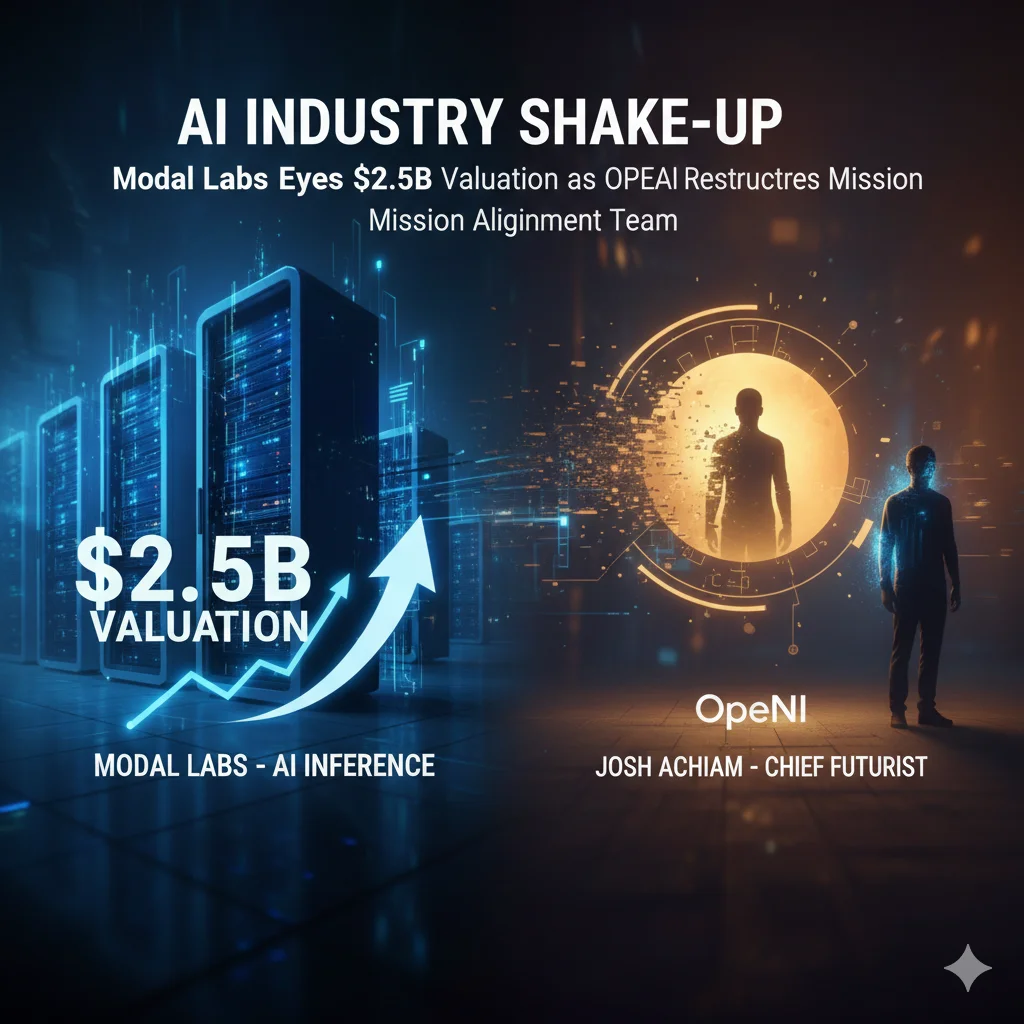
Modal Labs, a startup specializing in AI inference infrastructure, is currently in talks with venture capitalists about raising a new funding round at an impressive valuation of approximately $2.5 billion. According to sources familiar with the deal, this represents a remarkable achievement that would more than double the company's $1.1 billion valuation from less than five months ago, when it successfully closed an $87 million Series B round.
General Catalyst Leading the Charge:
Investment powerhouse General Catalyst is reportedly in discussions to lead this substantial funding round. Industry sources indicate that Modal's annualized revenue run rate (ARR) has reached approximately $50 million, demonstrating strong market traction and revenue growth. However, it's important to note that these discussions remain in early stages, and terms could still change before any deal is finalized.
Modal Labs co-founder and CEO Erik Bernhardsson has characterized recent interactions with VCs as general conversations rather than active fundraising efforts, though the substantial interest from major investors speaks volumes about the company's potential and market position.
Understanding Modal's AI Inference Focus:
Modal Labs has carved out a specialized niche in AI infrastructure by focusing on optimizing inference—the critical process of running trained AI models to generate responses from user requests. This technology is essential for improving inference efficiency, which directly impacts two crucial factors: reducing compute costs for AI operations and minimizing the lag time between a user's prompt and the AI's response.
In today's competitive AI landscape, inference optimization has become increasingly valuable. As artificial intelligence applications scale and user expectations for real-time responses grow, companies that can deliver faster, more cost-effective inference solutions are positioned to capture significant market share.
The AI Inference Gold Rush:
Modal Labs finds itself in excellent company within the booming AI inference sector, which is attracting intense investor attention and substantial capital deployment. The competitive landscape demonstrates just how valuable this technology has become:
Baseten, a direct competitor to Modal, recently announced a massive $300 million funding round at a $5 billion valuation, more than doubling its $2.1 billion valuation from just months earlier in September. This dramatic valuation increase mirrors the pattern we're seeing with Modal Labs.
-
Fireworks AI, an inference cloud provider, secured $250 million at a $4 billion valuation in October, further validating the market opportunity in AI infrastructure optimization.
-
Inferact, the commercialized version of the popular open-source inference project vLLM, raised an impressive $150 million in seed funding led by Andreessen Horowitz at an $800 million valuation in January, showcasing investor appetite even at the earliest stages.
-
RadixArk, the commercial entity built from the SGLang team, secured seed funding at a $400 million valuation with Accel leading the round, according to sources.
Erik Bernhardsson: From Spotify to AI Infrastructure:
Modal Labs was co-founded by CEO Erik Bernhardsson in 2021, bringing with him over 15 years of experience building and leading data teams at prominent technology companies. His background includes significant roles at Spotify and Better.com, where he served as CTO. This deep expertise in data infrastructure and machine learning systems has proven invaluable in positioning Modal as a serious contender in the competitive AI inference market.
OpenAI Disbands Mission Alignment Team Amid Reorganization:
In parallel news from the AI industry, OpenAI has made the decision to disband a team specifically designed to communicate the company's mission to both the public and its own employees. This development comes as the team's former leader, Josh Achiam, transitions into a new role as OpenAI's "chief futurist."
Understanding the Mission Alignment Team:
The mission alignment team appears to have been formed in September 2024 with a clear mandate: promoting OpenAI's stated mission to ensure that artificial general intelligence (AGI) benefits all of humanity. According to an OpenAI spokesperson, "The Mission Alignment project was a support function to help employees and the public understand our mission and the impact of AI. That work continues throughout the organization."
The team consisted of six or seven people who have now been reassigned to different roles throughout the company. While OpenAI confirmed the reassignments, the specific destinations and responsibilities of these team members remain unclear, though the company maintains they are engaged in similar work in their new positions.
Josh Achiam's New Role as Chief Futurist:
In a blog post published this week, Josh Achiam outlined his new responsibilities as OpenAI's chief futurist. "My goal is to support OpenAI's mission — to ensure that artificial general intelligence benefits all of humanity — by studying how the world will change in response to AI, AGI, and beyond," Achiam wrote.
In his new capacity, Achiam will collaborate with Jason Pruet, an OpenAI physicist, though it remains uncertain whether he will have a dedicated team supporting his futurist role. His personal website continues to describe him as being interested in ensuring that the "long-term future of humanity is good."
Historical Context: OpenAI's Alignment Teams:
This isn't the first time OpenAI has disbanded a team focused on alignment concerns. The company previously operated a "superalignment team" formed in 2023, which concentrated on studying long-term existential threats posed by artificial intelligence. That team was disbanded in 2024, making this recent restructuring part of a broader pattern of organizational evolution.
OpenAI attributes the disbanding of the mission alignment team to routine reorganizations typical of fast-moving technology companies, suggesting this represents operational optimization rather than a fundamental shift in priorities.
What These Developments Mean for the AI Industry:
These concurrent developments—Modal Labs' impressive valuation growth and OpenAI's internal restructuring—paint a picture of an AI industry in rapid flux. On one hand, infrastructure companies enabling efficient AI deployment are attracting unprecedented investment, with valuations doubling in months. On the other hand, established AI leaders like OpenAI are continuously evolving their organizational structures to meet changing demands and priorities.
The massive capital flowing into AI inference startups reflects the critical importance of infrastructure that can support the next generation of AI applications. As models become more sophisticated and deployment scales exponentially, companies that solve the fundamental challenges of cost-effective, low-latency inference will play increasingly vital roles in the AI ecosystem.
Meanwhile, OpenAI's reorganization suggests the company is adapting how it approaches mission communication and long-term planning, potentially streamlining operations while maintaining its commitment to beneficial AGI development through new structural approaches.
Looking Ahead:
As Modal Labs continues its funding discussions and OpenAI implements its organizational changes, the broader AI industry watches closely. These developments underscore both the immense opportunity in AI infrastructure and the ongoing challenges of building organizations capable of navigating the rapidly evolving artificial intelligence landscape.
Whether through billion-dollar valuations or innovative organizational roles, the AI industry continues to redefine itself at a remarkable pace.
Support our research
Independent analysis fueled by you.