
The latest surge in artificial intelligence innovation has produced an unexpected viral sensation
— a lobster-themed personal AI assistant originally known as Clawdbot, now officially renamed Moltbot. What began as a personal side project has quickly evolved into one of the most talked-about AI agent tools in the developer community, drawing massive attention across GitHub, X (formerly Twitter), and even financial markets.
But what exactly is Moltbot, why did Clawdbot have to change its name, and is it safe to use? Here’s everything you need to know about this viral AI assistant that promises to actually do things.
What Is Moltbot (Formerly Clawdbot)?
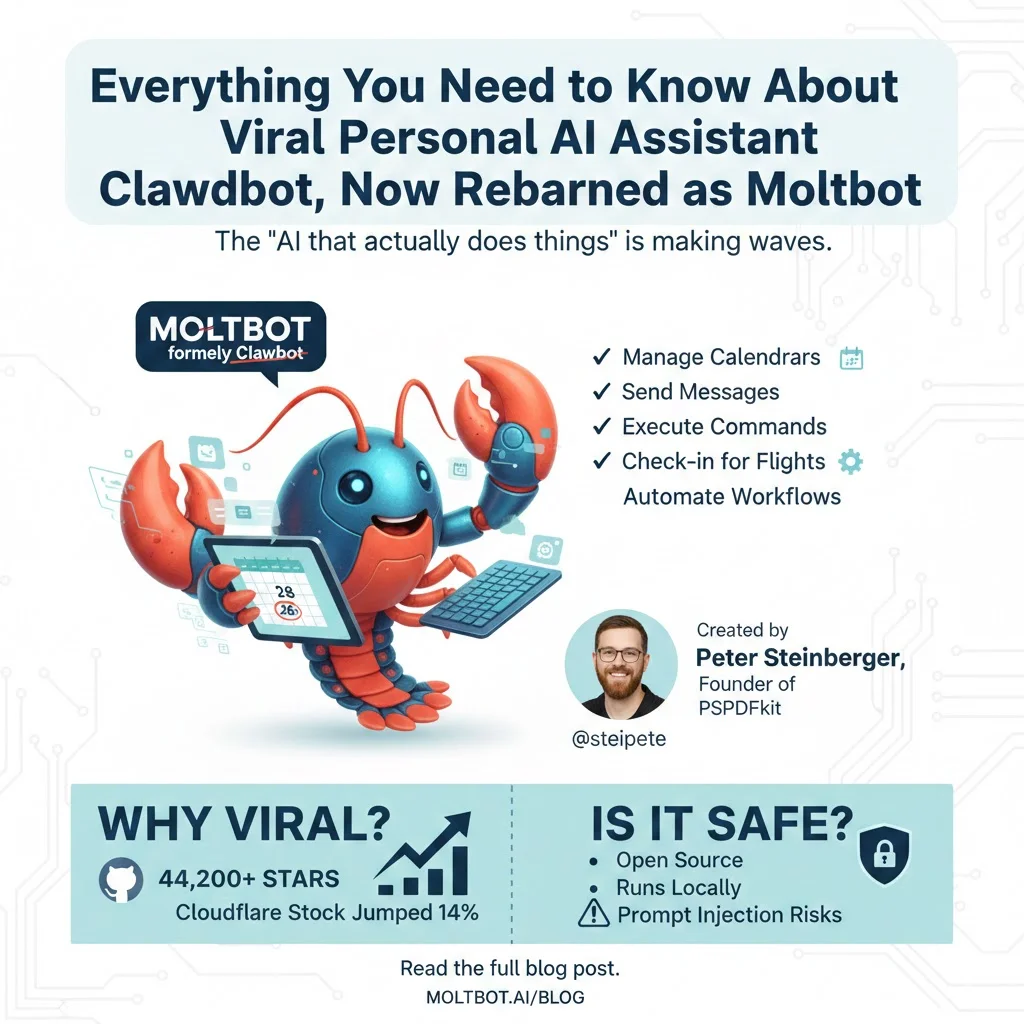
Moltbot is an open-source personal AI assistant designed to automate real-world digital tasks. Unlike traditional chatbots that simply generate text, Moltbot claims to be the “AI that actually does things.” This includes:
-
Managing calendars.
-
Sending messages through popular apps.
-
Executing system commands.
-
Checking users in for flights.
-
Managing workflows across tools.
This hands-on functionality is what separates Moltbot from conventional AI assistants like ChatGPT and has fueled its viral growth.
Who Created Moltbot?
Moltbot was created by Peter Steinberger, an Austrian software developer and entrepreneur best known as the founder of PSPDFkit. Known online as @steipete, Steinberger is a respected figure in the developer ecosystem and frequently documents his work publicly. After stepping away from PSPDFkit, Steinberger experienced a multi-year creative hiatus.
In his own words, he barely touched his computer for nearly three years. His return to development came through experimentation with AI, which reignited his passion and eventually led to the creation of Moltbot.
Originally built to manage his own “digital life,” the assistant began as Clawd, short for “Peter’s crusted assistant,” later renamed Molty. The publicly released Moltbot still derives from this personal tool.
Why Did Clawdbot Change Its Name to Moltbot?
The original name, Clawdbot, was a playful nod to Claude, Anthropic’s flagship AI model. Steinberger, who has openly described himself as a “Claudoholic,” initially embraced the reference.
However, Anthropic later raised copyright concerns, forcing a rebrand. Steinberger confirmed on X that the project had to change its name, though the lobster branding and overall identity remained intact. TechCrunch reached out to Anthropic for comment, but regardless of the legal challenge, Clawdbot officially molted into Moltbot — lobster soul and all.
Why Did Moltbot Go Viral?
Moltbot quickly became a darling of early adopters and developers experimenting with autonomous AI agents. Its appeal lies in its promise to move beyond AI as a passive assistant and toward human-AI collaboration.
This excitement translated into explosive traction:
-
Over 44,200 GitHub stars in a matter of weeks.
-
Massive engagement across social platforms.
-
Developers actively building extensions and workflows.
The hype even spilled into financial markets. Cloudflare’s stock jumped 14% in premarket trading, fueled by renewed investor enthusiasm after developers highlighted how Moltbot relies on Cloudflare infrastructure to run locally.
Is Moltbot Safe to Use?
This is where the conversation becomes more nuanced.
The Security Advantages:
-
Moltbot is open source, allowing public inspection of its code.
-
It runs locally on your computer or server, not in the cloud.
-
Users can choose different AI models depending on risk tolerance.
The Security Risks:
Despite these safeguards, Moltbot’s core functionality introduces serious risks. As investor Rahul Sood pointed out, an AI that “actually does things” also means it can execute arbitrary commands on your system.
One of the biggest concerns is prompt injection attacks, where malicious content — such as a message received on WhatsApp — could manipulate Moltbot into performing unintended actions without the user’s knowledge.
The only foolproof mitigation is running Moltbot in a fully isolated environment, such as a virtual private server (VPS) or sandboxed machine.
Why Moltbot Isn’t for Everyone (Yet)
Installing and running Moltbot requires a high degree of technical expertise.
Meta's Next Big Bet: This New App Lets You Build Games Simply by Typing a Prompt
Users must understand:
-
Server environments.
-
API security.
-
Permission management.
-
AI model selection.
Experienced developers have warned newcomers not to treat Moltbot like ChatGPT. Used carelessly, it could expose sensitive credentials or system access.
Even Steinberger encountered real-world threats when scammers hijacked his GitHub username during the rebranding process, launching fake cryptocurrency projects in his name. He later warned users that any crypto project claiming him as owner is a scam and clarified that the only legitimate account is @moltbot.
Should You Try Moltbot?
If you’re an experienced developer comfortable with VPS setups, sandboxing, and security trade-offs, Moltbot can be a fascinating glimpse into the future of autonomous AI assistants.
However, if terms like SSH keys, API credentials, or virtual private servers are unfamiliar, it’s best to wait. At present, running Moltbot safely often requires throwaway accounts and isolated machines — which undermines its convenience as a personal assistant.
The Bigger Picture: Why Moltbot Matters:
Despite its limitations, Moltbot represents a critical milestone in AI development. By solving a real personal problem, Peter Steinberger demonstrated what AI agents can actually accomplish when given autonomy.
Moltbot may not be ready for mainstream adoption yet, but it has already reshaped the conversation around useful AI, agentic workflows, and human-AI collaboration. Rather than being merely impressive, Moltbot points toward a future where AI assistants are genuinely productive — not just conversational.
Support our research
Independent analysis fueled by you.