
Elon Musk's Moon Factory Plan 2025: xAI's Revolutionary Lunar AI Manufacturing Vision Explained:
xAI Shifts Focus to Space-Based AI Infrastructure Amid Leadership Changes:
Elon Musk has unveiled perhaps his most audacious plan yet: building an artificial intelligence manufacturing facility on the moon. During a company-wide meeting this week, the tech billionaire outlined his vision for xAI's future, revealing plans that could revolutionize both space exploration and AI development.
The Moon Factory: Building AI Satellites in Lunar Orbit:
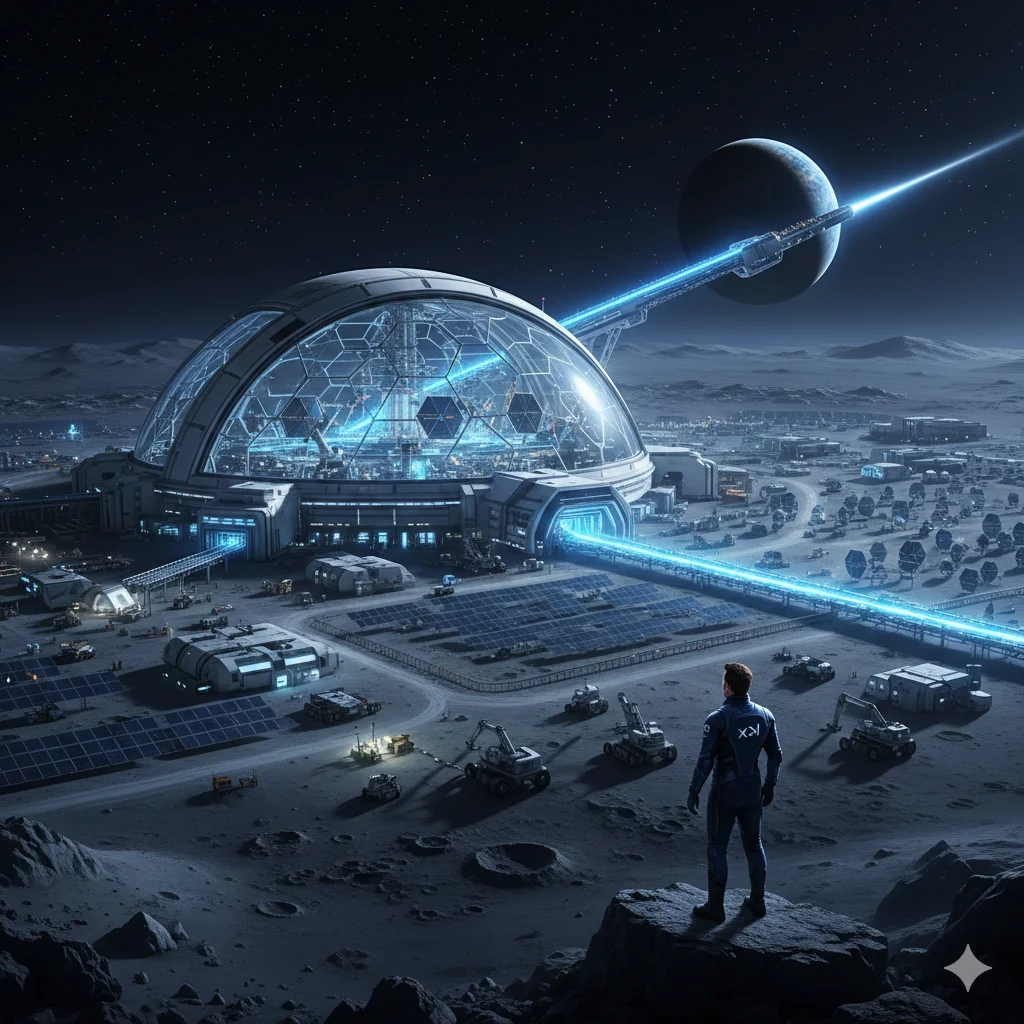
According to reports from The New York Times, Musk told xAI employees that the company needs to establish a lunar manufacturing facility—a factory on the moon designed to build AI satellites and launch them into space using a giant catapult system. This ambitious space technology project represents a dramatic shift in direction for both xAI and SpaceX.
"You have to go to the moon," Musk reportedly told his team, explaining that this move would give xAI unprecedented computing power advantages over competitors. The vision involves harnessing the moon's unique environment to create AI infrastructure that would be impossible to replicate on Earth.
Why the Moon? Understanding Musk's AI Strategy:
The lunar manufacturing concept isn't just about space exploration—it's fundamentally about artificial intelligence supremacy. Musk believes that establishing AI satellite production capabilities on the moon will provide xAI with computational resources far exceeding anything available to rival companies like OpenAI, Google's DeepMind, or Anthropic.
"It's difficult to imagine what an intelligence of that scale would think about," Musk said during the all-hands meeting, "but it's going to be incredibly exciting to see it happen."
This moon-based AI development strategy aligns with Musk's broader philosophy about technological leadership. "If you're moving faster than anyone else in any given technology arena, you will be the leader," he told employees, claiming that "xAI is moving faster than any other company—no one's even close."
xAI Co-Founders Exit Ahead of Massive SpaceX IPO:
The timing of this announcement is particularly noteworthy given recent organizational changes at xAI. Within 24 hours, two xAI co-founders—Tony Wu and Jimmy Ba—announced their departures from the company. This brings the total to six of xAI's 12 founding members who have left the young AI startup.
These leadership changes come as xAI and SpaceX prepare for a potentially historic initial public offering (IPO) that could value the merged entity at $1.5 trillion. The SpaceX IPO, reportedly scheduled for this summer, represents one of the most anticipated tech offerings in recent history.
From Mars to Moon: SpaceX's Strategic Pivot:
For most of SpaceX's 24-year history, Mars colonization has been the ultimate goal. However, just before this year's Super Bowl, Musk announced a significant strategic shift. SpaceX, he revealed, has "shifted focus to building a self-growing city on the Moon," arguing that Mars colonization would take "20+ years" while lunar development could happen in half that time.
This represents a dramatic change in space exploration strategy for a company that has never sent a mission to the moon—making the lunar factory announcement even more remarkable.
The Master Plan: Integrating AI Across Musk's Companies:
According to venture capital investors familiar with the strategy, Musk's lunar ambitions are part of a larger artificial intelligence master plan. The theory suggests Musk has been building toward creating the world's most powerful world model—an AI system trained on proprietary real-world data that competitors cannot access.
This integrated approach leverages data from across Musk's business empire:
-
Tesla contributes energy systems and road topology data.
-
Neuralink provides insights into brain activity and neural networks.
-
SpaceX offers physics and orbital mechanics expertise.
-
The Boring Company adds subsurface geological data.
-
xAI's moon factory would complete the picture with space-based manufacturing capabilities.
Legal Challenges: Can You Own a Moon Factory?
The legal framework surrounding lunar manufacturing raises significant questions. Under the 1967 Outer Space Treaty, no nation or company can claim sovereignty over the moon. However, a 2015 U.S. law created a crucial loophole: while you cannot own the moon itself, you can own whatever resources you extract from it.
As Professor Mary-Jane Rubenstein of Wesleyan University explained, this distinction is somewhat problematic. "It's more like saying you can't own the house, but you can have the floorboards and the beams," she noted, "because the stuff that is in the moon is the moon."
This legal scaffolding provides the foundation for Musk's moon factory ambitions, though not all countries have agreed to these rules—notably China and Russia operate under different frameworks.
What's Next for xAI and Space-Based AI?
As xAI moves toward its IPO while simultaneously losing founding team members, questions remain about execution. How will the company actually build this lunar infrastructure? What timeline is realistic for moon-based manufacturing? And can the remaining team deliver on these extraordinary promises?
Investors appear more excited about space-based data centers and orbital AI infrastructure than traditional Mars colonization plans. For xAI, the moon factory concept represents not just a technological moonshot, but potentially the key to dominating the next generation of artificial intelligence development.
Whether Musk can deliver on this vision remains to be seen—but if history has taught us anything, it's never wise to bet against Elon Musk's ability to achieve the seemingly impossible.
Support our research
Independent analysis fueled by you.