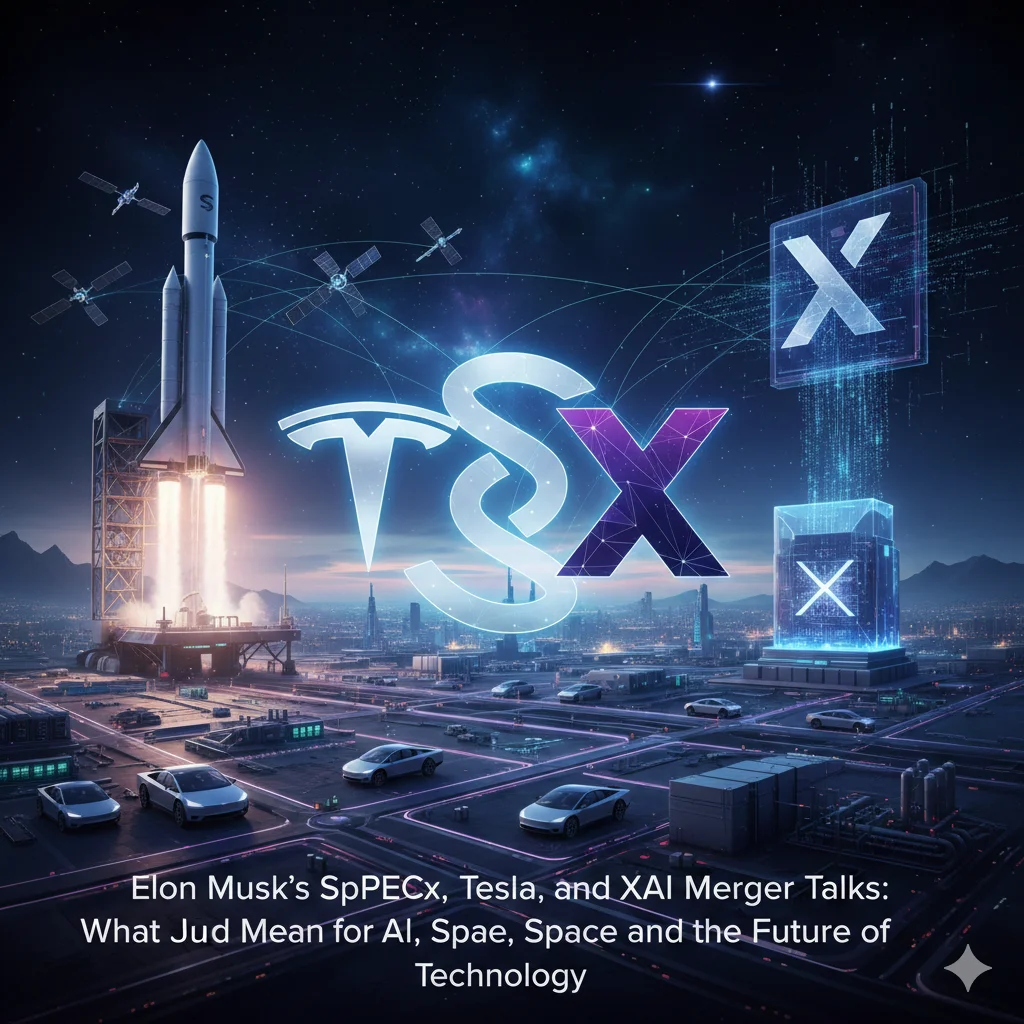

Elon Musk is once again at the center of a major technology industry shakeup.
According to multiple reports from Bloomberg and Reuters, three of Musk’s most influential companies — SpaceX, Tesla, and xAI — are reportedly in early-stage discussions about a potential merger. While nothing has been finalized, the implications of such a move could reshape the global landscape of artificial intelligence, space exploration, electric vehicles, and digital platforms.
Early Talks Point to Multiple Merger Scenarios:
Sources familiar with the matter suggest that several merger structures are being explored. One scenario under consideration involves a merger between SpaceX and Tesla, according to Bloomberg’s reporting. Another possibility would see SpaceX combining with xAI, Musk’s artificial intelligence company that already owns the social media platform X (formerly Twitter).
Reuters adds that a SpaceX–xAI merger could occur ahead of a planned SpaceX IPO, potentially expected later this year. If that happens, it would bring together an unprecedented mix of assets under one corporate umbrella — including SpaceX rockets, Starlink satellites, the Grok AI chatbot, X’s massive data stream, and advanced AI infrastructure.
Why SpaceX and xAI Could Be a Strategic Fit:
A merger between SpaceX and xAI would align closely with Musk’s long-term vision of AI dominance supported by massive computational power. Musk has previously hinted at placing data centers in orbit, which could theoretically offer lower latency, enhanced global connectivity, and reduced dependence on terrestrial infrastructure.
With Starlink already operating thousands of satellites, SpaceX could provide the backbone for space-based AI computing, while xAI would supply the models, training pipelines, and consumer-facing AI products like Grok. The integration of AI, satellite networks, and social media data could create one of the most powerful technology ecosystems in the world.
The Tesla Angle: Energy Meets AI and Space:
A SpaceX–Tesla merger would open a different but equally compelling strategic path. Tesla is not just an electric vehicle company — it is also a leader in energy storage, battery technology, and AI-driven autonomy.
By aligning Tesla’s energy storage systems and data-center-scale batteries with SpaceX’s infrastructure, Musk could support high-power computing needs for AI workloads, including potential off-planet data centers. Tesla’s expertise in Dojo AI, robotics, and autonomous systems could further strengthen SpaceX’s ambitions in space automation and exploration.
Signs Behind the Scenes: New Corporate Filings:
Although executives from SpaceX, Tesla, and xAI have not publicly commented on the merger talks, recent corporate activity suggests that preparations may be underway. Public filings show that two new corporate entities — K2 Merger Sub Inc. and K2 Merger Sub 2 LLC — were formed in Nevada on January 21.
Such entities are commonly used in mergers and acquisitions, indicating that Musk is likely keeping multiple options open while assessing regulatory, financial, and strategic considerations.
Resource Sharing Is Already Happening:
Even without a formal merger, Musk has been actively consolidating resources across his companies. In 2024, SpaceX reportedly invested $2 billion in xAI, according to The Wall Street Journal. More recently, Tesla disclosed that it also invested $2 billion in the AI startup, further tightening the operational and financial ties between Musk-led ventures.
Additionally, xAI acquired X (formerly Twitter) last year in a deal that valued xAI at $80 billion and X at $33 billion, granting xAI access to one of the largest real-time data streams on the internet — a critical asset for training large language models. Valuations and IPO Speculation
SpaceX remains the crown jewel of Musk’s empire. Founded in 2002, the company reportedly completed a secondary share sale valuing it at approximately $800 billion, making it the most valuable private company in the United States.
A Financial Times report recently indicated that Musk is targeting June for a SpaceX IPO, though Musk’s timelines have historically been fluid. If SpaceX goes public with xAI or Tesla folded into its structure, it would mark one of the most significant public offerings in modern tech history.
What This Means for the Tech Industry:
If even one of these mergers moves forward, it could redefine how AI, aerospace, energy, and social platforms interact. A unified Musk megacorporation could:
-
Accelerate AI development using proprietary data and infrastructure.
-
Enable space-based computing and global connectivity.
-
Consolidate capital, talent, and engineering at an unprecedented scale.
-
Challenge traditional boundaries between software, hardware, and space technology.
However, such consolidation would also raise serious regulatory, antitrust, and governance questions, especially given Musk’s influence across multiple critical industries.
Final Thoughts:
While the merger talks between SpaceX, Tesla, and xAI remain speculative for now, the direction is clear: Elon Musk is working toward a deeply integrated technology ecosystem that spans Earth, orbit, and artificial intelligence. Whether through formal mergers or continued collaboration, the convergence of these companies could shape the future of tech for decades to come.
As always with Musk, bold vision meets uncertain timelines — but the world will be watching closely.
Support our research
Independent analysis fueled by you.